
‘Remember 7.10.23’: In Israel, Hostage Square bears few remnants of a national crisis – but trauma lingers
Israelis grapple with the effects of the worst attack in the country’s history, and fears that another could occur.
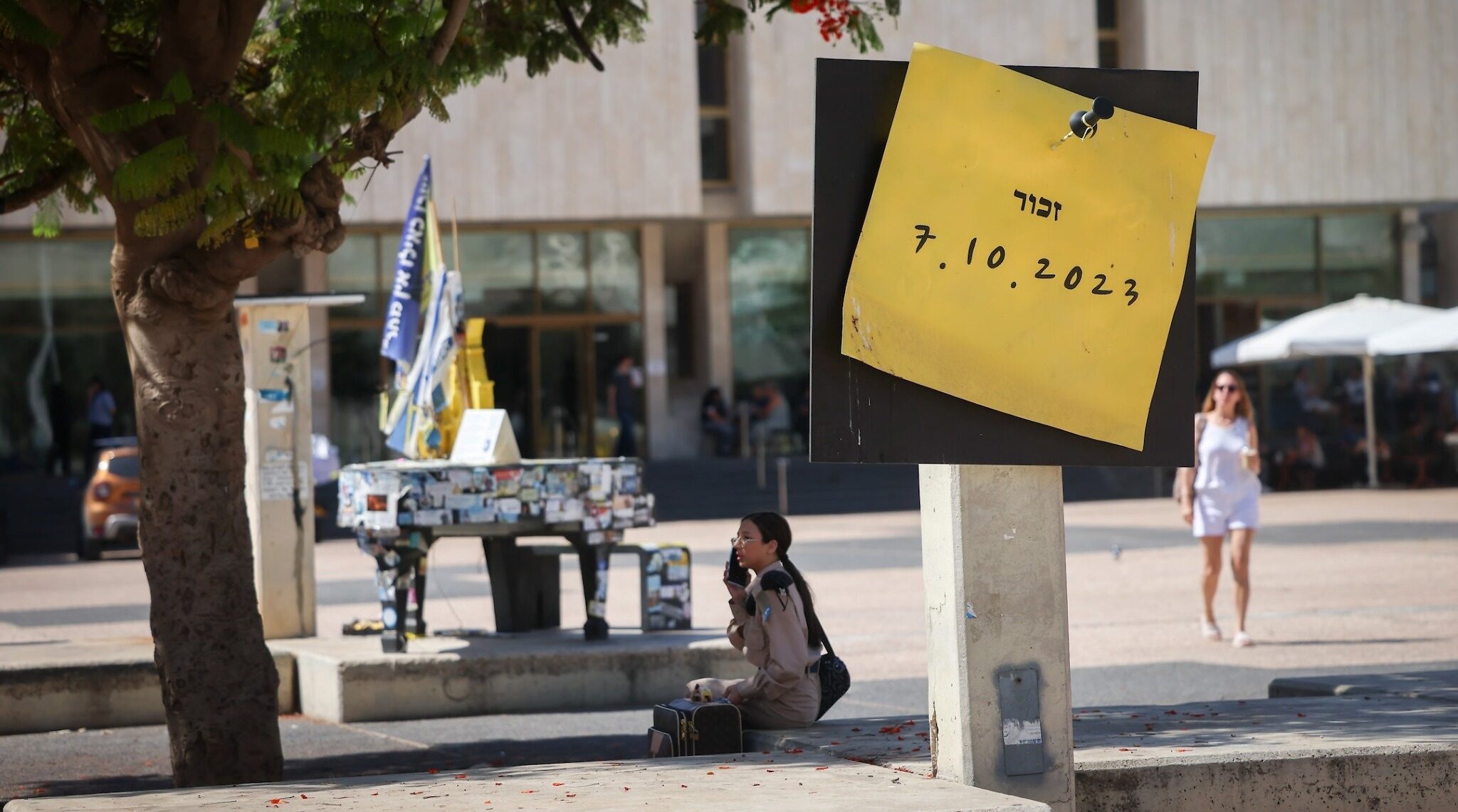
(JTA) — TEL AVIV – In the days following the Oct. 7, 2023, Hamas attacks, the families of the hostages held in Gaza turned the plaza next to the Tel Aviv Museum of Art into what became known as Hostage Square.
Filled with “Bring Them Home” signs and hostage posters, yellow ribbons and yellow balloons, the square hosted demonstrations and press conferences.
It was here that the families created a replica of a Hamas tunnel and established the Empty Shabbat Table, a haunting art installation to remind visitors – and especially the Israeli government – that their loved ones still languished in Gaza. And it was here, two years later, that the families and thousands of other Israelis gathered to watch the last of the living hostages return to Israel.
Three years after the attack on Simchat Torah, there are few remnants of the hostage families’ encampment: the tunnel replica, a few yellow ribbons and a sign bearing the words “Remember 7.10.23.” During the days leading up to the third anniversary, some paid respects to the few hostage families who set up a sukkah on the square, but the plaza was nearly empty.
By all outward appearances, Israelis have moved on.
Yet beneath the surface, many are still grappling with the trauma of Oct. 7 and the multifront war the attack triggered.
In a Channel 12 TV poll in June, 74% of respondents said they fear that terrorists will carry out another large-scale attack, and 66% said they want the Oct. 7 attack to be investigated by a state commission of inquiry.
Last month, in an Israel Democracy Institute survey, 68% of Jewish Israelis and 32% of Arab Israelis said the Oct. 7 attack is a “central factor” in deciding which party to vote for, behind security and the high cost of living.
In the café at the edge of Hostage Square, Isaac Badra, a 33-year-old realtor, recalled how he and his wife opened their home to their upstairs neighbors because the Badras live on the “safer” ground floor and their Tel Aviv building has no bomb shelter. The trauma persists, he said.
He vividly remembered the air-raid sirens, reserve soldiers rushing to base on Simchat Torah and the frantic phone calls with his wife’s family near the Gaza border as Hamas attacked Sderot, where they live.
“My wife’s mother said she saw terrorists in the street, but I couldn’t grasp what she was saying,” he recalled. When he turned on the TV, he realized the scale of the attack. “I locked all of our doors and our windows and prayed.”
Three years later, Badra said, “When I hear noises outside, I jump. When Arab construction workers shout out to each other, I jump. And now I doubt whether my friends abroad really have our back.”
Roni Shoval, a defense industry worker from northern Israel not far from the Lebanon border, said the trauma of the past three years “is still inside me.” He called the attacks “a modern Holocaust for Israel.”
Even three years later, “I’m not ready to visit Nova,” he said, referring to the memorial at the site of the music festival where Hamas murdered 378 people and abducted dozens more. “Look, I’m getting goosebumps now just talking about it.”
Shoval, 54, is still doing IDF reserve duty, years beyond the maximum age because the IDF needs his expertise. He doesn’t want the same for his children.
“My son will be drafted soon,” he said. “Back in the day, I served in Gaza and Lebanon. I don’t want him sent to Gaza and Lebanon.”
At a nearby table, 24-year-old Yael Meyer sat with classmates from Tel Aviv University. The attack the previous day aboard a flydubai flight bound for Tel Aviv, they said, only reinforced the trauma of Oct. 7 and the war that followed.
“I’m always aware that there could be another terror attack. But I always had the sense that the security services would protect us.” Since Oct. 7, that trust in the government is gone, she said.
Her friend Talia Zecler, also 24, said she felt “helpless” after the attack. “I was angry at my country. Entire families were killed or kidnapped,” she added. “It feels like we’re living in an endless war.”
Her heart races when the sound of a passing motorcycle resembles an air-raid siren. But at the same time, she still marvels at the bravery and solidarity of ordinary Israelis in the months after the attack.
“People became more connected after Oct. 7. They volunteered everywhere, including at Hostage Square,” she said. “There was a sense of unity, that we’re in this together, and we saw it on the flydubai flight.
“This is the Israeli spirit.”
Sitting in the café with her parents, S., a 19-year-old IDF soldier, said the trauma she experienced on Oct. 7 at her home in Jerusalem “is minuscule” compared to the experience of those whose families were directly harmed by the attacks on the Gaza border and, later, attacks by Hezbollah, Iran and the Houthis.
“Sure, when I hear a plane flying in the sky, I think, will there be another war with Iran? I immediately go there,” said S., whose name could not be published due to military protocol.
But as the country prepares to vote for the next government on Oct. 27, she plans to channel her hopes and dreams in the voting booth.
“The most important things for me right now are to have a national investigation of what happened on Oct. 7 and to repair our relations not only with our immediate neighbors but everywhere. We don’t live in a vacuum,” she said. PJC
comments