
Nonagenarian survivor takes part in March of the Living
“I wanted to honor her by doing the March,” Tissenbaum said. “I was really thinking of paying homage to her.”
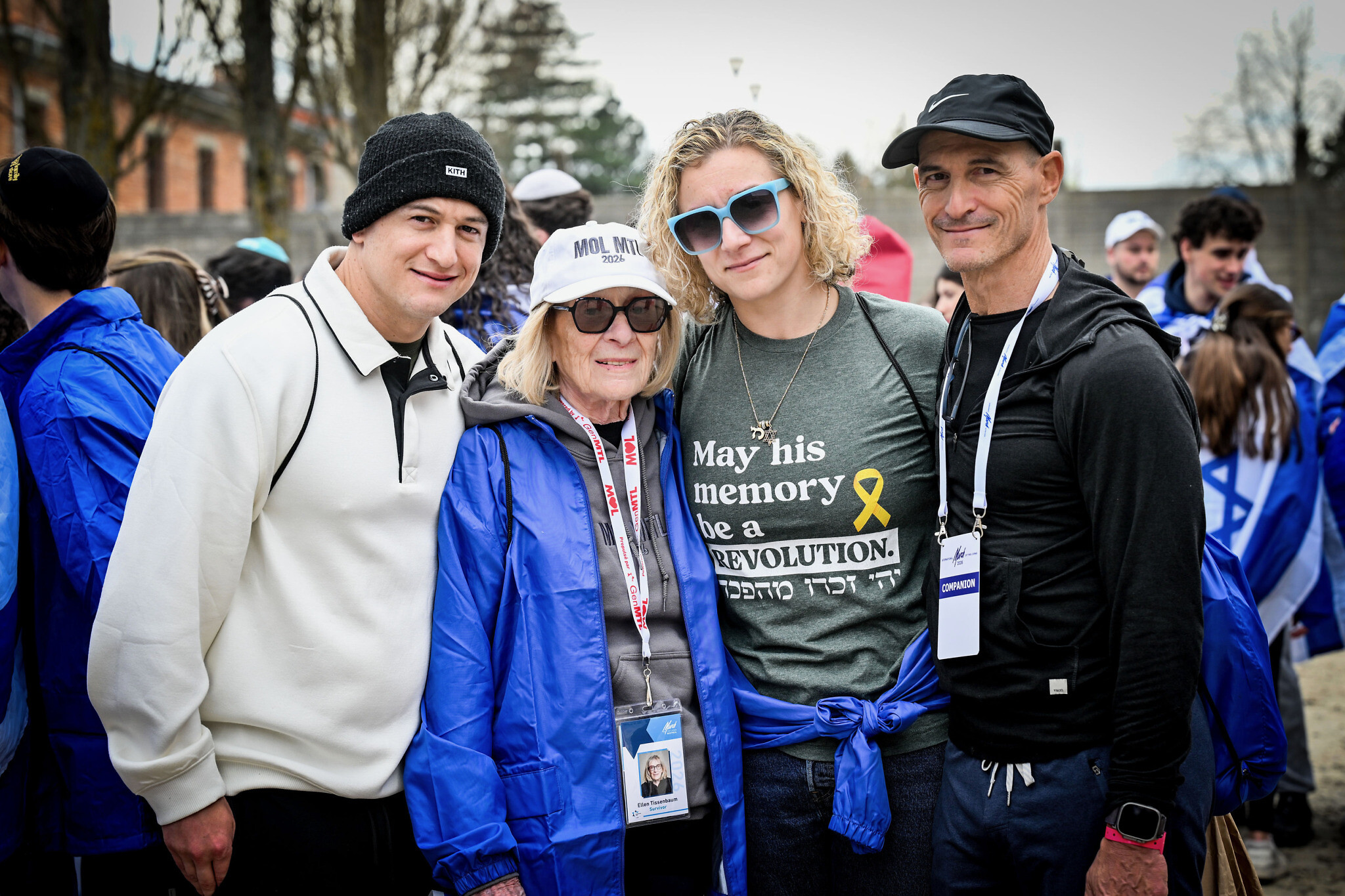
Ellen Tissenbaum’s life story reads more like the script of a Hollywood movie than a real-life biography.
After losing both of her parents to the Holocaust, Tissenbaum escaped from Holland to Canada and distanced herself from Judaism before eventually returning to her faith. Her story is shaped by experiences most people know only through history, culminating in an emotional visit to Auschwitz this April with the March of the Living, along with her son Allan Tissenbaum of Mt. Lebanon, his son, Jeremy Tissenbaum, and his niece Molly.
Born in 1936, Tissenbaum remembers being a happy child. Her mother and father immigrated to Holland from Germany to escape the rampant antisemitism leading up to Hitler’s rise and the Holocaust. The Netherlands maintained a stance of neutrality in the war before it was occupied by Germany in May 1940.
Tissenbaum said she still recalls airplanes flying over Amsterdam and “people in black boots, black leather coats, which I still won’t wear, and these loud noises — including dogs and whatnot — and the German soldiers marching through the town. I was petrified.”
When she was 4, she asked her mother why people were being so mean to her. Her mother’s response — “because we’re Jewish” — prompted Tissenbaum to innocently remark, “Take it away. I don’t want to be Jewish. I want to play with the people on the other side.”
Shortly after the Nazi’s invasion, soldiers stormed Tissenbaum’s house and arrested her father. The arrest, it turned out, was a case of mistaken identity. The Germans thought he was working for the resistance.
Suddenly, the country that had been a refuge became cold and dangerous. The butcher across the street from where she lived placed “No Jews Allowed” signs in his window. She was no longer able to attend school or play with children with whom she had been friends. The city’s Jews were forced into three separate zones.
“The Dutch people were very nice,” Tissenbaum recalled. “They gave the Jews a sort of council where they could squeal on other Jews.”
Her mother had a simple solution: The family would no longer be Jewish.
“We had my father’s best friend, went to church, got baptized and figured those drops of water would fix everything. My mother dyed her hair red. No more Jewish,” she said.
Soon, Tissenbaum’s father came home, briefly. A shell of the man he was before the arrest — once jolly and gentle — he no longer spoke. He was arrested again in a sweep following a Dutch protest of the Jewish community’s treatment and was sent first to Westerbork transit camp and then Sobibor extermination camp. She never saw him again.
After his arrest in 1943, her father’s best friend collected Tissenbaum and her mother, took them to his house and hid them in a secret room.
The man had a wife and eight children, and tried to provide for everyone with meager rations that seem to diminish daily. Soon, another woman and her two children came to share the secret room.
Despite the hardships, Tissenbaum said, life was “wonderful.”
“We came out at night. Everyone was nice to us. I can think of nothing but goodness that these people did for us,” she said.
Before long, the familiar sounds of the Nazis returned.
“You could hear the trucks and the Germans and the blaring and the kicking in of the front door,” Tissenbaum recalled. “They took my father’s best friend outside, put a gun to his head and said they would shoot him if he didn’t say where the Jews are hiding. He had no choice.”
Tissenbaum and her mother were sent to a camp. They were separated before being reunited for a train ride to Westerbork. She can’t recall how long she stayed in the work camp, but said she was “cute, blonde and little. During the day, I was able to go to the garden of the Germans and steal potatoes for me and my mother to have something to eat.”
One day, the women were taken and lined up before being separated. Tissenbaum’s mother told her, “Never become Jewish again. Those were her last words to me.”
The final image she carries of her mother is of her being forced onto a cattle car headed to Auschwitz. Her mother died shortly after the camp was liberated.
Fate played a hand in Tissenbaum’s life when her father’s best friend, the same person who hid them, managed to get papers from a doctor saying she was his illegitimate child.
She lived for the remainder of the war with the family as a Christian, and accepted her parents’ absence without question, she recalled.
“I went to school; I went to catechism. I was really accepted as part of their family and we didn’t talk about being Jewish,” she said.
Tissenbaum became part of a three-way legal dispute between the family she was staying with, an aunt and uncle in Argentina, and another aunt and uncle in Canada. The Canadian relatives eventually gained custody.
“One day the doorbell rings, they call me to the door and there are these two strangers standing there. They tell me they are my aunt and uncle and have come to take me to Canada,” she remembered. “Where’s Canada? I don’t know what Canada is.”
Tissenbaum stayed with the family. She became a nurse working at the Jewish General Hospital in Montreal. She got married.
Eventually, she got back in touch with the family in Holland that hid her twice from the Nazis. She reestablished a connection with the family that remains to this day.
This year, just weeks before her 90th birthday, Tissenbaum traveled to Poland to take part in the March of the Living — a walk between Auschwitz and Birkenau, both death camps.
It’s something she began thinking about two years earlier when a non-Jewish friend died. While at the wake, the friend’s stepson, a pilot, recounted a story of having plane trouble in Poland forcing him to spend time in the country, where he saw Auschwitz.
“He said if everybody stood on the railroad tracks in Poland, the world would be a better place,” she recounted.
At the time, Tissenbaum was teaching at a university where American students had asked about her life and her mother.
“I wanted to honor her by doing the March,” Tissenbaum said. “I was really thinking of paying homage to her.”
She attended the march with 100 high school students, serving as bus captain.
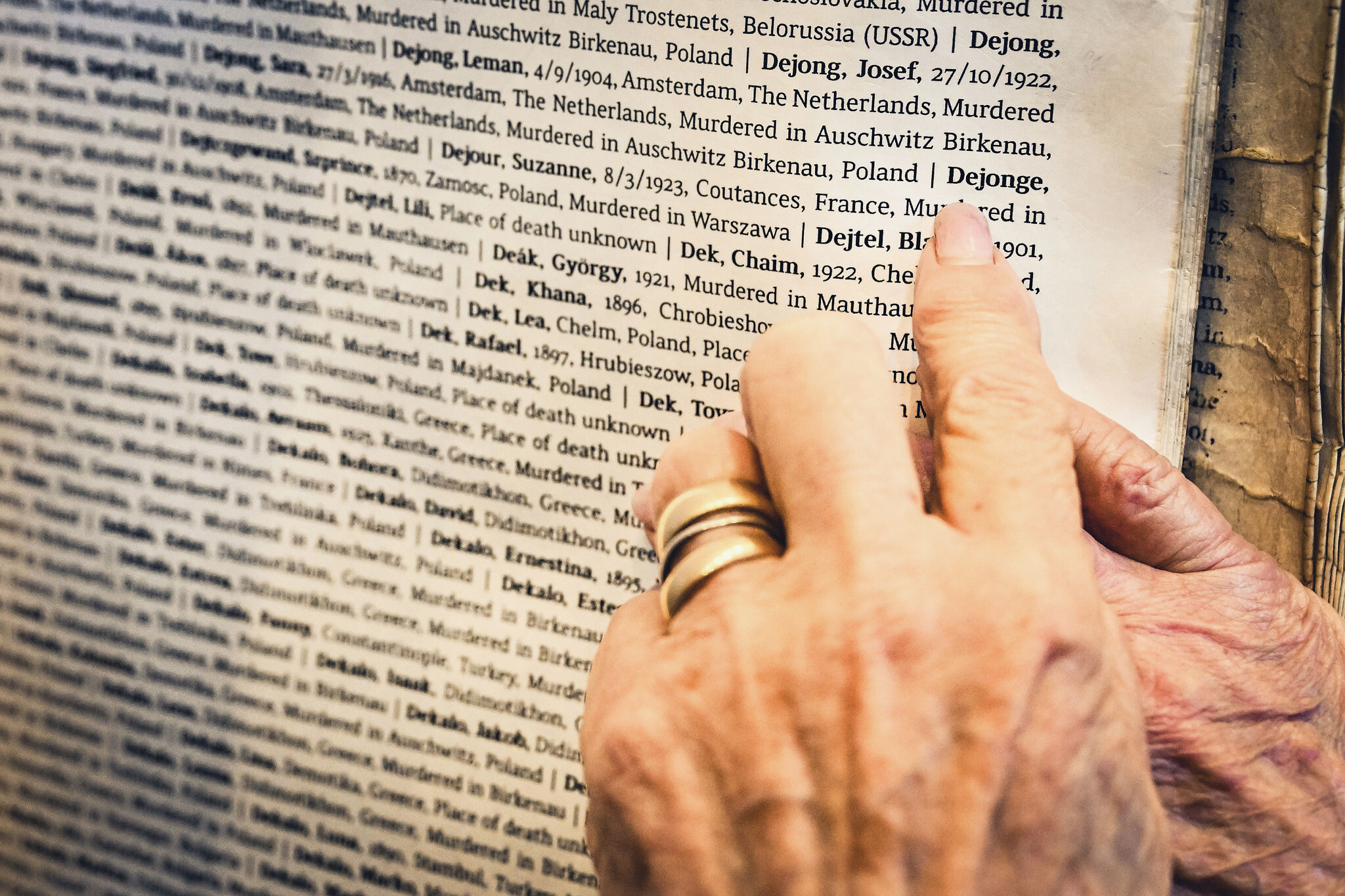
The second day of the march — when they visited Auschwitz and went through the barracks — was particularly challenging. It wasn’t only the camp’s architecture that was difficult. While there, Tissenbaum said she was in the library at the former death camp going through “pages and pages and pages” of people who died and found her mother’s name.
The trip spurred the nonagenarian to publicly share her story, something she didn’t do in the past.
“I’ve been silent. It’s lately, in the last few years, that I’ve started to write and put it down for my grandchildren,” she said.
As for the march itself, Tissenbaum said that what she did as an homage to her mother didn’t bring closure.
“I don’t think there can ever be closure,” she said. “These are losses that you feel deep down. Every once in a while they come up. You feel your kids have been deprived, your grandchildren have been deprived. I’ve had a lot of substitute people in my life that have given me so much.”
As for her mother’s final wish that her daughter never reembrace Jewish heritage, Tissenbaum said that was the wish of a mother who didn’t want to see her child hurt again.
“I’m very vocal. I wear my Magen David. I don’t care. I’m Jewish,” she said. PJC
David Rullo can be reached at drullo@pittsburghjewishchronicle.org.
comments