
New study charts Pittsburgh Jewry’s strengths, struggles and shifts
Because the area is home to fewer Jewish children than other Jewish communities of similar size, the need to invest in families is paramount.
There is a strong base of young Jewish adults in Greater Pittsburgh, with 41% of Jewish Pittsburghers between the ages of 25 and 54. That demographic could help the community grow — if those young adults decide to stay here. Because the area is home to fewer Jewish children than other Jewish communities of similar size, the need to invest in families is paramount.
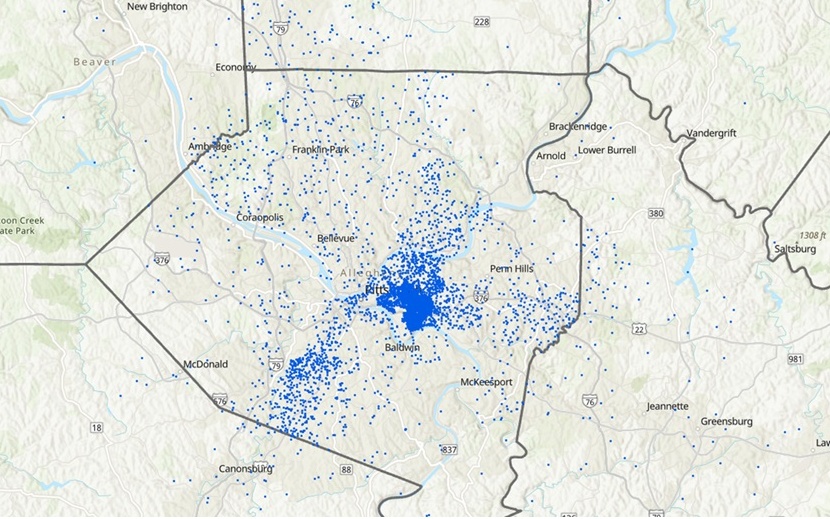
And while the number of Jewish residents in Greater Pittsburgh remains stable, and the majority of Jews continue to live in the East End, there is a growing number of Jewish families living north and south of the city limits.
These are just some of the takeaways from a new survey of Jewish Pittsburgh that reveals both strengths and challenges that may help the community plan for its future.
The 2025 Community Pulse Survey was funded and led locally by the Jewish Federation of Greater Pittsburgh in partnership with the Jewish Federations of North America and the research firm Burson. The survey was conducted from May to June 2025 with 532 local Jewish adults.
It’s been eight years since the last comprehensive community study of Jewish Pittsburgh was completed, conducted by researchers at Brandeis University. That study included interviews with approximately 2,100 Jewish households throughout Greater Pittsburgh.
Ilene Rinn, the Federation’s associate vice president of planning and impact, said it was the right time to survey the community again.
“Our last community study was done in 2017 and so much in Pittsburgh has changed since then,” she said. “There was the tragic shooting, COVID — and so we felt it was the right time to take the pulse of the community.”
Moreover, she noted, JFNA, the umbrella organization of Federations in North America, is piloting an Impact Index Program, surveying cohorts of cities of similar size to obtain data that will help community leaders “make more informed decisions about funding, engagement, etc.” Pittsburgh was one of 26 communities nationwide to participate in the initiative. Other communities in Pittsburgh’s cohort included Atlanta, Baltimore, Detroit, Palm Beach and Washington, D.C.
While the recent survey “was a not as deep or comprehensive as the 2017 study,” Rinn said, “it still gave us some good data to work with.”
Greater Pittsburgh is home to 46,300 Jewish residents, according to the new survey. Rinn said that number is consistent with the number reported in 2017, which was 49,200. The apparent disparity, she said, can be attributed to the ways the respective surveys were conducted.
“It’s within the margin of error,” she said, “so it’s still stable.”
Other insights from the survey include the finding that Jews in Pittsburgh “are more engaged and satisfied than those in most other U.S. communities surveyed,” while “only about half say they feel a deep sense of belonging in Jewish community life.”
Additionally, while antisemitism remains a major concern, most Jewish Pittsburghers feel comfortable expressing their Jewish identity publicly, due to strong security measures in place. More than half of Pittsburgh’s Jewish community has seen antisemitic content and nearly a third have faced antisemitic remarks directly, while vandalism and physical attacks remain uncommon.
Pittsburgh is ahead of the curve nationally for awareness of antisemitism and security resources, with 68% of Jewish Pittsburghers knowing where to turn if they are the target of antisemitism, compared to 46% nationally.
The survey also measured diversity and inclusion, concluding that 12% of Jewish households have at least one member who is LGBTQ+; 17% of households have a member who has a disability; 29% of household have a member who is neurodivergent; and 28% of households have a member with a mental health challenge.
One in five households is struggling financially.
Regarding Israel, 83% of Jewish Pittsburghers said it is important “that Israel is both a Jewish and democratic state”; 68% feel “emotionally attached to Israel”; 61% said they “have a responsibility to care for Israel”; and 79% said they “sometimes find it hard to support actions taken by the Israeli government.” A quarter of Jewish Pittsburghers “don’t want to be in community with other Jews who disagree with their views about Israel,” according to the survey.
As for political leanings, 21% of Jewish Pittsburghers are very liberal; 26% are somewhat liberal; 36% are moderate; 11% are somewhat conservative; and 6% are conservative.
About 80% of the people who took the survey “were engaged with the Jewish community, and wanted to be more engaged,” Rinn said, noting that since Oct. 7, 2023, when Hamas launched its attack on Israel, Jewish communities worldwide have trended toward increased engagement.
“This study reinforced that and gave us some sort of specifics about what they were looking for,” she said.
The Federation plans to use the data to guide programming and strengthen collaborations.
“This research reinforces the strength of our Jewish community, but it also gives us the clear direction we need to grow stronger together,” said Jeff Finkelstein, Federation’s president and CEO. “Because of this study, we and our partners can plan smarter, allocate more effectively and ensure that our community is welcoming, supportive and connected. That is the very heart of what Federation does.”
Rinn served as the study’s liaison between JFNA and Pittsburgh, and will work with the Federation’s manager of research and analysis “to figure out what to do next, how to shop this around to other constituencies.”
The results of the survey will help the Federation in fundraising, planning and marketing, according to David Heyman, the Federation’s associate vice president of marketing.
“We’ve been talking about security a lot recently, and so the fact that people do feel safer, and they know where to go if they have an incident and so forth, those are all reassuring to us,” he said. “But I think also the demographic research tells us that we’ve got a large young adult audience, that 41% that we need to make certain that when we’re picking communication, both channels and messaging, that we’re doing that in a way that’s going to be impactful to that part of the community.”
In terms of engagement, Rinn said the survey results will help the Federation plan how best to serve the Jewish population, especially young adults, now and for years to come.
“We want to make sure that we’re planning not only for their needs now, but thinking about what are the things that, as they age, have a family — what sort of things would keep them in Pittsburgh,” she said. The Federation has been convening some small focus groups, “sharing this data with young adults, trying to get a little more granular to tweak and adjust some of the programming that we are doing so that we meet their needs now and for the future.” PJC
Toby Tabachnick can be reached at ttabachnick@pittsburghjewishchronicle.org.
comments