
Jewish law professor appointed to Pennsylvania human rights panel
"I never thought when I sent my kids away to college that Max would have to worry about hot coffee being poured on him in a library.”
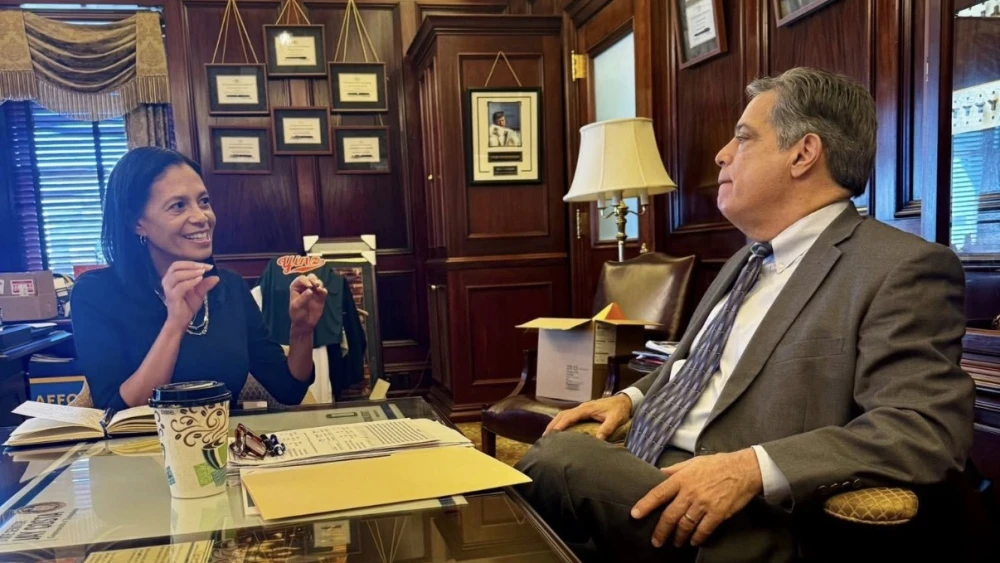
Andrea J. Martin’s sons understand that “anti-Zionism is the new antisemitism, because they faced it in a way that I never did,” the 57-year-old attorney and assistant law professor at Penn State Dickinson Law told JNS.
Pennsylvania Gov. Josh Shapiro, a Democrat, appointed Martin, who also co-founded the independent Center for Jewish Legal Studies, to the Pennsylvania Human Relations Commission in July.
The state panel’s goal is to help Pennsylvanians “work, live and participate in public life free from discrimination,” according to Martin.
“All Pennsylvanians should feel that they can come to this commission and be represented,” she told JNS. “We need to enforce the law, not politics.”
Martin’s five-year term on the panel comes after she redirected her work toward protecting Jewish civil rights. The Oct. 7 attacks and the Jew-hatred that followed on U.S. campuses while her sons were in school changed the work that she wanted to do.
Martin and her husband, Jeff Martin, who is retired, raised their sons in Carlisle, Pa. Her Jewish upbringing was more cultural than religious, but she wanted her sons, Max and Sid, “to grow up in a synagogue and go to religious school, to Sunday school,” she told JNS.
She said of her two sons that people “say they sound like old Jewish guys at a nursing home playing chess.”
The family traveled to Israel with their synagogue, Temple Ohev Shalom, a Reform congregation in Harrisburg. Sid later returned to Israel on a Birthright trip, and Max has plans to go.
“They’re both strong, proud Jewish boys,” she told JNS.
Max graduated from New York University and Sid from Pennsylvania State University, the public school where his mother works. Martin, who is black and Jewish, told JNS that her sons “experienced some racism in high school, but not antisemitism.”
At NYU, Max “faced horrific antisemitism,” Martin said.
“I used to worry because they were black Jews, and I was more concerned that they were black,” she told JNS. “I never thought when I sent my kids away to college that Max would have to worry about hot coffee being poured on him in a library.”
“I never knew America would turn on Jews this way, and that antisemitism would reach these levels,” she said.
“If you ask those college students in the protests, many of them did not even know what ‘river,’ what ‘sea’ they were talking about,” she said, of the anti-Israel slogan “from the river to the sea,” which calls for Israel to be erased between the Jordan River and the Mediterranean Sea.
“Since Oct. 7, I have to say it’s been eye-opening. It’s changed my life,” Martin told JNS. “It’s changed how I want to use my voice.”
Martin grew up in Washington, D.C., and attended the University of Rhode Island before earning a law degree at Howard University. She began her career as a prosecutor in the Rhode Island attorney general’s office, where she helped draft hate crimes legislation and “sat on the then-governor’s Commission on Prejudice and Bias,” she told JNS.
At Penn State, she teaches law and the Holocaust. “My scholarship is in antisemitism and anti-discrimination law,” Martin said.
The Center for Jewish Legal Studies grew out of Martin’s concern that legal scholarship had not addressed threats to Jewish civil rights. At the center, she and her co-founder bring scholars together to develop that work.
Martin recently spoke at an international law conference at Northwestern University’s law school in the Chicago area, addressing allegations of genocide against Israel.
“I spoke about the ‘genocide’ libel, and where the false narrative came from of ‘settler colonialism,’” she said.
Martin told JNS that anti-Zionism should be written without the hyphen, just as “antisemitism” has lost its hyphen, because it is not a movement against the Zionist political movement and is “being used as a proxy for Jew-hatred,” she said.
“The anti-Zionism we see today has nothing to do with that original political movement, because Israel has been established,” she said. “It’s there. It’s a state.”
“So if you call yourself an ‘anti-Zionist’ today, you’re really just anti-Jew, because you’re not questioning any other state’s ability to have their own country,” she told JNS. “You’re only focused on the Jewish state.”
Addressing antisemitism today
In 2025, after the Pennsylvania governor and his family held a Passover seder at the governor’s residence, a man broke into the home and used Molotov cocktails to set fires. Cody Balmer pleaded guilty to the attack and was sentenced to prison. According to court documents, he attacked Shapiro’s home because of “what he wants to do to the Palestinian people.”
Martin told JNS that she met Shapiro briefly at an event in Pittsburgh held by billionaire Jewish businessman and philanthropist Robert Kraft but has never sat down with the governor to discuss Jew-hatred and her support for the state adopting the International Holocaust Remembrance Alliance’s working definition of antisemitism.
The definition identifies accusations against Israel such as “comparing Israeli policy to that of the Nazis” and “denying the Jewish people their right to self-determination by claiming that the existence of a state of Israel is a racist endeavor.”
The commission already uses the IHRA definition, but Martin wants Shapiro to adopt it for the legislature statewide via executive order.
“It’s the only one that addresses what antisemitism looks like today, which is based on anti-Zionism,” she told JNS. “It’s the only definition that does that effectively with its examples.”
Martin attended her first commission meeting in September. Training for new commissioners is slated for late October or early November. The commission is meant to have 11 members but currently has 10, she said.
“I will learn all I can about the process and procedures and will do my best for the residents of the commonwealth,” she told JNS. She added that she wants to help develop Jew-hatred training for institutions seeking the commission’s assistance.
Last week, Martin testified at a hearing of the Pennsylvania legislature about Jew-hatred at schools in the state. She hopes families facing discrimination in public schools know that they can turn to the commission.
“I think we need to explain who we are as a commission,” she told JNS. “I think we need to explain we’re not partisan, that we believe in upholding everyone’s rights.”
There have been 395 hate crime offenses—part of 325 incidents—in Pennsylvania since Jan. 1, 2025, according to FBI data. Of those incidents, 83, or about 26%, have been religion-based. Jews have been the targets in 54, which is about 17% of all hate-crime incidents and about 65% of all religion-based hate crime incidents.
Jews reportedly make up about 2.7% of Pennsylvania residents.
According to the Anti-Defamation League, there were 281 antisemitic incidents in Pennsylvania in 2025, down 40% from 2024. Philadelphia and Pittsburgh accounted for 53% of those incidents, or roughly 149 combined. Statewide, 32 incidents occurred at colleges and universities and 21 at K-12 schools.
The commission offers a way to address incidents that occur at state agencies and public institutions without requiring every person affected to pursue a lawsuit.
“Lawsuits are expensive and take time,” Martin told JNS. “A lot of people don’t want to sue. That’s not what this is about. They just want to be treated fairly, equitably.”
“It really shouldn’t be that difficult,” she said. “I hope I make a difference. I hope I make the Jewish community proud.” PJC
comments