
From Bergen-Belsen to America, a twin’s unforgettable Holocaust story
“They say never forget, and we have to remember because people have forgotten."
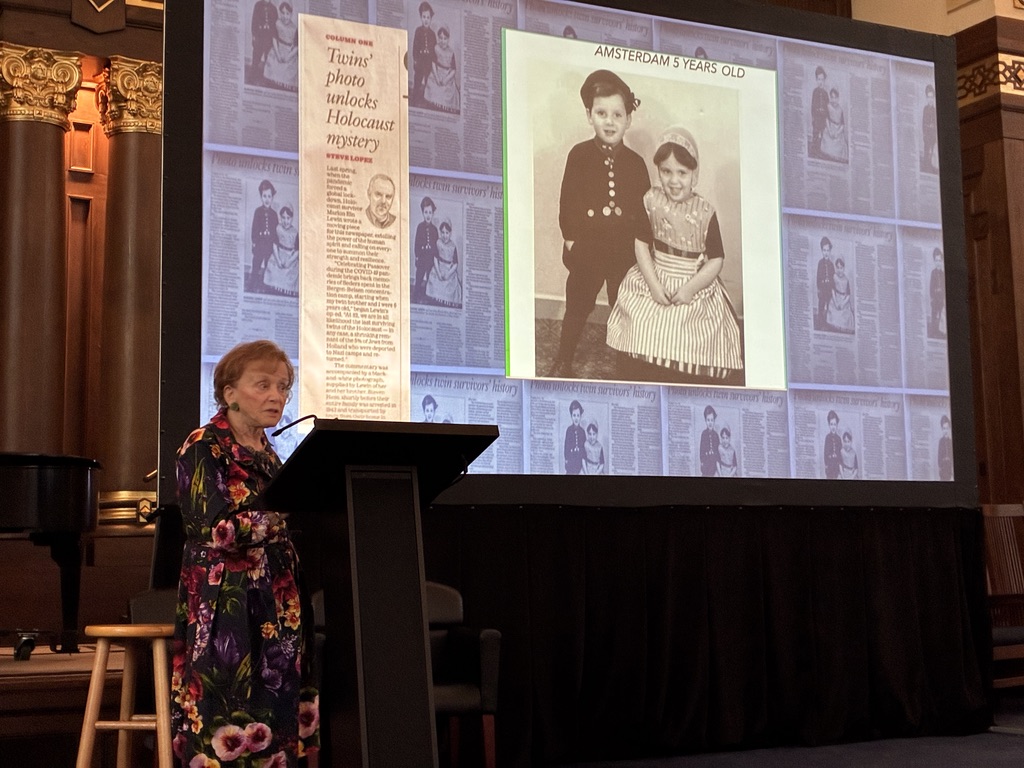
Until a few years ago, Marion Ein Lewin never talked about how she survived the Shoah. But in 2020 during the pandemic, she was inspired to write an op-ed for the Los Angeles Times about her memories of the Holocaust.
“Celebrating Passover during the COVID-19 pandemic brings back memories of seders spent in the Bergen-Belsen concentration camp, starting when my twin brother and I were 6 years old,” she wrote.
Later, LA Times columnist Steve Lopez wrote about Lewin and her twin brother Steven’s story of survival, connecting them with the daughters of their childhood nanny, Marretje, who named one of her daughters Marion.
Get The Jewish Chronicle Weekly Edition by email and never miss our top stories Free Sign Up
But despite rarely speaking of her life before coming to America, Lewin holds many memories of growing up in Amsterdam before the war.
“I really remember the windmills and tulips and skating on the ice,” she said. “It’s such a picturesque country, and it’s very much a country for children because it’s so scenic and so small.”
She also remembers when it changed.
“I remember because I never heard such a loud noise in our beautiful apartment. Those were those boots that the Nazis wore,” she said. “They spoke in a very loud and aggressive tone, German, which my parents, who had come from Germany to escape Hitler, knew, but for me, it was new. You had to rush and get dressed. And it seemed, even at my age, very scary and very ominous.”
Her story is unique for two reasons: Her entire family survived, and she and her brother are widely considered the only surviving twins of the Holocaust who are still alive. It’s a story she shared during a Holocaust Center of Pittsburgh event at Rodef Shalom on Sept. 10.
Lewin’s family – she and her mother, father and brother – were arrested in 1943 and taken to the Westerbork camp in the German-occupied Netherlands.
After being held there for months, the family was loaded on a train with no idea where they were headed.
They were taken to Bergen-Belsen, a concentration camp in Germany.
Lewin said the Nazis had calculated how long people would last and that a child could survive up to a year. Mass graves were commonplace at the camp.
“My brother and I learned how to count by counting corpses,” she said. “I know that sounds horrific, and of course it is horrific, but that was our life. It was like seeing cars parked in front of your door.”
The oldest women in the camp took care of them, telling Lewin’s mother that the twins were “very unruly.” She and her brother developed a secret language, a version of pig latin, to communicate.
They kept themselves busy with games they created: taking lice out of their hair, lining them up and counting them, or seeing who could make the straightest line.
In the crowded camp, prisoners had to share bunk beds. Lewin and her brother were always the first picked by others to share the small beds because they were so skinny that they didn’t take up as much space as others.
For one of the twins’ birthdays, their parents gave them bread with butter and chocolate sprinkles. They rationed it out for weeks, eating little crumbs every day.
Bergen-Belsen was liberated on April 15, 1945, but Lewin’s family and 2,500 other prisoners had already been put on a train. Over the course of a 13-day journey, a third of those on the train died from lack of water and food.
Finally, the train was liberated by Russian soldiers in eastern Germany, and Lewin’s family returned to Amsterdam before moving to America.
Her family came to New York in 1947 to start anew. They traveled on the RMS Queen Elizabeth, a luxury liner that proved a shock for Lewin after years of suffering.
“I thought I’d entered paradise to be somewhere where you had a white sheet and towels,” she said.
She and her brother were just 9 years old when they moved to New York. As young Holocaust survivors, they spent the first six months at events, meeting prominent figures and political leaders: Eleanor Roosevelt, the head of the United Nations or the mayor of New York.
But Lewin wanted a sense of normalcy and asked her mother why she wasn’t in school. Her mother explained that people wanted to honor them as Holocaust survivors.
“I said to my mother, ‘But I don’t always want to be known as a Holocaust survivor. I want to be known as an American girl,’” Lewin recounted. “Of course, I will always be a Holocaust survivor. I will always feel especially blessed that I survived the Holocaust and my whole family did. But on the other hand, if you go through an experience like that, you want to grab the world and learn and discover and see.”
Lewin and her brother were placed in kindergarten, moving up a grade every few weeks until they caught up with other kids their age.
But the memories of the Holocaust didn’t leave Lewin, and her Los Angeles Times op-ed sparked a series of public talks, and eventually, a book in 2023.
Lewin and her brother helped Faris Cassell — an author and journalist — write a book on their experiences: “Inseparable: The Hess Twins’ Holocaust Journey through Bergen-Belsen to America.”
“They say never forget, and we have to remember because people have forgotten,” Lewin said. “Our Holocaust journey, it was truly a tale of horror, slaughter, but also a story of hope, resilience and overcoming.” PJC
Abigail Hakas is a freelance writer living in Pittsburgh.
comments