
Gaza ceasefire starts as IDF completes partial withdrawal; Hamas has 72 hours to return hostages
Solider killed by Hamas sniper hours before deal goes into effect; IDF, Hamas warn Gazans not to approach troops in new positions; coastal road opens for Palestinians to return to Gaza City
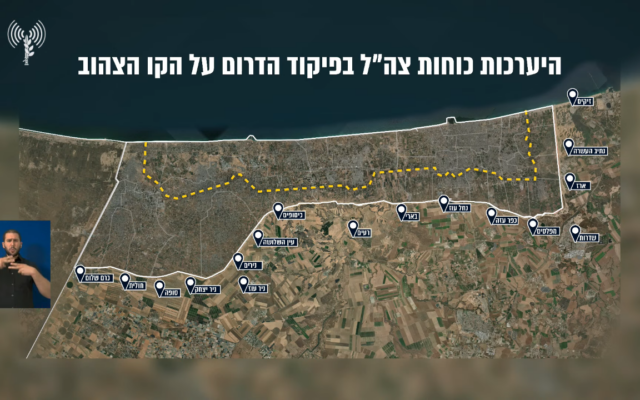
The Israel Defense Forces completed a withdrawal to agreed-upon deployment lines in the Gaza Strip on Friday at noon, officially beginning a ceasefire and a 72-hour countdown during which Hamas is to release the hostages it is holding under the first phase of the US-brokered deal.
The withdrawal was conducted under the cover of artillery shelling and airstrikes in some areas and an IDF reservist was killed by a Hamas sniper hours before the agreement went into place.
The completion of the withdrawal started a 72-hour countdown, during which Hamas is obligated to release all the living hostages and as many of the dead hostages that it can secure, according to the terms of the deal. That puts the deadline at noon on Monday.
The IDF published footage of the pullback, without providing further details.
US Envoy Steve Witkoff later said that the US military had confirmed that the IDF had completed its obligations.
“CENTCOM has confirmed that the Israeli Defense Forces completed the first phase withdrawal to the yellow line at 12PM local time. The 72 hour period to release the hostages has begun,” Witkoff posted on X.
Media outlets in Gaza reported Friday that five people were seriously injured in an IDF strike on a school that had been serving as a shelter for displaced people in Jabalia, in northern Gaza City.
There was no immediate comment from the IDF.
Ahead of the deal taking effect, an IDF reservist soldier was killed in a Hamas sniper attack in Gaza City on Thursday afternoon.
The slain soldier was named Friday morning as Sgt. First Class (res.) Michael Mordechai Nachmani, 26, a Technology and Maintenance Corps soldier in the 614th Combat Engineering Battalion, from Dimona.
Israel’s toll in the ground offensive against Hamas in Gaza and in military operations along the border with the Strip stands at 472. The toll includes two police officers and three Defense Ministry civilian contractors.
Following the withdrawal, the IDF remains in control of just over half of the Strip’s territory, or 53 percent — most of which is outside of urban areas.
This includes a buffer zone along the entire Gaza border, including the Philadelphi Corridor — the Egypt-Gaza border area — along with Beit Hanoun and Beit Lahiya in the Strip’s far north, a ridge on the eastern outskirts of Gaza City, and large portions of Rafah and Khan Younis in southern Gaza.
In a tearful statement at a press conference, IDF Spokesman Brig. Gen. Effie Defrin said the ceasefire in the Gaza Strip was “an emotional moment for the people of Israel and for the IDF troops and soldiers who have fought and acted over the past two years with courage, bravery, and out of a sense of mission and dedication.”
Defrin showed the IDF’s current deployment in the Gaza Strip as part of the deal, and said that troops “will act to eliminate any threat to their security, no risks will be taken.
“We will do everything possible to protect the security of the residents of the western Negev, the south and the entire country,” he said.
Asked whether Hamas still poses a threat to Israel, Defrin said: “Hamas today is not the Hamas of two years ago; Hamas has been defeated everywhere we fought it.”
Both the IDF and Hamas’s Civil Defense agency earlier issued calls urging residents not to go near areas where Israeli forces were stationed in the Strip.
“According to the agreement, IDF troops will remain deployed in specific areas of the Gaza Strip. Do not approach IDF troops in the area until further notice. Approaching the forces exposes you to danger,” warned the IDF’s Arabic-language spokesperson Col. Avichay Adraee.
Adraee said moving from southern Gaza to the Strip’s north, and vice versa, was permitted via the Rashid coastal road and the Salah a-Din highway.
“We warn you that in the northern Gaza Strip area, approaching the areas of Beit Hanoun, Beit Lahia, Shejayia and the areas where forces are stationed is extremely dangerous,” he said. “In the southern part of the Strip, it is very dangerous to approach the Rafah crossing area, the Philadelphi Corridor and all areas where forces are stationed in Khan Yunis.”
He also warned that along Gaza’s coast “there is great danger in fishing, swimming and diving. We warn against entering the sea in the coming days.”
Hamas’s Civil Defense agency also told Gazans not to approach the borders of the enclave until an official announcement is made about an IDF withdrawal. “Violating this warning puts your lives at risk,” the statement said.
Following the announcements, footage from Gaza showed hundreds of people beginning to move along the coastal al-Rashid Road moving back north toward Gaza City, the enclave’s main urban center which has been under Israeli assault for the past month.
The ceasefire between Israel and Hamas was announced in the early hours of the morning on Thursday and was ratified by the government later that evening. The hostages — some 20 living, at least 26 thought to be dead — are meant to come home within 72 hours of the completion of an agreed-upon withdrawal of the IDF.
The terror group has, in the past, told mediators it does not know where some of the bodies of slain hostages are located, which may delay the release of the bodies.
Israel is due to release 250 Palestinian security prisoners serving life sentences, plus another 1,700 Gazans imprisoned since the October 7, 2023, Hamas-led attack that launched the war.
Meanwhile, the announcement of a ceasefire mixed emotions in Gaza, much of which has been flattened by Israel’s offensive and has seen much of the population displaced.
“Honestly, when I heard the news, I couldn’t hold back. Tears of joy flowed. Two years of bombing, terror, destruction, loss, humiliation, and the constant feeling that we could die at any moment,” displaced Palestinian Samer Joudeh told AFP.
Nevin Qudeeh said she felt the greatest sense of relief since the war erupted two years ago. She’ll be even happier, she added, when she can return home.
“We’re staying on the streets.”
“I am happy and unhappy,” said Mohammad Al-Farra. “We have lost a lot of people and lost loved ones, friends,” relatives, and homes that are about a lot more than stones and physical buildings, he said.
One cannot help but wonder what the day after would look like, he said — or where to even begin picking up the pieces. “The situation is very difficult.”
But he said they would overcome future hardships just like they’ve been doing.
Taghreed al-Jabali, displaced from Khan Younis, also shared the mixed feelings.
“We don’t know whether to feel happy or sad,” she said, lamenting the killings and losses of the last two years, including children missing two full years of school.
“Our sons and daughters didn’t receive an education. A whole generation was lost. Two generations were lost, not just one. May God make it up for us,” she said.
The war erupted when Hamas-led terrorists rampaged through southern communities on October 7, 2023, murdering some 1,200 people, mostly civilians, and taking 251 hostages.
The Hamas-run Gaza health ministry says more than 67,000 people in the Strip have been killed or are presumed dead in the fighting so far, though the toll cannot be verified and does not differentiate between civilians and fighters. Israel says it has killed over 22,000 combatants in battle as of August and another 1,600 terrorists inside Israel during the October 7 onslaught.
Israel has said it seeks to minimize civilian fatalities and stresses that Hamas uses Gaza’s civilians as human shields, fighting from civilian areas including homes, hospitals, schools and mosques. PJC
comments