
Federation mission to Israel proves ‘hope for the future is bright’
“We felt it was important to go there and physically stand with Israel,” he said.
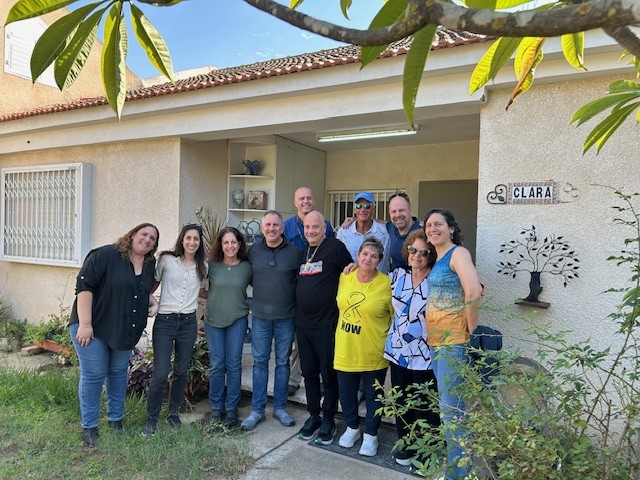
Scott Leib was surprised and unsettled to see damaged buildings in Tel Aviv during a recent solidarity mission to Israel.
“I generally feel really safe and secure in Israel,” he said, “but to see that, it was a realization of just how close Israel’s adversaries are and how they can have such a direct impact even right in the city.”
Leib was in Israel Dec. 3-8 as part of a solidarity mission organized by the Jewish Federation of Greater Pittsburgh. He expected to see damage in the north and south of the country, he said, but was taken aback to see the war’s scars in the Mediterranean city and the work to rebuild the damage.
“At first, I looked and I thought, ‘Oh, look, there’s some new construction, and then I realized they’re working to repair damage from a missile,” he said.
For Leib, it was reminder of the resilience of the Israeli people, something he found inspirational during the mission’s five days in Israel.
Brian Eglash has been to Israel three times since Oct. 7, when Hamas attacked the country, murdered more than 1,200 people and took more than 250 hostages.
Eglash is Federation’s senior vice president and chief development officer.
“We felt it was important to go there and physically stand with Israel,” he said. “It’s so important because, throughout the war, Israel has been very isolated.”
He, too, said the trip spoke to the resilience, courage and hope of the Israeli people.
“The hope for the future is bright and that was really, really powerful,” he said.
The mission included stops at Kibbutz Nir Yitzhak, a Gaza-bordering community Federation supports in its efforts to rebuild.
“People were murdered, kidnapped, their homes were destroyed,” Eglash said. “We’ve committed nearly a million dollars to help them rebuild over a three-year period.”
The group also spent time at the site of the Nova festival; Bat Yam; Partnership2Gether sister region Karmiel/Misgav; and Eshbal, a community of educators running a boarding school for some of Israel’s teens navigating difficult circumstances. They met with Brothers for Life, an organization similar to Wounded Warrior Project, shared a meal with Major General Doron Almog, chairman of the Jewish Agency for Israel, and celebrated Shabbat in Jerusalem.
Eglash said a visit with former hostage Clara Marman was particularly meaningful.
“She invited us into her home,” he said. “She hadn’t moved back in yet — she is in two weeks — but they had to completely remodel it because of damage.”
Marman recounted being kidnapped by Hamas with her partner, sister, brother, niece and their dog, a Shih Tzu named Bella, who was potty trained while in Hamas’ custody.
Clara and the other women, along with Bella, were released in November 2023; the men were rescued by IDF commandos in February 2024.
“It was really powerful to meet them,” Eglash said.
Solidarity Mission Co-Chair Debbie Resnick said she hadn’t been to Israel since 2019 but felt it important to go on the trip and share what she experienced.
“I wanted to bring the story back to our community,” she said. “I wanted to be able to see it with my own eyes, hear it with my ears — hear the voices — and be able to learn the stories so they resonate in my heart.”
She recounted meeting Shalev Biton, a Nova festival survivor, who was saved by Yunis Alkarnawi, a Bedouin Arab.
Her husband, Josh Resnick, said learning Biton’s story was important because “it showed me how we can’t stereotype any one group. This guy’s life was saved, and the people with whom he was with were saved by this Arab Israeli — and they were all Jewish, Israeli.”
Debbie Resnick said the mission also included time at different medical centers, meeting with wounded soldiers — including a 23-year-old IDF soldier who is a double amputee because of the war.
“The patriotism among these young adults is off the charts,” she said. “They love Israel. They felt that what they did was right and they would do it again.”
She said many Israelis, including children, are facing post-traumatic stress disorder.
“What they are finding is that PTSD is surfacing in children now,” she said. “Many of these children spent hours living in bomb shelter. Many are having behavioral problems now — that’s a big concern. The suicide rate is high. The divorce rate is high.”
Michele Rosenthal said the mission provided opportunities to meet and talk with people “you wouldn’t get to on your own.”
She called the trip “amazing,” “touching” and “meaningful.” As an example, she cited a visit to the Tkuma Car Cemetery, comprised of more than 1,500 cars burnt and destroyed during Hamas’ terrorist attack, many from the Nova festival.
“The magnitude of that. They had to go through those cars, remove personal belongings, bodies. It’s so hard to grasp,” she said.
Rosenthal was also struck by a shelter at the Nova site where people “squeezed in. Many were killed. A few were taken hostage. A few survived.”
The group also visited the Tree of Life memorial — a particularly poignant moment for Rosenthal, whose brothers, Cecil and David Rosenthal, were murdered on Oct. 27, 2018, during the Pittsburgh synagogue shooting.
“That was probably my hardest moment,” she said.
For Leib, who is on Federation’s board, the trip provided clarity and connection about the work the organization does.
“We sit in Federation meetings, or in planning and impact meetings, and talk about approving funding and it seems kind of remote or intangible: ‘Oh, that’s nice, we’re doing some kind of art therapy thing.’ But when you see the center and hear from the children who do this every day instead of going out to play, it makes you realize that the work we’re doing in Pittsburgh does have an effect on the other side of the world, in Israel, and the people are appreciative of our community and the help we’re providing,” he said. “That was very meaningful.” PJC
David Rullo can be reached at drullo@pittsburghjewishchronicle.org.
comments