
CMU professor leads research project for Dept. of Energy’s Genesis Mission
“Our team is working on data infrastructure that is going to make it easier for researchers to apply AI to data from multiple sky surveys,” Mandelbaum offered.
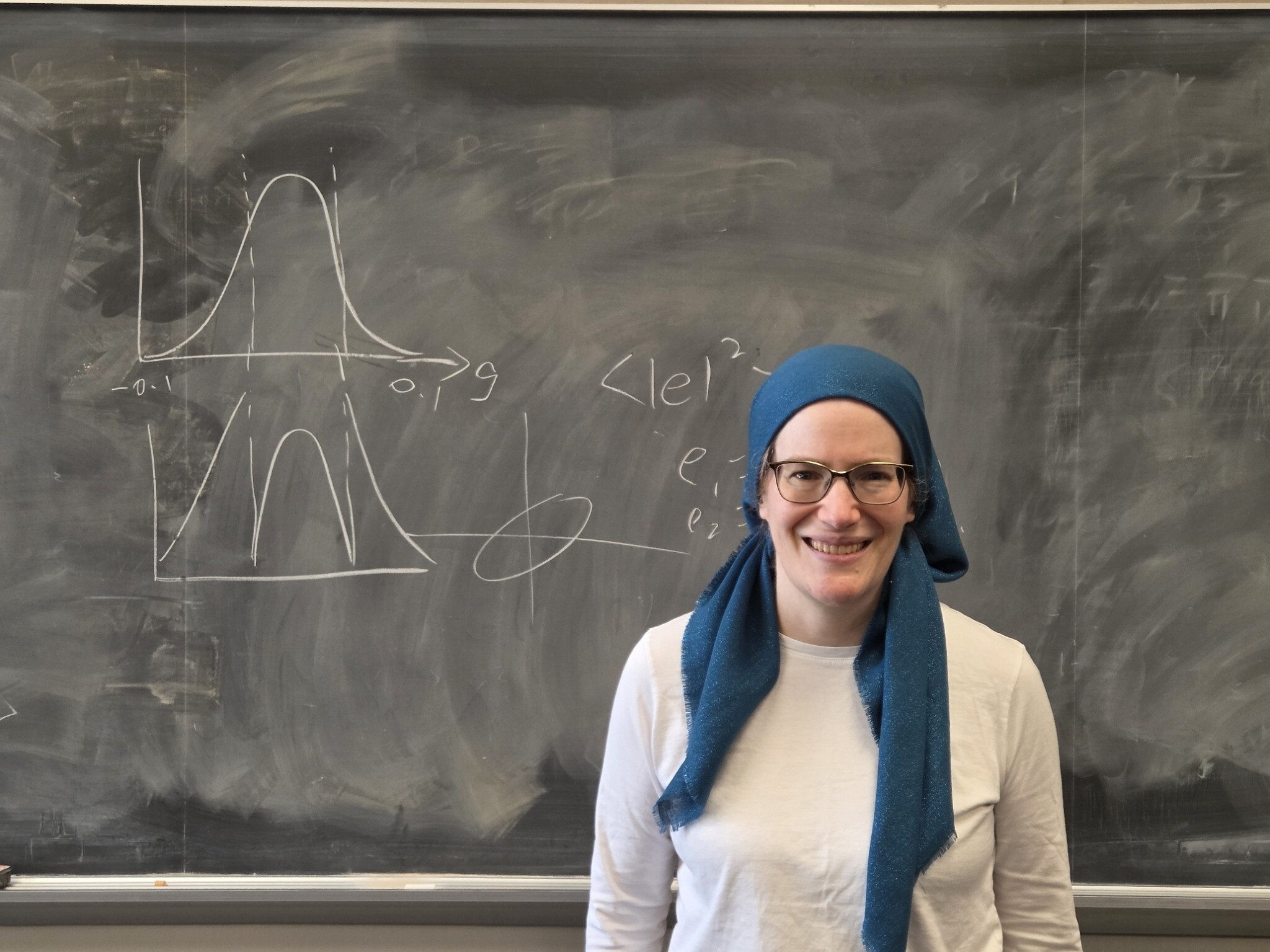
For Rachel Mandelbaum, Carnegie Mellon University’s work with the Genesis Mission is a natural fit.
Mandelbaum is a professor and the department head in physics and carries out research in the university’s McWilliams Center for Cosmology and Astrophysics. The Jewish scientist is the lead in one of three Genesis Mission research projects awarded to CMU last month by the Department of Energy.
Mandelbaum is a professor and the department head in Physics and carries out research in the university’s McWilliams Center for Cosmology and Astrophysics.
As part of the Genesis Mission-funded project to help scientists use artificial intelligence to better understand the universe, researchers at CMU are partnering with the University of Washington in collaboration with the U.S. Department of Energy’s SLAC National Accelerator Laboratory.
“We have a tradition of collaboration between people working in AI and computer science, with people working in a variety of scientific domains like astrophysics,” Mandelbaum said.
The research, she said, will span nine months, a period Mandelbaum classified as “quite short.” It’s part of the Genesis Mission’s Phase 1 projects.
The hope is that after completing this Phase 1 project, CMU will also be involved in a Phase 2 project, which will last three years and is meant for teams that are three to five times larger than the ones currently working on CMU’s Genesis Mission research.
As for the research Mandelbaum and her team are doing, she said, it has to do with being able to efficiently share large volumes of data.
“Imagine that a team says we’re going to use this telescope for five years to look at the sky and study something,” she said. “The survey team, the observatory, has to decide how they are going to provide this data for people to carry out scientific analysis. Each observatory or team generally considers this question in isolation.”
If a researcher wants to use an AI method to learn something from data collected by several different teams, using as much information as possible, she explained, there is a need for a common format, so all the data can be used and understood efficiently.
“Our team is working on data infrastructure that is going to make it easier for researchers to apply AI to data from multiple sky surveys,” Mandelbaum offered. “We’re not carrying out the scientific analysis of that data. We’re producing tools that researchers will be able to use for their analysis and especially their application of AI tools to the data.”
The scientific community’s data infrastructure is sometimes a limiting factor to what it can do, she said.
Mandelbaum’s analogy is a person who looks through a telescope at the sky for one night and gets many images. They can download that to their computer, go home and analyze the data. But a survey of the sky every 30 seconds for 10 years is unable to fit on a laptop, making it more difficult to analyze. CMU’s research for the Genesis Mission will allow the scientific community to look at that large data, from multiple cosmic surveys at once, in the most efficient way.
CMU’s involvement with the Genesis Mission, Mandelbaum said, is a great opportunity for the university to play a leading role in the science that comes from a new generation of sky surveys coming online now.
“The Rubin Observatory’s Legacy Survey of Space and Time, a 10-year survey that started in June, 2026 — NASA is going to launch the Nancy Grace Roman Space Telescope that is going to start a survey,” Mandelbaum said. “That launch is Aug. 30. We have a lot of exciting things that are starting up. Thousands of astronomers are going to use this data and to be part of the team that’s providing them with the tool that will actually let them do the science with all these data sets together. It’s a huge opportunity from the impact of this one nine-month project.”
Because of its work with projects like the Genesis Mission, Mandelbaum said, CMU is one of the premier schools for astrophysics. In fact, her department recently launched a new doctorate program in astronomy and astrophysics, with the first admission cycle in the fall of 2025.
“We had a huge volume of applications for that program,” she said. “It was highly selective and we were very successful in recruiting our top picks. Half the offers we made for admission were accepted.”
And while 50% might not typically seem very high, Mandelbaum said it’s incredibly high in admission yields.
“Two of those incoming students won graduate research fellowships from the Natural Science Foundation, which are highly selective,” she said.
The department, she noted, has also found success recruiting strong post-doctoral fellows and faculty in astrophysics “because the work and the environment is so compelling.”
The Gensis Mission is a national initiative to build the world’s most powerful scientific platform to accelerate discovery science, strengthen national security, and drive energy innovation, according to the Department of Energy. Its goal is to develop an integrated platform that connects the world’s best supercomputers, experimental facilities, AI systems, and unique datasets across every major scientific domain to double the productivity and impact of American research and innovation within a decade.
It was launched in November 2025 by an executive order.
For Mandelbaum, the opportunity to work on the Genesis Mission as part of CMU is exciting. As a scientist though, it’s the result that is most thrilling.
“I am fundamentally driven by wanting to do some science and data infrastructure is a steppingstone to that. It’s not the end game. I’m excited that the data infrastructure will let a lot of people do their own science, and they’re going to do so many different things with these data sets, and that’s amazing,” she said.” PJC
David Rullo can be reached at drullo@pittsburghjewishchronicle.org.
comments