
Chabad crosses the Alleghenies
A discovery sheds light on the early history of Chabad Chassidim in Pittsburgh.
I discovered a little fact the other day, and it brought a smile to my face.
Here it is.
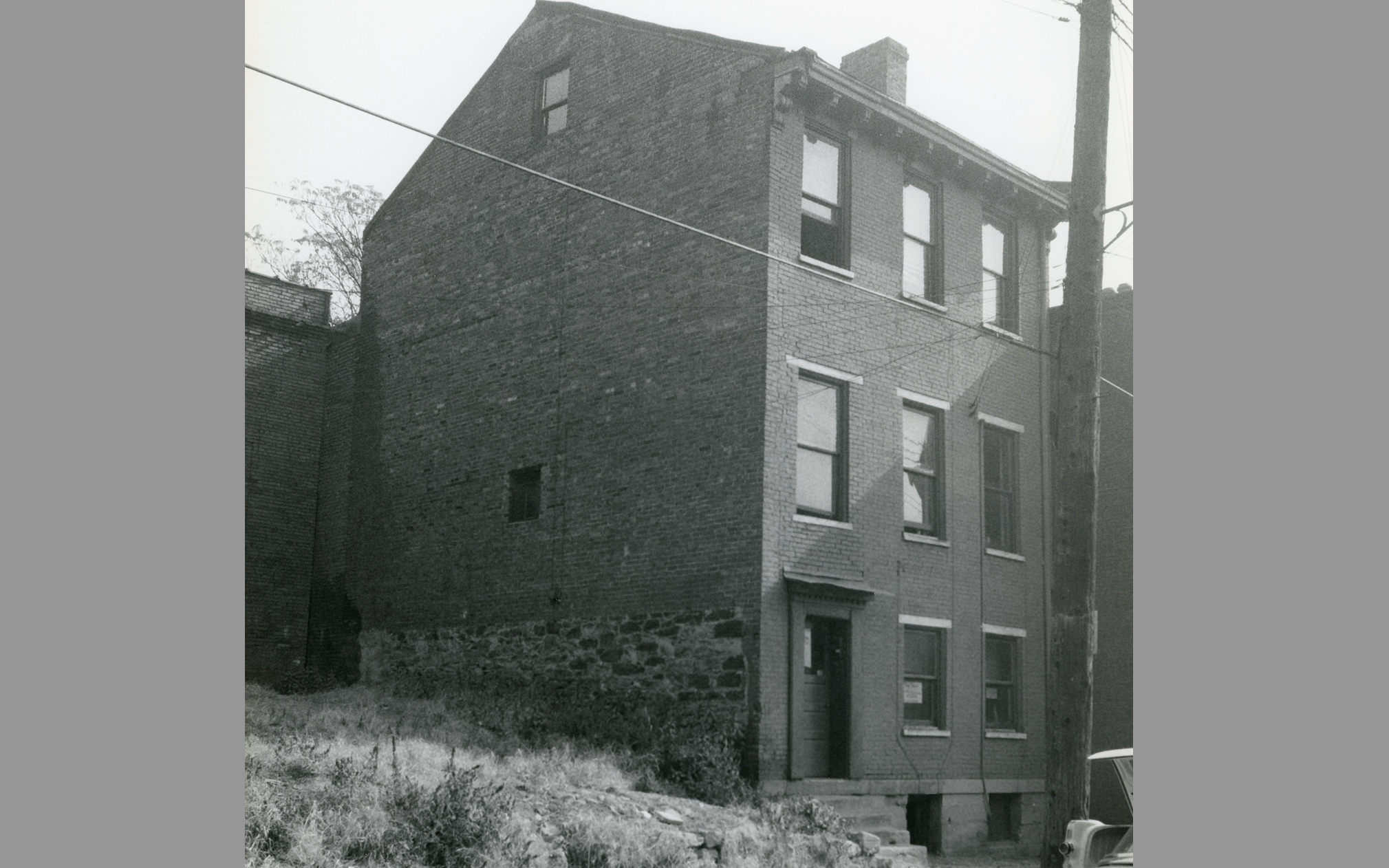
On the afternoon of the last day of Passover 1903, a group met on the second floor of 11 Townsend St. in the Hill District for a prayer service using the Nusach Ari liturgy.
How about that? Are you smiling, too?
I’ve been telling people about this fact since I discovered it, and I have watched many faces slowly expand into delighted smiles. For everyone else, let me explain.
This gathering on Townsend Street was the first Nusach Ari service in Pittsburgh.
What about now? Any smiles?
No?
OK, maybe I need to explain a little more.
Nusach Ari is a liturgy developed by Rabbi Shneur Zalman of Liadi in the early 19th century based on the 16th-century teachings of Rabbi Isaac Luria. Today, Nusach Ari is the standard mode of prayer used by all Chabad congregations throughout the world.
And so the service on Townsend Street marks an arrival of Chabad in our region. Not the global Chabad movement as it looks today, but adherents of its leaders and its teachings.
Smiles? Anyone?
Hmm. Perhaps even more explanation is needed.
See, before this fact emerged, the arrival of Chabad in western Pennsylvania was placed at late 1941. That’s when Rabbi Yosef Yitzchak Schneersohn of New York, now known as the Frierdiker Rebbe, or “Previous Rebbe,” received a letter from Jacob Schiff of Congregation Anshe Lubovitz of Pittsburgh. The Jewish community had stopped investing in the Hill District, leaving dozens of Jewish kids without educational resources.
The Frierdiker Rebbe dispatched Rabbi Mordechai Dov Altein to Pittsburgh on Dec. 7, 1941 “to learn Torah and create activities among the youth.” Rabbi Altein started an afterschool cheder in early 1942. The following year, under the leadership of Rabbi Sholom Posner, this cheder became an all-day school, now known as Yeshiva Schools.
From that nucleus was born Chabad of Western Pennsylvania, which today includes thousands of people and a constellation of synagogues, centers and school buildings.
Within this account is an unanswered question: Why did Schiff write in the first place?
“Anshe Lubovitz” means “people from Lubavitch.” The Russian town of Lubavitch was the seat of the Chabad-Lubavitch Chassidic dynasty from 1813 until 1915. The term “Lubavitcher” is still used today all over the world as a synonym for Chabad Chassidim.
So what was the connection between Anshe Lubovitz Congregation and the Lubavitcher Chassidim? It’s never been clear. A shared name is not necessarily a shared identity. The town of Lubavitch was also home to Jews who were not Chabad Chassidim. Schiff may have simply taken a gamble that a shared homeland would engender some sympathy.
The Jewish Criterion stumbled over this question in September 1942, when it published a short history of Anshe Lubovitz Congregation as part of a longer community history.
Before offering biographical details about the congregation, author Ruth Arnfield wrote an aside, “There is a small town in Russia called Lubovitz, and in that town there is a schul. Its leader at one time was one Rabbi Schneersohn, whose spiritual guidance was such that he came to be known as ‘The Little Rabbi of Lubovitz.’ His fame extended to groups of Jewish orthodoxy beyond his own country and Yeshivas bearing the name of Lubovitz have sprung up in many lands. Today Rabbi Schneersohn is in New York City.”
Arnfield’s larger history contains many transmission errors. These slight discolorations of fact can occur when research over-relies on people without asking for paper to verify. Her description of Lubavitch is correct in some broad strokes but flubs details. One example: She seems to conflate several generations of Lubavitch leadership into a single person.
Based on nothing except a hunch, I suspect Arnfield interviewed the newly arrived Rabbi Altein, who offered a quick survey of Lubavitch history: the town in the Russian Empire, Rabbi Schneersohn, the Tomchei Tmimim network of yeshivas and the recent migration of the dynasty to New York City. In the giving over, perhaps some details got muddied.
Even so, Arnfield’s report is noteworthy. She senses some link between the Pittsburgh congregation and the Chabad Chassidim, but she cannot find a definitive connection.
Were the founders of Anshe Lubovitz merely Jewish immigrants from Lubavitch? Were they Chabad Chassidim? Or, further yet, were they official emissaries of the movement?
Using county records, we know Anshe Lubovitz was incorporated in 1907. This occurred during the tenure of Rabbi Sholom Dovber Schneersohn, known as the Rebbe Rashab.
Although the Rebbe Rashab reckoned with Jewish dispersal, he discouraged American immigration. It is unlikely he would have sent Chassidim to Pittsburgh in the early 1900s.
So was Anshe Lubovitz a congregation of landsmen from Lubavitch, or were they Chabad Chassidim? The answer might come from their prayers. If they used the Nusach Ashkenaz siddur favored by much of Eastern European Jewry, they were likely landsmen. If they used Nusach Ari, they likely held some identity as Chabad Chassidim.
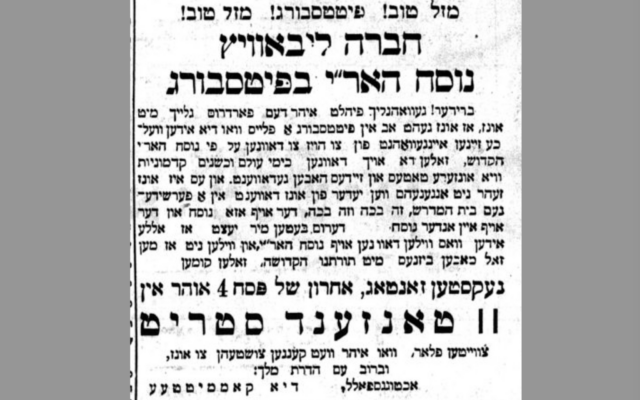
Early records for Anshe Lubovitz are nearly non-existent. No minutes survive, no membership lists, no correspondence. With the discovery of this service notice from 1903 can we begin to make a case that Anshe Lubovitz identified as Chabad Chassidim? If so, the Chabad lineage in western Pennsylvania is 38 years older than previously assumed.
That maybe got a few more smiles, but I think we can do better.
Chassidic history in North America is understudied, especially before the 1920s. Jewish historians have often ignored it, or overlooked it. It is easy to overlook. It requires specialized knowledge and fluency in several languages. Chassidic congregations rarely put “Chassidic” in their name. You have to know the code words, like “Anshe Sfard.”
Chabad history presents an even finer distinction, especially before the movement relocated to America in 1940. “Toldos Chabad B’artzos Habris: 5660-5710” is an official chronicle of the Chabad movement on this continent from 1900-1950. It lists Anshe Lubovitz among 48 Nusach Ari congregations active by the late 1940s, but it does not mention Pittsburgh in its chapter on Chabad in North America before World War I.
A 2005 survey by Ira Robinson only found two Nusach Ari congregations in North America outside New York by 1900 — one in Baltimore and one in Philadelphia. Perhaps there were others, hidden in undiscovered historical records. Congregation Tzemach Tzedek of Cleveland, for example, claims it has operated continuously since 1903.
If the Cleveland group convened anytime after Passover, then our service on Townsend Street just might be the first Nusach Ari service held west of the Allegheny Mountains.
Eh?
OK, OK. Fine. Maybe this isn’t really your thing.
But here’s one last thought.
Does it seem odd to hold an inaugural service on the afternoon of the last day of Passover? Why not the first day? Why not the evening before, or in the morning?
If you visit a Chabad community today on the final afternoon of Passover, you can join the custom of Moshiach’s Seuda — “Messiah’s Meal.” It connects the redemption from Egypt with the ultimate redemption, complete with four cups of wine and three matzos.
I asked resident Chabad historian Dr. Eli Rubin what he made of this Nusach Ari service from 1903. He replied, “They certainly would not have called it Moshiach’s seuda at that point, but it is possible that it was already a Chassidic custom to celebrate the eighth with an extra measure of fervor, and just a few years later, in 1906, the Rashab would turn this into the official custom of Lubavitch, which later became known as Moshiach’s seuda.”
And so it is with some confidence, although not complete certainty, that we can imagine this minyan of Chabad Chassidim, gathering for mincha on the second floor of a building in the Hill District, praying for the coming of the Messiah, speedily in our days. Amen! PJC
Eric Lidji is the director of the Rauh Jewish Archives at the Heinz History Center. He can be reached at rjarchives@heinzhistorycenter.org or 412-454-6406.
comments