
Bethel Park teacher deepens Holocaust education through advanced seminar
“I value my connection to the JFR," she said.
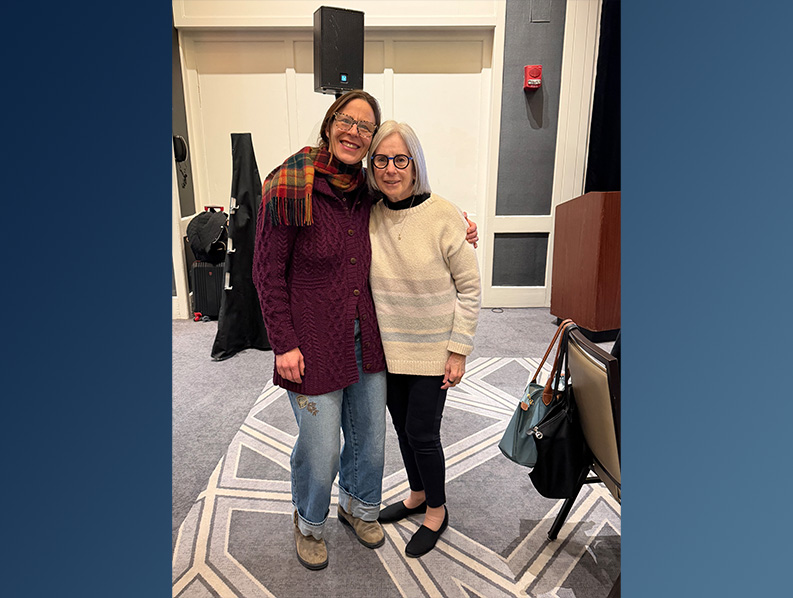
As a non-Jewish educator teaching about the Holocaust, Leigh Ann Totty feels a “big responsibility” to learn from experts in the field as well as survivors.
Totty, a 10th grade English language arts teacher at Bethel Park High School, said her education on the subject began in the early 2000s through the Holocaust Center of Pittsburgh. The organization nominated her to attend the Jewish Foundation for the Righteous’ Summer Institute for Teachers in 2008, and in 2019 she attended a JFR advanced seminar as an Alfred Lerner Fellow.
This year, JFR selected 23 middle and high school educators and Holocaust center staff from eight states to participate in its 2026 advanced seminar, which took place January 17-18 in New Jersey. The seminar is an intensive two-day, graduate-level program focused on strengthening Holocaust education and addressing both historical and contemporary antisemitism.
Speakers at this year’s seminar included Andy Pearce of University College London, Avinoam Patt of New York University, Noah Shenker of Colgate University and Holocaust historian and exhibition curator Paul Salmons.
Participants in the seminar are already well versed in Holocaust history and are given the opportunity to study more focused topics relating to the Holocaust and antisemitism. Special emphasis was placed this year on the opportunities and challenges of artificial intelligence in Holocaust education and research.
Totty said it’s important to think how AI can be used as we move further away in time from the Holocaust.
“We’re thinking about a world without Holocaust survivors in the room or in person and that is creating some challenges,” she said.
One of the sessions, she said, focused on how to get students engaged and see Holocaust education as relevant. Another centered on how to avoid misinformation about the Holocaust coming from AI.
Totty is unique among many who attend JFR’s programs and seminars because she isn’t a history teacher.
“I come to the Holocaust through the English language arts,” she said. “The timelessness that JFR, through all their programs, provides enhanced understanding that was relevant to the texts that I teach and be able to bring that knowledge to the students.”
Totty said the Holocaust lessons she teaches are part of the English course all students are required to take. In addition to classics like Homer’s “The Odyssey” and Williams Shakespeare’s “Macbeth,” students read “Maus” by Art Spiegelman and Elie Wiesel’s “Night.”
The South Hills teacher credits JFR Executive Vice President Stanlee J. Stahl for selecting teachers from across the United States that “value education and want to be lifelong learners.”
“We put ourselves in the mind of being the learner over the weekend, bringing in our experiences to help others, as well as trying to sit in the minds of the students,” she said.
The session taught by Holocaust historian Paul Salmons, in particular, she said, focused on running lessons through the eyes of students.
Other sessions centered on contemporary situations and the challenges of the Holocaust; how the backgrounds of students might make learning about the Holocaust difficult; and how examining what’s currently happening in the United Sates might be relevant to consider when teaching the Holocaust.
“Whether it be immigrant or refugee status, thinking about Holocaust survivors were faced with situations of where to go, what to do, feeling that uncertainty that is present in some of the literature and the experiences survivors have, and how that might connect to students today,” she said.
Totty said the topics presented this year were “relevant and important.”
“I value my connection to the JFR and with Stanlee,” she said.
Totty also is pleased to have the opportunity to speak with other educators teaching about the Holocaust.
“I think one of the values of JFR is having a connection of people that are interested in the subject to help continue to learn,” she said. “We had a chance to hear scholars talk about their ideas and their process of coming to their conclusions, and helping us to be attentive to things like AI or the challenges of living in a world where we won’t have survivors.”
The JFR experience begins though a local network, she said, pointing to Classrooms Without Borders and the Holocaust Center of Pittsburgh.
“I think any connection to the JFR begins with Emily Loeb of the Holocaust Center,” she said.
Her relationships with Loeb and Classrooms Without Borders Executive Director Zipora Gur have been fundamental, she said.
“They have really helped shape the teacher I am and have been great mentors,” Totty said. PJC
David Rullo can be reached at drullo@pittsburghjewishchronicle.org.
comments