
Barry Faigen, who had a love of family, community and helping others, dies at 71
“He had a deep understanding not just of the numbers, but what they stood for, and he used his skills for the betterment of the community."
Growing up, Robert Faigen and his brothers were accustomed to seeing their father, Barry Faigen, perform mitzvot as a way of life — whether it was helping a nonprofit with budgeting or delivering a home-cooked Shabbat meal.
“I once asked him ‘Why do you do this?’ and my father talked about the importance of community,” Robert Faigen, of West Hempstead, New York, recalled. “He taught us that time is the most valuable thing we have and the most valuable thing we can give others.”
Barry Faigen’s life of service is being remembered by family and countless friends and acquaintances as they mourn his death on Dec. 3, following a two-year battle with cancer.
He was 71 and lived in Squirrel Hill.
“Barry had a deep love for the Jewish people and the Pittsburgh community,” said Rabbi Chezky Rosenfeld, who spoke at Faigen’s funeral. “When something needed to be done, he would step up. You didn’t even have to ask.”
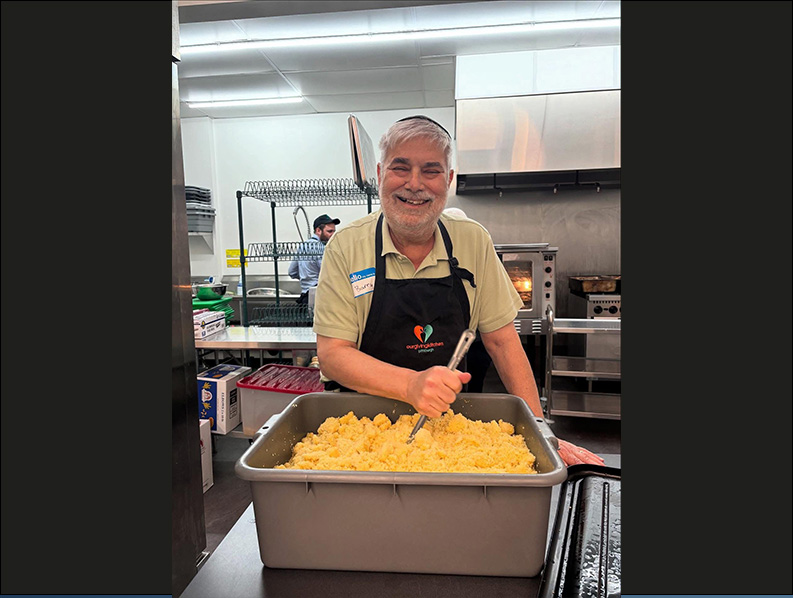
The two men became close friends through Our Giving Kitchen, a nonprofit food distribution center Rosenfeld founded four years ago in Squirrel Hill.
“Barry believed in our mission and from day one supported us in everything we did,” Rosenfeld said. “He’d roll up his sleeves and throw himself into whatever needed to be done — whether it was making meatballs or doing dishes.”
Barry also was hands-on with the business side of things, Rosenfeld recalled. “We would have hard conversations about what was working or not. He wasn’t a ‘yes man.’ He’d lean into things and call out what he didn’t like. It came from a place of deep caring.”
Robert Faigen described his father as warm, genuine, and a straight shooter: “He’d tell you what was for your own good even if you didn’t want to hear it because he genuinely cared. Everything he did, he did from the heart, not for recognition or glory.”
Barry grew up in Greenfield and had his bar mitzvah at B’nai Emunoh. When it closed, he joined Poale Zedeck. He attended public schools and graduated from Penn State University as a CPA with a degree in accounting and finance — and a girlfriend, Debra Susan Eisman, a fellow Pittsburgher, whom he married in 1980.
During his 30-year career, Barry worked as a chief financial officer for various companies, Robert Faigen said, and, after retiring, volunteered his expertise with Yeshiva Schools, Community Day School, Jewish Federation of Greater Pittsburgh, Chabad, and other nonprofits.
Jeffrey Finkelstein, president and CEO of the Jewish Federation of Greater Pittsburgh, remembers Faigen as an original, hardworking member of the organization’s audit committee.
“He read everything ahead of time and came in with questions,” Finkelstein said. “And it came from a place of love.”
“He had a deep understanding not just of the numbers, but what they stood for, and he used his skills for the betterment of the community. He was deeply Orthodox, but he cared deeply about everyone in the Jewish community,” Finkelstein added.
Barry was president of Hillel Academy twice.
All three sons, including Robert’s twin Seth, and Matt, were educated at Hillel.
“He didn’t care about fancy cars or clothes,” said Robert Faigen. “They weren’t a priority for him. He cared about Jewish education. That’s where the money went. Even after we graduated, he continued to give.”
His children’s enrollment in Hillel also marked a deepening of Barry’s own immersion in Jewish studies, Robert Faigen said. “He was continuously educating himself, studying Torah on a daily basis. He finished the Talmud twice.”
Debby Eisner, a retired audiologist, was also engaged in community service. She was named one of the Pittsburgh Jewish Chronicle’s 2025 Volunteers of the Year.
“My mom and dad were a team,” said Robert Faigen. “They were always doing nice things, even for strangers. My mom ran bingo at the Jewish Home (for the Aged) until it closed. She was always cooking meals for people who were sick.”
Yet none of the outreach they performed took away from their parenting, Robert Faigen said, noting that his father shared his passion for golf with him and his brothers, and never missed their JCC basketball games, not only showing up, but acting fully engaged.
“Every time I’d glance at him, he’d give me a nod,” he said.
Barry was equally involved with his 12 grandchildren, ages 3 to 16, using FaceTime between in-person visits to stay in touch.
“He was the most involved grandfather,” said Robert Faigen. “If one of our kids made an art project, he’d say ‘Let me see it’ on FaceTime. He’d want to know how a test went. He’d want to know the options for summer camp.”
“He got to know the rabbi in my shul,and would give him a big hug every time he visited.”
Barry’s warmth included strangers as well as people in his vast circle of friends, some of whom had joined him in weekly $1 poker games for 40 years.
Barry modeled the importance of gratitude, Robert Faigen said, noting that he often would approach people in uniform, whether military or law enforcement, to thank them for their service.
He made everyone in his orbit feel valued, Robert Faigen noted, as he described a visit the family had at the hospital near the end of his father’s life.
“We had closed the door to visitors that last day when one of the nurses knocked and said someone named Darrell was coming to see us. It turned out that Darrell is the custodian at Poale Zedeck. He told us that my father would say hello to him every morning and ask how he was doing … how my father gave him time and got to know him.” PJC
Deborah Weisberg is a freelance writer living in Pittsburgh.
comments