
Antisemitism in schools takes center stage at Pennsylvania Senate hearing
“There should never be hate in any school system and we need to nip it in the bud.”
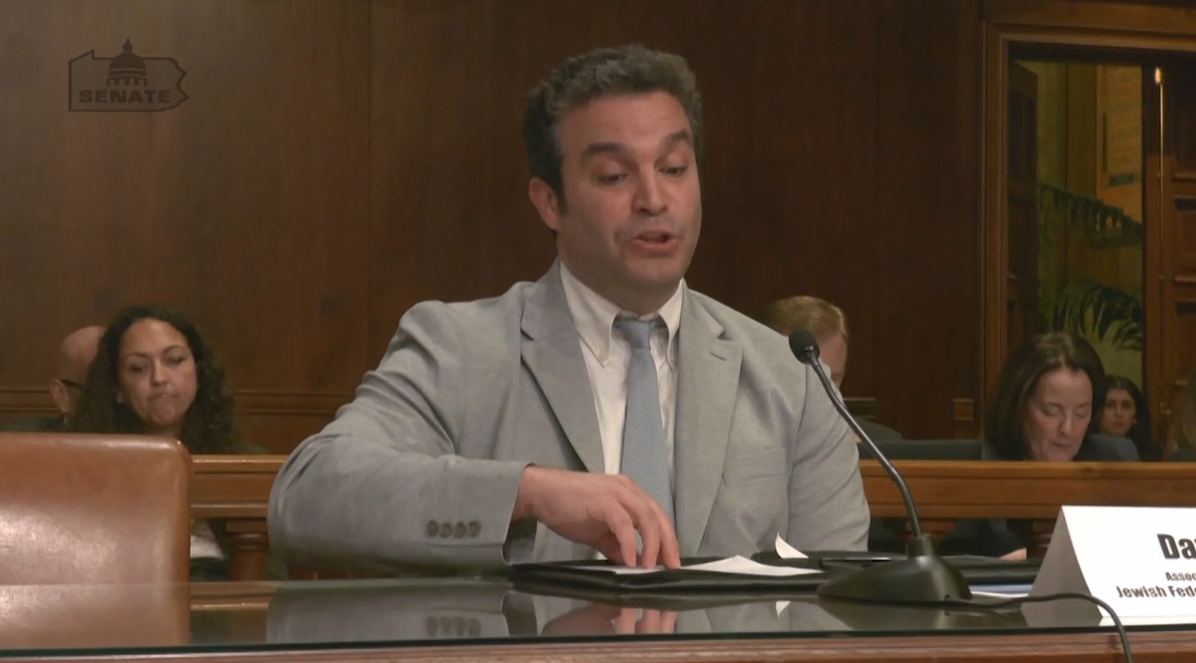
Speaking at a Sept. 30 public hearing on antisemitism in Harrisburg, David Knoll called on Pennsylvania lawmakers to consider the challenges confronting Jewish communities. The hearing was held by the Senate Majority Policy Committee.
Knoll, the Jewish Federation of Greater Pittsburgh’s assistant vice president of public affairs, spoke on the first of two panels testifying at the hearing, along with Andrew Goretsky, senior regional director of the Anti-Defamation League in Philadelphia, and Jason Holtzman, chief of the Jewish Federation of Greater Philadelphia’s Jewish Community Relations Council.
A second panel included Andrea Martin, commissioner of the Pennsylvania Human Relations Commission, Naomi Rogdriguez, a parent educator and researcher, and Julie Webb, an educator and parent.
Knoll was the only Pittsburgh representative at the hearing, which focused on antisemitism directed at students in K-12 and on college campuses.
Sen. David Argall, chair of the Majority Policy Committee, opened the hearing by acknowledging that “antisemitic incidents are growing at unprecedented levels.”
“According to the ADL’s 2025 audit of antisemitic incidents,” Argall said, “Pennsylvania recorded 281, the fifth highest number in the nation.”
That number, he noted, reflects Pennsylvanians who have been threatened, intimidated or harmed because they are Jewish.
Schools, he said, have become “flashpoints for antisemitism.”
“The 2026 antisemitism campus report card informs us that half of our non-Jewish students have reported witnessing or experiencing antisemitic behavior over the last year,” Argall said.
The senator went on to list incidents at the University of Pennsylvania, the University of Pittsburgh and Penn State University, as well as in K-12 schools in Philadelphia.
The purpose of the hearing, he said, was “to listen, to learn, to hear from the experts, to hear from the local Jewish Federations, from educators, from parents.”
Knoll was in Harrisburg for both the hearing and Federation’s Community Relations Council’s Interfaith Harrisburg Day of Advocacy.
He began his testimony by recalling many of the antisemitic incidents that have occurred on Pittsburgh college campuses since Oct. 7, 2023, and the effects they’ve had on students.
“Many have reported feeling pressure to hide their Jewish identity, stay silent about their beliefs or think twice about participating fully in campus life,” Knoll said.
And Pittsburgh’s CRC, he noted, is increasingly responding to incidents in middle schools and high schools.
“Just this past week we responded to reports of a high school teacher teaching his students that Hamas is not a terrorist organization and that Israel has no right to exist,” Knoll said. “Again, this week, we responded to a case in which a student was called a ‘dirty Jew’ and had pennies thrown at them, and another where a student was called ‘racist’ and a ‘genocider’ simply for being Jewish. There was one more where a Jewish child was blamed for genocide and had his face superimposed on the body of a concentration camp prisoner.”
The ADL’s Goretsky related an incident from 2005 when he was working in the education field.
Goretsky recalled attending a training session where a presenter equated Zionism with racism, sexism and other -isms.
“I asked him to explain what Zionism actually meant,” Goretsky said. “The presenter did not know.”
The presenter later apologized, but Goretsky said he has often thought about that incident and wondered how many educators walked away from it and similar training believing Zionism is a slur.
The ADL regional director said his organization recorded 6,274 antisemitic incidents last year and that schools were a hot point for hate.
Some of the antisemitic episodes he highlighted included:
• Graffiti in a high school bathroom reading “Jews need to f–king die”;
• A text message a student received calling them a “dirty Jew” and threatening them with rape;
• A person standing outside a Jewish school shouting “F–k the Jews” and “Jew is the worst religion”;
• A student who was pushed and told, “You sit in the front. Kikes like you can’t sit in the back”; and
• A student who had their Star of David ripped from their neck during a football game while an attacker yelled, “I hate
Jews” and called the student a kike.
“Antisemitism does not only spread through swastikas and slurs,” Goretsky said. “It spreads through curriculum nobody vetted, through professional development nobody fact-checked and through the casual repetition of worlds like ‘Zionist’ as an insult by young people who have simply never been taught otherwise.”
The Jewish Federation of Philadelphia’s Holtzman said he has received reports for the last three years of educators bringing “inflammatory” materials into their classrooms.
And while he said it was not antisemitic to criticize Israel or its government, or to advocate for Palestinian rights, the use of violent statements should be taken seriously and condemned. And, he noted, Jewish Americans shouldn’t be forced to answer for the “alleged decisions or actions of the Israeli government.”
Holtzman also called for a clear and consistent definition of antisemitism that can provide institutions with a common framework to evaluate incidents while preserving the ability to consider context and the facts of each case.
In an interview with the Chronicle, Argall said he decided to host the hearing after learning from constituents about the rise in hate crimes against the Jewish community.
“We’ve heard from teachers, we’ve heard from students, we’ve heard from parents, so I thought the best way to move forward was to shine some light on the issue,” he said.
The senator said he had believed progress was being made in the fight against antisemitism and was disheartened to hear stories showing that, instead, it is getting worse.
Argall said that next steps will include reviewing the testimony and determining if there are regulations in place that can be tightened or legislation that should be considered for the next session.
Knoll said the hearing was important because “we’re seeing an explosion of hate against our kids.”
He spoke with senators after the hearing, he said, who were motivated to help fight the hate directed at Jewish students.
“This isn’t a Republican issue. It isn’t a Democrat issue. This is a Pennsylvania issue. How do we curb antisemitism in our schools?” Knoll said. “There should never be hate in any school system and we need to nip it in the bud.”
PJC
David Rullo can be reached at drullo@pittsburghjewishchronicle.org
comments