
Anemic Maccabi Games protest fails to score
"It was nothing more than a brief and irrelevant footnote in what has already proven to be a joyful and powerful expression of Jewish pride."
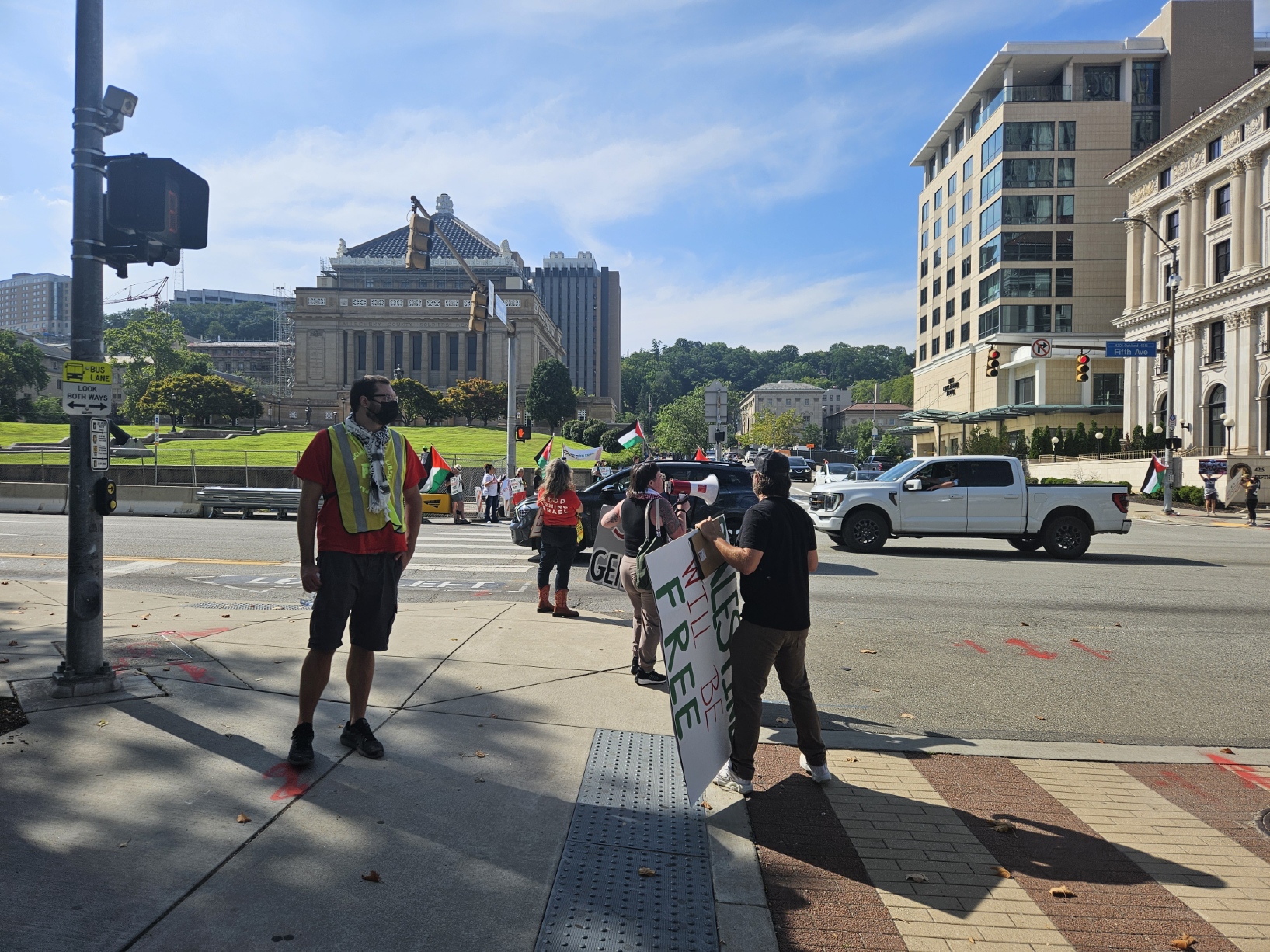
The planned protest of a sports event for Jewish children yielded a meek turnout of anti-Israel activists and little interest from passersby.
Fewer than two dozen people initially gathered Monday on the corners of Bigelow and Fifth avenues to protest the start of the JCC Maccabi Campus Games held, in part, on the University of Pittsburgh’s campus.
A small assembly of mostly young adults, mixed with a spattering of senior citizens, some wearing T-shirts with slogans supporting the Palestinian cause, carried homemade as well as professionally printed signs, along with Palestinian flags and banners sporting slogans such as “Shame.” A few of the participants wore safety vests and masks — like those worn during the pandemic — beneath the late day sun.
By 5 p.m. the protestors swelled from the roughly two dozen that arrived at 4 p.m. to nearly 40. The anti-Israel extremists gathered in small groups on each of the four corners of the two roads in the city’s Oakland neighborhood, banging a few pans with wooden spoons, shouting pro-Palestinian, and at times, antisemitic chants, and walking in an unorganized manner from one corner to another.
Organizers screamed from a megaphone — seeming to take particular interest in shouting in the direction of Maccabi Games attendees — the same chants heard at numerous rallies since Hamas’ Oct. 7, 2023, attack on mostly unarmed, Israeli civilians, including “From the river to the sea, Palestine will be free,” and “Free, free Palestine.”
Hoping to gain sympathy from the situation in Gaza — including the dissemination of debunked images of a Palestinian boy who The New York Times claimed was a victim of starvation but had an ongoing medical condition — protestors also shouted slogans such as “Stop starving Gaza” and “Let Gaza live.”
An occasional horn honked in support of the protest, but most people, traveling during rush hour, silently made their way along the neighborhood’s busy thoroughfare. Even those attending the Maccabi Games, who walked through the protest on their way to the opening ceremony, seemed unconcerned by the demonstration. One father was heard telling his children, “Oh look, how cute. Take a photo kids.”
Disparate groups of protesters attempted to promote their own causes — a few Jewish Voice for Peace activists wore shirts with various anti-Israel slogans, and a representative from UE Local 667, the union representing workers from the East End Food Co-op, attempted to gather signatures for a petition that’s been circulating for nearly a year; the union has thus far been unable gather the requisite number of signatures to force the grocery store’s board to consider an initiative to boycott Israeli products. By 5 p.m. his petition sheet appeared to remain mostly empty.
The lack of on-site support from Pittsburgh’s progressive community may have been a disappointment to organizers, who heavily promoted the protests on social media, including Pitt Apartheid Divest, Students for Justice in Palestine, BDS Pittsburgh, Party for Socialism and Liberalism, Pittsburgh Palestinian Coalition and Jewish Voice for Peace.
A day before the event, JVP published a screed on Instagram claiming the Maccabi Games’ “underlying purpose is to promote Jewish teens’ connections to and uncritical support of the state of Israel.”
It targeted shlichim, young Israeli emissaries temporarily in Pittsburgh, because of the work they do in the community, JVP’s support of the protests and promotion of anti-Israeli and Jewish sentiment appears to violate its own directive. The group’s webpage claims that, “Attacking Jewish individuals or communal spaces for being Jewish or blaming the Jewish people for the actions of the Israeli government, is antisemitic and unacceptable and flatly contrary to the values of our movement. Our movement for justice in Palestine stands firm as an anti-racist movement, which of course includes opposing all acts of antisemitism.”
Established in 1982, the Maccabi Games is the largest Jewish youth event in the world, engaging nearly 2,000 teens and thousands of families. Its website lists its aims as:
• Providing a supportive environment fostering respect, sportsmanship and fun
• Instilling Jewish values and cultural pride
• Promoting health and fitness through sports
• Teaching teamwork, integrity and community service
No political message or statement of support of any Israeli political party is noted on the website.
Jason Kunzman, president and CEO of the Jewish Community Center of Greater Pittsburgh, the Games’ host, told WESA, that about 70% of those who participate in the Maccabi Games do not engage in any other form of Jewish activity throughout the rest of the year.
“The Maccabi Games are an important on-ramp for Jewish engagement for this age cohort,” he said.
Shawn Brokos, Jewish Federation of Greater Pittsburgh community security director, said the Federation was aware of the protests in advance and that there was a large law enforcement contingent in place.
“We’re grateful for that,” she said.
The Games’ guests and athletes had been briefed on the possibility of protests.
“We’ve been monitoring intelligence for a while, expecting that we would see at least one protest,” Brokos said.
Laura Cherner, Federation’s community relations council director, said it was an honor to host the Games and that Monday’s opening ceremony “set an uplifting and energizing tone for the week ahead.”
“While there was a small protest, it was nothing more than a brief and irrelevant footnote in what has already proven to be a joyful and powerful expression of Jewish pride and peoplehood,” Cherner said. “The best way the community can continue to support the teens participating in the games is to cheer them on at their events.”
The Maccabi Games continue through Aug. 8. PJC
David Rullo can be reached at drullo@pittsburghjewishchronicle.org.
comments