
A trip to Jewish Amsterdam
What I’d been looking for the entire time, I realized, was living Judaism, and we found it nearby at the Portuguese Synagogue, or Esnoga.

Jewish Amsterdam is a difficult place to visit. On the one hand, millions of people visit the Anne Frank House and the Jewish Quarter every year, as they should. On the other, you can’t ignore the fact that the tireless work of the organizations overseeing these and other monuments and museums commemorating the history of Dutch Jews are only necessary because 75% of Dutch Jews were murdered in the Shoah. You cannot accept the beauty and meaning of Jewish Amsterdam without also acknowledging the huge emptiness at its center.
Rembrandt’s sympathies
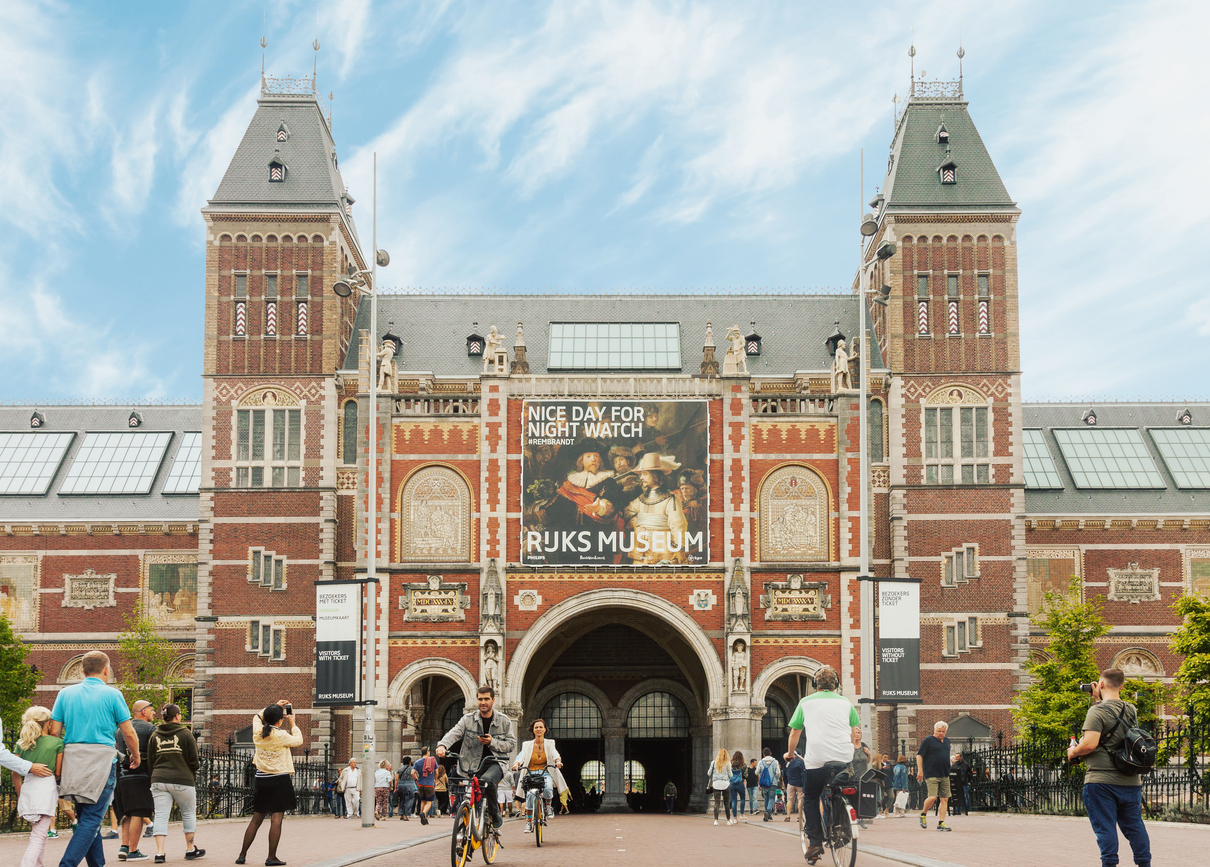
When I found Rembrandt’s “Jewish Bride” of 1669 in the Rijksmuseum, I was there with a dozen others trying to take a look and with many dozens more on their way. Also known as “Isaac and Rebecca,” the painting shows the moment in Genesis 26:8 when the Philistine King Abimelech, just told that the pair were brother and sister, sees definitive evidence that they are actually husband and wife. Before I was pushed along, I was at least able to lean in quickly and take in Isaac’s sleeve, a huge sweep of gold painted in incredibly heavy impasto. From only a foot away, the illusion is so real you can almost hear the fabric move.
Thankfully, the Rembrandt House Museum allowed for more quiet. Much less crowded, the museum occupies the very house where Rembrandt lived from 1639 to 1658. Many of his neighbors were Sephardic Jews, and you can tell that Rembrandt had a real connection with them. In his art, he couldn’t get away from the scene in Genesis 40 where the imprisoned Joseph interprets the dreams of the cupbearer and the baker, which inspired nearly a dozen paintings and etchings. There were also etchings of Abraham casting out Hagar and Ishmael, Abraham with Isaac on his lap, and, most movingly, the 1648 etching “Jews in the Synagogue.”
Get The Jewish Chronicle Weekly Edition by email and never miss our top stories Free Sign Up
The Shoah
The Anne Frank House was, as it should be, a study in contrasts. The 17th-century Westerkerk is only a few hundred feet away and its tolling bell could be heard from inside the Annex itself, and just outside were canal boat tours and side streets filled with restaurants and shops. It would make no sense to sequester what happened to Anne Frank and so many others from the religious, commercial and everyday life of Amsterdam. This bustle and mixture (after all, we took one of the boat tours ourselves) felt emblematic of every place that Jews have been forced by circumstance to settle in to survive and succeed — or, in this case, hide to save our lives.
But the Anne Frank House was just as crowded as the Rijksmuseum. The number of people in each room of the annex almost always outnumbered the Jews who had hid there, and I at least wanted to apologize for making more noise than they were ever allowed. The few rooms are bare of daylight and furniture, and much of what survived from Anne’s time (the bookcase hiding the annex entrance, walls of postcards and magazine clippings) were behind glass; most vividly, though, the original sink and countertop in the kitchen were not behind glass. I stared a long time at both, and it was hard to move on from them.
If all that most non-Jews know about the Shoah is a place like this, it is about as good as we can expect, but I would have much rather seen an aging Anne in a documentary, running her hands across that countertop and remembering how she survived the war. But as my wife said as we left, the people of the Netherlands and Amsterdam failed her. An old and cherished nickname for the city, Mokum, comes from the Yiddish word Makom, “place” or, more specifically and spiritually, “place of refuge,” also an epithet for God. Seeing this word all over the city — on postcards, the sides of buildings, on signs and T-shirts and magnets — was a painful reminder that Amsterdam was indeed a place of refuge for Jews — until it wasn’t. As later testimony put it about wartime Amsterdam: “The main support of the German forces in the police sector and beyond was the Dutch police. Without it, not 10% of the German occupation tasks would have been fulfilled.”
We also saw two other sites related to the Shoah. The first was the National Holocaust Names Memorial, a labyrinth of walls where each brick is inscribed with the name and age for each of the more than 100,000 Jews of the Netherlands murdered during the Shoah. Since I turned 47 on the day we arrived in Amsterdam, my eye was particularly drawn to those who were killed at that age — Markus Solmanovits, Isaac Snuijf, Sara Smalhout-Blok, Sara de Rood-Kan were only 4.
The second was the Hollandsche Schouwburg, the site of a theater that became, in 1942, a place where thousands of Jews were rounded up and imprisoned before being deported to concentration and extermination camps. Compared to the Anne Frank House, the number of visitors at both sites were miniscule, and a remark from Primo Levi kept coming to mind: “A single Anne Frank excites more emotion than the myriads who suffered as she did but whose image has remained in the shadows. Perhaps it is necessary that it can be so. If we had to and were able to suffer the sufferings of everyone, we could not live.”
The problem with museums
I thought that Amsterdam’s Jewish Museum would be a balm of some kind, but it was just as devastating in its own way. While it was a powerful experience to see so many Kiddush cups, Torah scrolls, groggers, mezuzot, tallits, candelabras, challah covers, etrog holders, omer-counting calendars, siddurim, and so much else — while it was powerful because these objects are so immensely familiar and beautiful, and were so obviously lovingly used — I would have preferred to have never seen them if it meant that three-quarters of the Jews of Amsterdam were not murdered in the Shoah. I would have preferred that four Ashkenazi synagogues — the Grosse Shul/Great Synagogue of 1671, the Neie Shul/New Synagogue of 1752, the Obbene Shul/Upper Synagogue of 1686 and the Dritt Shul/Third Synagogue of 1700 — still be welcoming Jews to Shabbat services, rather than be turned into even the most beautiful museum of Jewish daily and ritual life in Amsterdam.
What I’d been looking for the entire time, I realized, was living Judaism, and we found it nearby at the Portuguese Synagogue, or Esnoga. When the Sephardic Jews of Spain were expelled in 1492, many of them fled west to Portugal only to face horrendous persecution there as well. When large numbers of them finally escaped Portugal for Amsterdam in early 1600s, they had already lived for generations as forced converts who continued to practice Judaism in secret.
Now able to live openly as Jews, the Kahal Kados Talmud Tora was founded by this community in 1639, and the Esnoga was completed in 5435/1675. Modeled on Solomon’s Temple, it is lit entirely by candles, and a dusting of sand (to absorb dirt and muffle the noise of footsteps) is scattered across the floor. Sitting on one of its benches and staring out toward the ark, I took out my phone to see how just old the benches were.
And there was the shock of life that I was looking for because, like the timber roof, I read that the benches are the originals. I began to move to different seats and ask at each one how much warmth from how many bodies had sat where I was, since 1675? How much suffering had been answered with the statement which the building of this synagogue proclaimed, proudly and unapologetically Jewish? How much solace and happiness had the place housed — and continues to, with its membership today still more than 600?
I leaned over and told my daughter, “Don’t ever forget that you came to this place.” And I should have added: “Do everything you can to keep your Bible and your siddur, your mezuzot and your kiddush cup and your Haggadah — do everything you can to keep these things from becoming pieces in a museum.” PJC
Tim Miller is a poet and writer living in Pittsburgh. He is online at wordandsilence.com.
comments