
Unification of Rodef Shalom and Temple Sinai brings mightier religious school
'The question is, how can we craft a program that's meaningful, that's interesting, that's tempting, that's exciting'
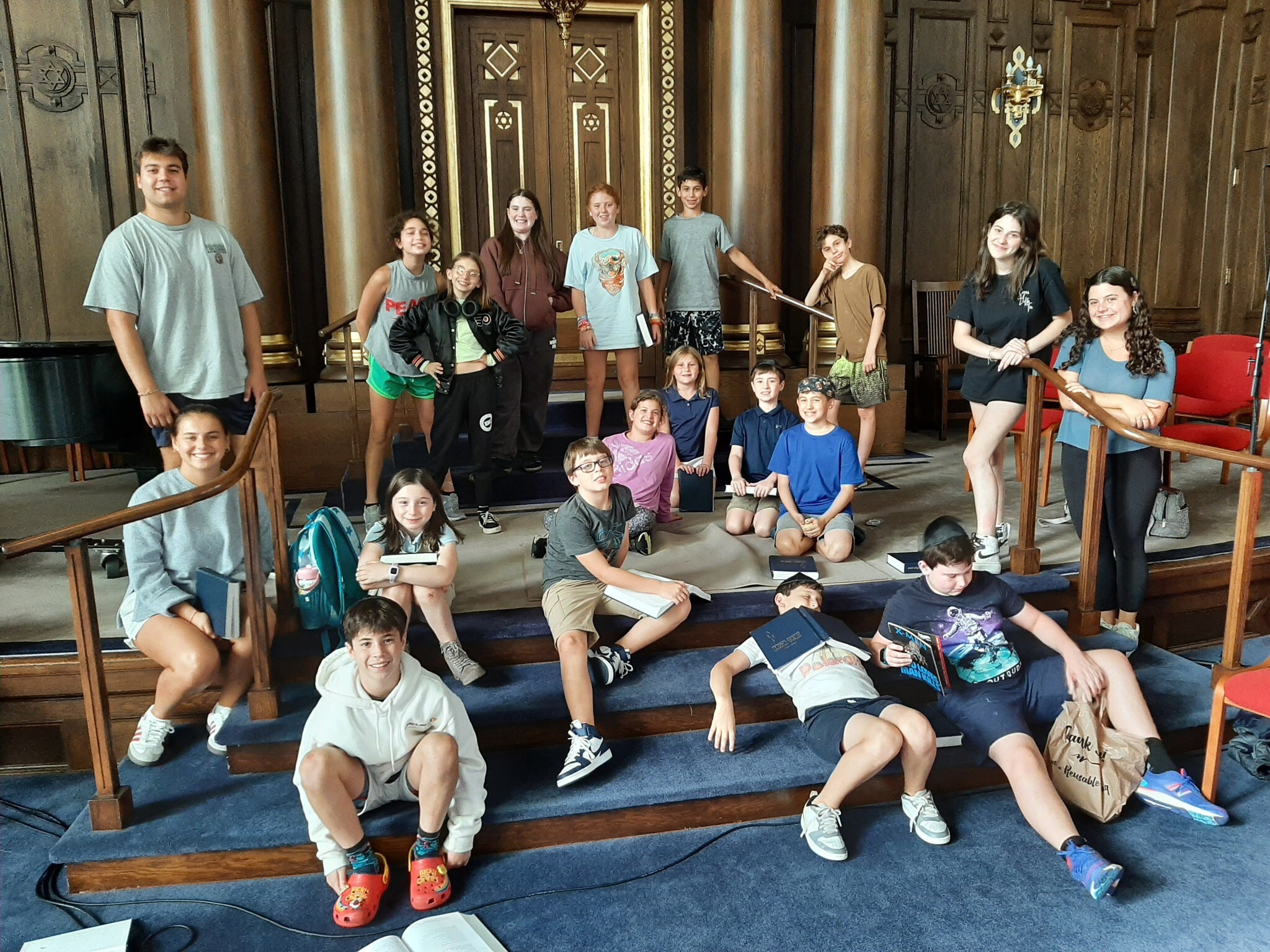
As Rodef Shalom Congregation and Temple Sinai work toward a shared future, their religious schools are following suit. Starting this fall, J-JEP and NextDOR will collectively operate as the “Unified Religious School.”
“It’s pronounced, ‘Yours.’ Get it? Yours,” Rabbi Larry Freedman said. “That’s our working title. It needs some work.”
Like its title, the educational institution is undergoing development.
According to Freedman, URS’ director, the school is creating a model infused with its predecessors’ strengths.
Before Rodef Shalom and Temple Sinai’s unification, each congregation maintained a religious school. Rodef Shalom, along with Congregation Beth Shalom, operated J-JEP, a religious school serving students from both congregations. Temple Sinai operated NextDOR.
“J-JEP had a very strong lower grade program — lots of topics, lots of activities — but no high school program,” Freedman said.
NextDOR, he continued, offered a meaningful program for teens.
Along with welcoming students from both J-JEP and NextDOR, URS is “taking the best of both curricula,” Temple Sinai’s Rabbi Daniel Fellman said.
Going through changes
Fellman, Freedman and other colleagues have partnered on the educational enterprise for months. Some details — like the school’s name — remain uncertain; others are concrete.
For starters, URS will continue J-JEP’s tradition of serving bagels, juice and coffee from 8:15 to 9:45 a.m. Sunday mornings.
Classes, which begin on Sept. 7, are open to students from across the community and will occur on Sundays and Wednesdays through April 26, are listed online. Highlights include a family Hebrew program from 8:30 to 9:30 a.m. on Sundays enabling parents (or other adults) to join students in the learning process.
On Wednesday evenings from 5:30 to 7:30 p.m., teens can enjoy a new experience, Fellman explained.
“It is loosely based on the high school program that Sinai had been operating, but only loosely,” he said.
Students will be served a kosher dinner before breaking into two one-hour classes: The first slot will be determined by grade level, the second by electives.
Educators hope a slate of offerings and opportunities will capture teens’ attention.
“The question is, how can we craft a program that’s meaningful, that’s interesting, that’s tempting, that’s exciting?” Fellman said.
One pathway is through intellectualism, educators told the Chronicle.
During their teenage years, students are at a “time when they finally can handle mature, sophisticated, nuanced learning that they can manipulate for themselves,” Freedman said. This is the stage of life where they start to “figure out the type of adult, the type of Jew, they want to be.”
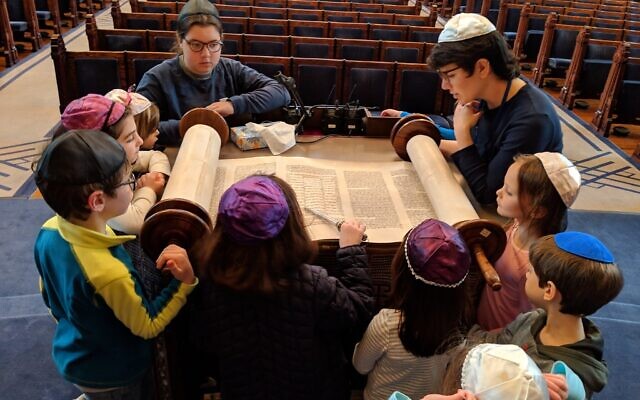
Rabbi Mark Asher Goodman, a former J-JEP teacher who is continuing on to URS, said high school years are “when you start to intellectually understand Judaism at a higher level.”
Whether it’s exploring rabbinic writings or explicating biblical verses, the learning one completes as a teen can prompt “those bigger, kind of moral, questions: Why be Jewish? What does it mean to be Jewish? What does it mean to be a good person?” he said. “Those are really important questions and things that happen developmentally for 16 and 17-year-olds in a big way.”
Tackling complex issues must happen within a short timeframe, as URS’ high school program only runs for a few hours each week.
The schedule is consistent with comparable institutions nationwide.
Within religious schools, contact hours — whether in a classroom, private tutoring or online — range between 0.5 and 6 hours per week, according to a report from George Washington University’s Graduate School of Education and Human Development and the Consortium for Applied Studies in Jewish Education.
Let it grow
With classes beginning next week, URS is expecting to welcome upward of 220 students, with about 140 coming from J-JEP and another 85 from NextDOR.
Freedman, Fellman and colleagues are enthused about the number of enrollees and hope to see the school grow.
Population data suggest the rabbis’ aspirations are within reach.
At the time of the 2017 Greater Pittsburgh Jewish Community Study, 6,400 of the 8,400 children living in Greater Pittsburgh Jewish households were being raised Jewish. Among Jewish children in grades K-12, 45% were enrolled in Jewish part-time school, day school or a Jewish tutoring program; 28% of preschool-aged Jewish children were enrolled in a Jewish preschool.
Denominational differences or congregational nuances are not an impediment to URS’ success, educators said.
While catering to students from both Reform (Rodef Shalom) and Conservative (Beth Shalom) congregations, J-JEP strove to “engage kids on different levels,” Freedman said. “We brought in some rabbinics — which most Reform religious schools don’t have. We did some stories [involving Rabbi] Akiva, we did a little on how halacha works, we did a little bit of Rashi.”
Moving forward, bolstering students from different congregational or religious backgrounds will remain the goal, he added.
Fellman agreed and pointed to language as a unifier.
“Hebrew is Hebrew,” he said. “There’s no such thing as Reform Hebrew or Conservative Hebrew or Orthodox Hebrew.”
Just as Hebrew can coalesce young students, learning about prayer, the holidays or Jewish practices can demonstrate “something we share,” he said.
Among both educators and practitioners, the purpose of Jewish education or even Judaism itself is too often lost, Freedman explained.
“The bottom line of Judaism — the point of the Torah — is to make the world a better place and make yourself a better person. That’s it in a nutshell, and we do that through mitzvot. The ideological issues of who gave the mitzvot and why do we have to do them is a conversation that the rabbis like, and that some of the parents like; the kids don’t care,” Freedman said. “Torah is our received tradition. We can talk about how it got there another day, but it’s our received tradition. Every Jewish child owns it, and every Jewish child is going to learn what we are called to do through it. And that doesn’t matter what your movement is.”
Ultimately, URS is a new school with a very old goal, he continued. “What we’re really trying to do is teach the kids the meaning — and uplift the spirituality — and the value of living a Jewish life.” PJC
Adam Reinherz can be reached at areinherz@pittsburghjewishchronicle.org.
comments