
The season of our rejoicing
The Water Drawing Ceremony and more
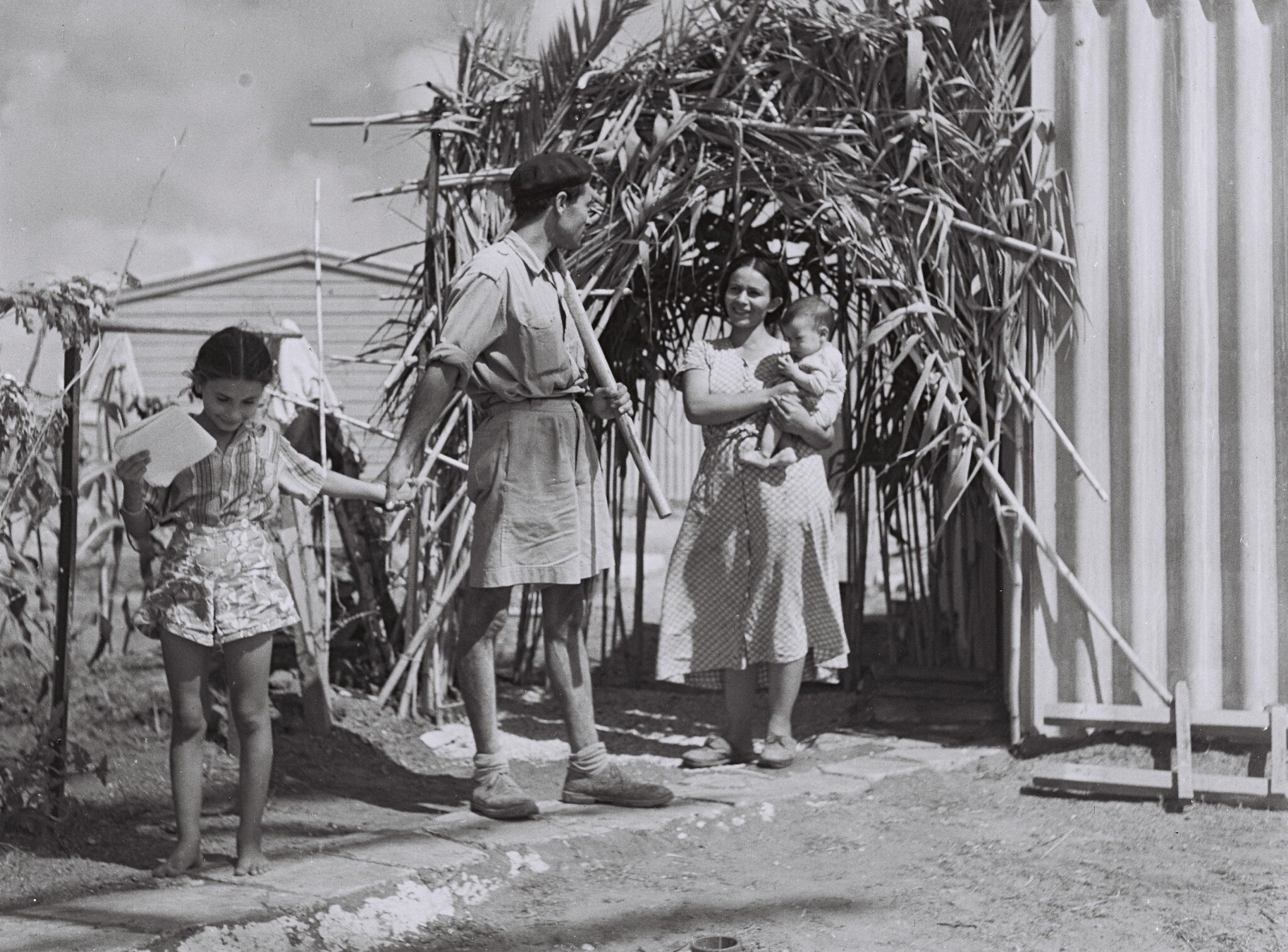
“Ready-made”
Sukkot is the only Jewish holiday that could conceivably be sponsored by Home Depot — or better, yet, Ikea. The requirement for a “frail, temporary structure” was ideal in the wilderness, and for different reasons has remained so, whether in the suburbs or the big city.
In the late 1950s, Zeiger and Farkas Corporation, on Marcy Avenue in Brooklyn, offered itself as the one-stop shop for “A New Model of Ready-Made Tabernacles.” “Water- and fireproof,” the ad promised. “Can be erected in 15 minutes. You can put the whole tabernacle together yourself — ready-made. Tools are not needed; hammer, nails, or screws are not needed.” As if to call each of these guarantees into doubt, however, the ad concludes with trepidation: “If you have complained about our last year’s tabernacles, we are ready to help you.”
A shared pilgrimage
Traveling to the Holy Land in the Middle Ages, Jews from Germany and Spain were astonished to come upon local Jews and Muslims pilgrimaging together to the grave of the prophet Ezekiel. Muslims often paid their respects at Jewish holy sites on their way to make Hajj, but the period from Rosh Hashanah through Sukkot was also a popular time.
Get The Jewish Chronicle Weekly Edition by email and never miss our top stories Free Sign Up
At Ezekiel’s grave, Jewish leaders from the academies in Baghdad made an appearance, and Arab merchants set up shops. “On the holiday of Sukkot,” writes one traveler, “people come there from all lands … about sixty or eighty thousand Jews, in addition to Muslims.” Sukkahs were erected around the prophet’s tomb, and vows and donations were made.
The Water Drawing Ceremony
As one of the three pilgrimage festivals mentioned in the Torah, Sukkot sometimes received the highest honor of all and was referred to simply as he-Chag, “the Festival,” and it is the only one where we are commanded to be joyful. Its outsized importance has not lasted, however, for while all three pilgrimage festivals were associated with the agricultural year, Pesach and Shavuot have both taken on meaning beyond the growing earth — Pesach with the Exodus, and Shavuot with the giving of the Torah. Sukkot, by and large, never went beyond its agricultural roots, and it remains difficult for anyone in a modern society to understand a religious festival that was primarily an act of relief and thanks for the securing of food for the coming year.
It is worth focusing, then, on one way that the ancient Israelites celebrated Sukkot after all the pilgrims from the surrounding country had arrived in Jerusalem. Beginning on the second night of Sukkot and continuing for each night after, the Water Drawing Ceremony took place. The sages were so attached to it that they declared, “Whoever did not see the joy of the Water Drawing Ceremony has not seen joy in his life.”
Mishnah Sukkah describes the ceremony, which took place in the Women’s Courtyard of the Temple: As night descended, four huge candelabras were set atop large poles, and a basin filled with oil was attached to each candelabrum. Strips were torn from the priests’ clothing and used as wicks and, once lit, “the light from the candelabra was so bright that there was not a courtyard in Jerusalem that was not illuminated from the light.”
For the rest of the night, dancing, music (“lyres, harps, cymbals, and trumpets, and countless other musical instruments”), and even the juggling of flaming torches by famous scholars, were all a prelude to what happened in the morning. Two priests were stationed above the courtyard with trumpets, and “When the rooster crowed at dawn, they sounded a tekia, and sounded a terua, and sounded a tekia.” These blasts continued as other priests went to the pool of Siloam to draw water, and returned with it to the Women’s Courtyard. A single priest now ascended the altar ramp, where two silver bowls were waiting. One was for wine and the other for the water just drawn. Each of bowls had holes on the bottom, and emptied out onto the altar below at the conclusion of the morning service. The amount of water gathered at Siloam was large enough that it was able to last (no miracle needed) for the remaining mornings of Sukkot.
As a harvest festival, the Water Drawing Ceremony was also a plea for rain in the new year, and a later mystical interpretation describes this process in more detail: After the water was poured on the altar, it “dripped down into a cavern that was under the altar. This cavern existed from the six days of Creation, and it went down into the very depths. When the angel in charge of water heard the water dripping down, he commanded the water reservoirs of heaven to give forth water, as well as those under the earth. In this way the water libation brought about abundant rain.”
It’s hard not to dwell on these Israelites celebrating Sukkot so profusely, and to stay with them in their exuberance. They have no idea what the next 2,000 years will bring: for them, the Temple will always be there, and they will never know about the Mishnah and Talmud, about exile everywhere but also home in many of those places — North Africa, Spain, Amsterdam, Poland, England and the Ottoman Empire, America and finally Israel again; they will die before the Second Temple is destroyed, before pogroms and blood libels, before the Dreyfus affair and the Shoah, and before the current war; they will never read Maimonides or Rashi or Moses Mendelsohn or even a local Jewish newspaper; they will never know what a shtetl is, or Yiddish, or Pittsburgh. They’re still just back there, pulling another all-nighter on Sukkot.
But then I think: What will Jews in another 2,000 years, looking back on our “ready-made tabernacles” — and, in a few months, our electric menorahs — say about us? What is waiting for us in our long future, that we can barely imagine? PJC
Tim Miller is a freelance writer living in Pittsburgh. He is online at wordandsilence.com.
comments