
Sharaka brings message of peace, understanding and partnership to Pittsburgh
“I wish people would have the humbleness to judge Israel once they have been there,” he said.
Sharaka’s mission is daunting: to shape a new Middle East, built on dialogue, understanding, cooperation and friendship. Whatever the challenges, the organization’s members are facing them head-on.
The group was formed five years ago in the shadow of the Abraham Accords by Israelis, Arabs, Jews, Muslims, Christians and Druze living in the Middle East and North Africa, according to Noah Meirov, managing director of Sharaka.
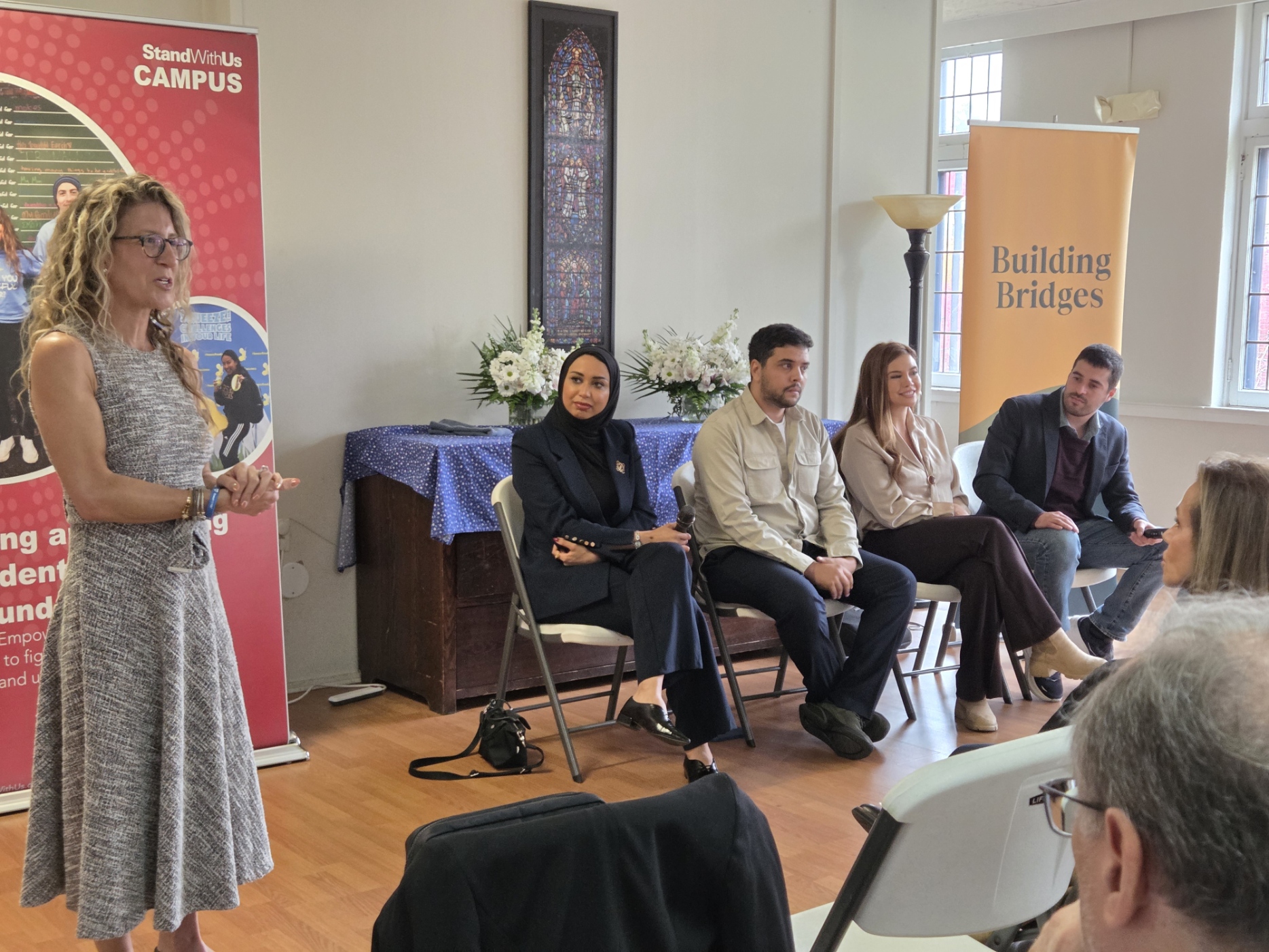
Meirov was in town to host a Nov. 5 roundtable discussion at the Church of the Redeemer in Squirrel Hill, sponsored by StandWithUs and featuring Sharaka representatives Fatema Alharbi from Bahrain, Youssef Elazhari from Morocco and Syrian Hayvi Bouzo.
Alharbi began the conversation discussing growing up in Bahrain.
“The only things we knew about Israel and Jews was from the media,” she said. “We didn’t ever get to meet the people.”
That, despite the fact that the country continues to be home to a small Jewish community more than a century old, Alharbi said.
“The picture we saw through the media is an evil figure, an enemy, people we’re supposed to hate because they are Jews, because of their religion. And they are supposed to hate us because we are Muslim,” she said.
Growing up, Alharbi told her parents she would like to one day visit Israel,but didn’t believe it would be possible until the Abraham Accords.
In 2020, she was invited to the Jewish state by Sharaka. It only took a few minutes in Tel Aviv for her to realize the lessons she grew up with were false.
Alharbi said as she was exploring the city, a stranger approached her asking where she was from. When he learned she was from Bahrain, the stranger said, “Welcome. We’ve been waiting to have peace with Arabs for a long time.”
The trip, she said, included meeting Arabs, Muslims, Christians and Jews, and visiting various places of worship, including the Al-Aqsa Mosque.
“Everyone that I met, no matter their religion or background, told me, ‘We are fed up with conflict.’ The Arabs told me, ‘We don’t want to kill anyone. We just want to have dreams and families and go to university and travel.’”
It was because of those interactions, Alharbi explained, that she wanted to become an advocate for peace and understanding.
Youssef Elazhari began his part of the conversation by explaining that Morocco has a community of nearly 2,000 Jews that has been there since the destruction of the First Temple.
His parents, he explained, had Jewish friends and he grew up believing Jews to be equals. Still, he said, tensions exist, especially since most Moroccans didn’t support the Jewish state.
“This is their perspective: ‘Let’s find a compromise. We hate Israel but we love our Jewish neighbors and friends. Jews are good, Zionism is bad.’”
Like Alharbi, Elazhari was surprised after landing at Ben Gurion Airport.
“Imagine, the signs had three languages — Hebrew, Arabic and English. I had to ask my friend if we were in the right airport,” he recounted.
The surprise continued when Elazhari had to report to a nurse to test for COVID before leaving the airport.
The nurse, he said, was clearly Muslim. When he questioned her about her identity, the medical worker replied, “Listen, my parents used to be Palestinians. I am an Arab Israeli.”
The interaction inspired Elazhari to research other Muslim countries including Morocco, Algeria, Jordan and Pakistan — all countries that didn’t exist before the middle of the last century.
“How come we accept that some countries evolve and get new identities, but we blame Israel for their identity, which is biblical?” he asked.
Sharaka, which means “partnership” in Arabic, has no political message, he explained; instead it strives to create relationships between Israelis and the Arab world.
“I wish people would have the humbleness to judge Israel once they have been there,” he said.
Hayvi Bouzo grew up in Syria to a mixed family — her father is part Kurdish, her mother part Turkish.
“I grew up knowing very well the different conflicts in the Middle East that not a lot of people talk about,” she said.
Living in a dictatorship, she said, means that all information is controlled and designed by the regime. That includes what many in the country know about Israel and the Jewish community, despite the fact that Jews lived in some parts of the country, like the Jewish Quarter in Aleppo.
Her family, she explained, would often bemoan the way minorities were treated in the country, but were forced to keep those sympathies hidden.
The fall of dictator Bashar al-Assad, the rise of social media and the signing of the Abraham Accords, she said, were major turning points for Syria.
She, too, went to Israel with Sharaka.
“For the first time, I saw that people-to-people, peace was happening on the ground,” she said. “So, there is a major shift that is happening in the Arab-speaking countries. Of course there’s still antisemitism. There’s still Al Jazeera,” she said.
All three participants said they faced backlash from friends and family over their work with Sharaka and their belief in peace. During a question-and-answer period, the need for better media in the Middle East and America, and the necessity of moderates like those working with Sharaka, was discussed.
Julie Paris, StandWithUs’ Mid-Atlantic regional director, said the visit from the Sharaka delegation was the final stop on a college campus multicity tour, whose mission included combatting antisemitism and supporting Israel.
“The urgency of this work has never been clearer; especially with the recent news of Kazakhstan joining the Abraham Accords,” Paris said. “We are hopeful these connections will continue to grow, expanding the circle of peace across the world.”
The Church of the Redeemer discussion, she said, was meant to foster “greater understanding and help our community become better neighbors by listening to diverse voices. The panelists — outstanding educators and bridge-builders from Israel, Bahrain, Morocco and Syria — are heroes who take great risks in speaking up, rejecting extremism, and bravely supporting Israel and the Jewish community.”
StandWithUs, she said, is grateful for Sharaka and hopes to amplify their message.
“By sharing their lived experiences and forging a new path forward based on mutual respect, understanding and an open mind, we prove that our allies and friends are playing a tremendous role in creating a safer, more peaceful future for the Middle East and the world,” she said.
After the roundtable event, the Sharaka representatives met with university students at Hillel JUC in Oakland. PJC
David Rullo can be reached at drullo@pittsburghjewishchronicle.org.
comments