
Pittsburgh scholar studies world’s oldest synagogue paintings firsthand in Syria
Jill Joshowitz has been studying the paintings for years. Earlier this month, she saw them in person for the first time.
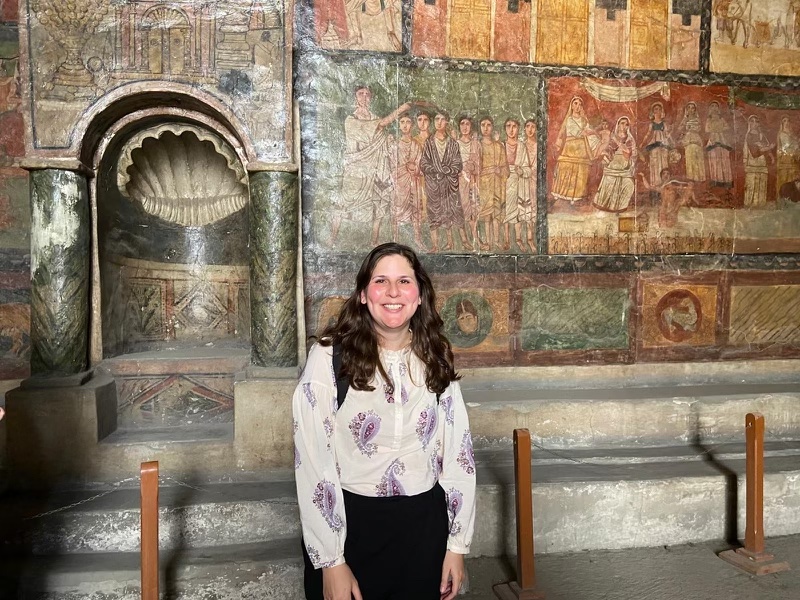
Although she had studied them for years, traveling to Syria to see the world’s earliest synagogue paintings was the opportunity of a lifetime for Pittsburgh-based Jewish visual art historian Jill Joshowitz.
As the October 27 project coordinator at the Heinz History Center, Joshowitz was part of a delegation of scholars, rabbis and lay leaders invited to visit the National Museum of Damascus, where more than two dozen panels of biblical scenes painted 1700 years ago are housed.
“I spent almost a decade of my life researching and writing about these paintings, so getting to actually see them — something I never thought would happen in my lifetime — was absolutely surreal,” said Joshowitz, of Squirrel Hill. “Each, on its own, was fascinating, but all together, they were spectacular.”
Highly colored and painted on mudbrick walls in the Dura-Europos Synagogue, they are the oldest and only example of Jewish, figural biblical imagery known to have survived from late antiquity, said Joshowitz, who emphasized that other, similar illustrations from the same era are in stone or mosaic. “That makes the paintings even more special, because they were made with organic materials, which tend to decay over time.”
What helped to preserve them through millennia was that in 256 CE, a decade after they were created, a Roman garrison filled the synagogue with dirt in an effort to fortify the city against an impending, and ultimately successful, invasion by Sasanian Persians, Joshowitz said.
“There were probably more than 50 panels originally, but only the ones that were fully buried survived, and it was the unexpected consequence of a military strategy.”
Dura-Europas was located on an escarpment above the Euphrates River, making it a strategic trade as well as military center.
The synagogue paintings provide insight into how Jews understood the Bible and expressed their faith in their polytheistic town during a peaceful period, Joshowitz said. “The paintings were a celebration of their Jewish identity and heroes and role models.”
Moses figures prominently in many of the images and his importance is depicted by his garb and height, she said. “One of the most striking scenes shows Moses leading the Israelites out of Egypt.”
“The figures aren’t proportionate to one another and size was used to convey a person’s significance.”
God is not depicted in human form and is illustrated, instead, as an outstretched arm, taking action, in the upper register of a panel, Joshowitz said.
It isn’t known who the painters were since ancient artists rarely signed their work. “They may have even been contractors hired to execute the worshippers’ vision, and I speculate that they weren’t necessarily Jewish,” she said. “The congregation had to have had assets to commission a wall painting program. It would not have been inexpensive.”
It wasn’t until the 1930s that the panels were discovered during an archaeological dig at the Dura-Europos Synagogue site. They were later moved to the National Museum in Damascus where a replica of the synagogue was built to contain them.
“There was an effort at that time to create a national museum,” Joshowitz said. “The Dura-Europos panels were among the archaeological artifacts this new museum acquired.”
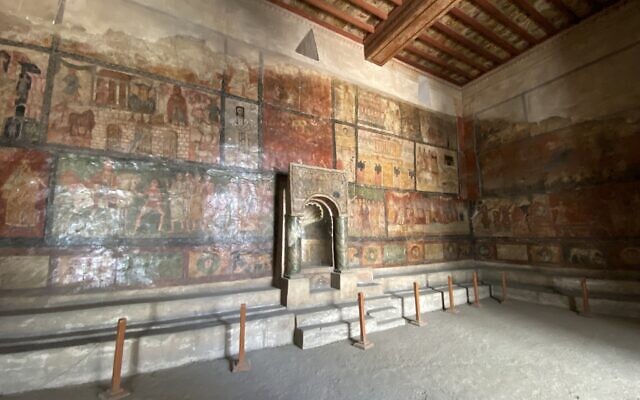
They were kept behind heavy doors for decades and their fate during Syria’s civil war, which began in 2011 and ultimately led to the fall of the Bashar al-Assad regime in 2024, was unknown, said Joshowitz, who traveled to Syria uncertain what to expect.
“I figured it might be the best day of my life, or the worst day. I thought maybe the paintings had been removed. But I wanted to find out.”
Her two-day trip in September was facilitated by Rabbi Asher Lopatin, director of community relations of the Jewish Federation of Ann Arbor, Michigan, and Joe Jajati, grandson of a former leader of Syria’s Jewish community and founder of the Syrian Mosaic Foundation.
Lopatin had visited Damascus in February, about two months after the fall of al-Asad, and was part of the first Jewish delegation to put foot on Syrian soil in more than 30 years.
In a conversation with Joshowitz, he expressed an interest in returning to Syria specifically to see the paintings, and asked if she wanted to join his delegation.
“It was a risk, not knowing what we’d find,” she said. “But I was willing to take it, whether we’d find them intact, or disassembled or destroyed. It was worth knowing.”
She said she was “absolutely thrilled” to see that they were there and in good hands.
Although the group was given about 40 minutes to view the panels, Joshowitz requested, and was granted, more time. Artifacts from a later temple, the Jobar Synagogue, also were shown to the delegation.
A native Pittsburgher, Joshowitz earned her doctorate in Judaic studies from New York University in 2023 after studying biblical art of the eastern Mediterranean. She was a Fulbright Scholar at Hebrew University and received research fellowships that supported her ability to go to archaeological sites in Israel and Turkey while pursuing her PhD.
She is scheduled to lecture on the paintings at the University of California, Irvine, in November, and said she would welcome an opportunity to give similar talks in her hometown.
While the panels are of great scholarly inquiry, Joshowitz is hopeful that press and social media coverage generated by the recent trips will pique popular interest, as well.
“We have a lot to learn from these paintings, including how ancient Jews understood the Bible,” she said. “What are the stories they thought were valuable, compared to what modern Jews think are valuable?”
Replicas of three Dura-Europos panels can be seen at the Israel heritage room at the University of Pittsburgh nationality rooms. PJC
Deborah Weisberg is a freelance writer living in Pittsburgh.
comments