
Jewish organizations work to meet increased need
“There is no question there is a lot of anxiety around food security,” he said.
Inflation, tariffs, supply chain issues and the temporary suspension of SNAP benefits have added downward pressure to Jewish households — some of which were already facing food insecurity and worries over meeting their daily financial obligations.
Squirrel Hill Food Pantry Director Jesse Sharrard said that on Nov. 7, only six days after SNAP — the Supplemental Nutrition Assistance Program — benefits were suspended due to the federal government shutdown, need exceeded the pantry’s expectations.
In those six days, he said, “we had already provided food to as many families as we would typically provide in two weeks.”
The Squirrel Hill Food Pantry, part of Jewish Family and Community Services, isn’t alone in seeing increased need.
Jewish Assistance Fund has offered “no repay” grants to members of the Pittsburgh Jewish community since 1985.
Cindy Goodman-Leib, executive director of JAF, said what happens nationally impacts the Jewish community locally. She cited the government shutdown, the pause in SNAP benefits, the rising price of essential items and even damage from recent storms as factors affecting the financial well-being of Jewish households.
JAF, she said, has heard from people who felt the immediate impact of not receiving SNAP benefits earlier this month.
The organization also saw what Goodman-Leib called “a significant increase” in the number of people contacting JAF for the first time, those who were finding it challenging to pay their bills due to the financial impact of the government shutdown and pause in SNAP benefits, which were resumed after the government reopened November 13.
“We are working closely with our partners, and we ramped up our efforts to increase the community’s awareness of JAF’s no repay grants,” she said.
Rabbi Moishe Mayir Vogel is the executive director of the Aleph Institute, an organization that provides relief for incarcerated Jews and their families. As part of that support, it runs a kosher food bank on its property that is available to the wider Jewish community needing assistance.
He said there was an immediate feeling of anxiety when the delay of SNAP benefits was first announced.
“More families have reached out to us,” he said. “I put three new families on the list in just the last couple of days. There’s a lot of nervousness, a lot of fear.”
Jewish families share the same concerns as the broader Pittsburgh community, Vogel said, but some also have the added burden of the high price of kosher food.
“The cost of food is 30 to 40% more than non-kosher food,” Vogel said.
While SNAP benefits normally last three weeks for a typical family receiving aid, he said, “in the kosher world, the food stamps last two weeks at the very most.”
And while many believe the Jewish community is more affluent than the non-Jewish world, the numbers reported in the Jewish Federation of Greater Pittsburgh’s 2017 Jewish Community Study contradict that.
Thirty-seven percent of Jewish households were reported to make $50,000 a year or less and 17% of Jewish households were reported to make just $25,000 annually. Those numbers were only slightly better than the broader community, where 46% of households made less than $50,000 and 23% made less than $25,000.
According to the Commonwealth of Pennsylvania website, a three-person household qualifies for SNAP benefits if its income is $4,304 a month or $51,648 annually.
Our Giving Kitchen founder Rabbi Chezky Rosenfeld said the nonprofit has seen a 50% increase in requests for meals.
“There is no question there is a lot of anxiety around food security,” he said.
Earlier this year, the organization moved to a new location on Murray Avenue, doubling its capacity. It can generate more than 300 kosher meals a week, which are available on site or delivered through a dozen partner charities, including homeless shelters and food pantries.
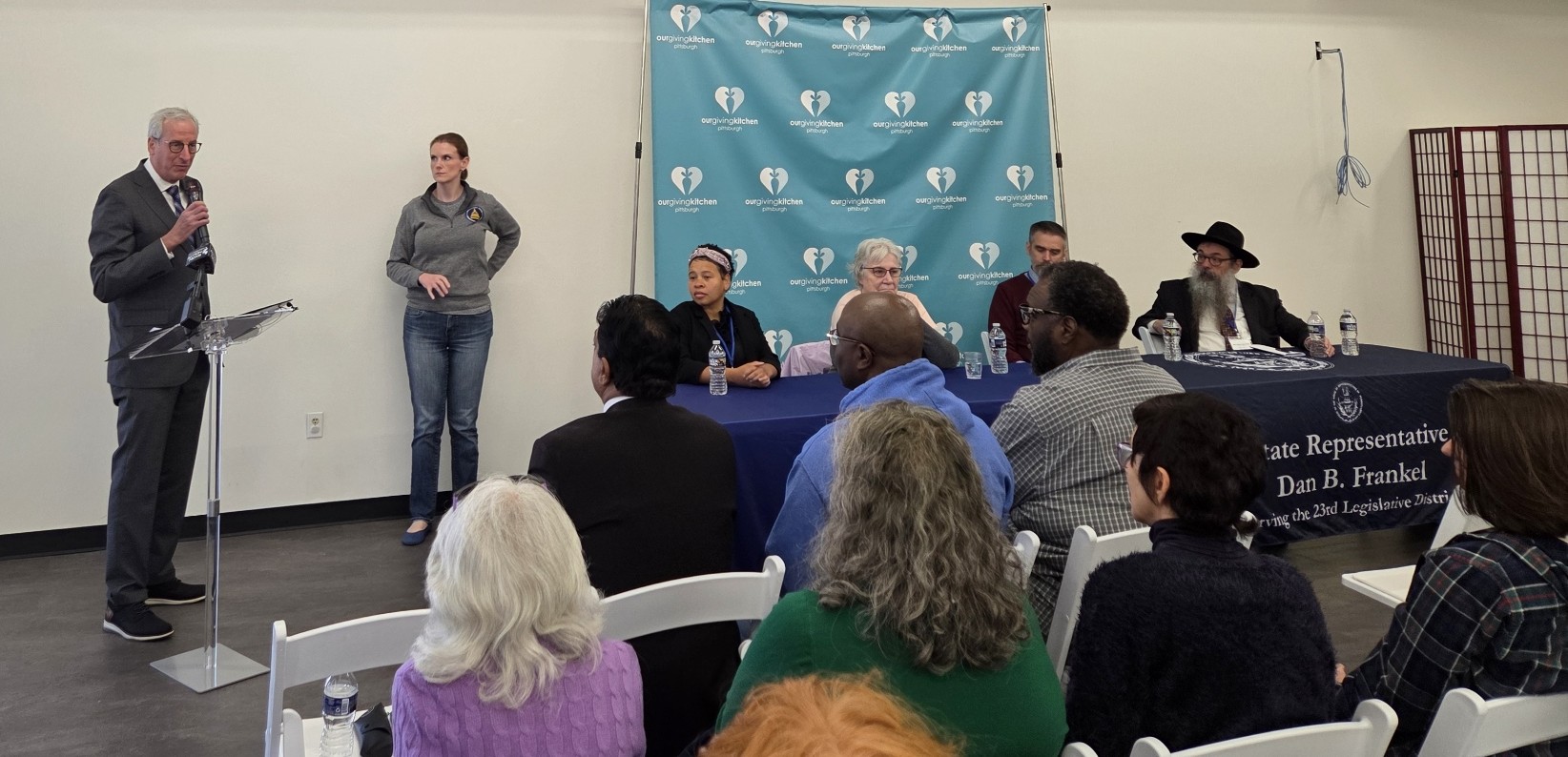
Rosenfeld and The Giving Kitchen hosted a press conference organized by State Reps. Abigail Salisbury and Dan Frankel, which included several different food aid organizations, including the Squirrel Hill Food Pantry and the Aleph Institute.
“What happens when the entire net is torn out from under families already walking the tightrope of poverty? We’re going to find out unfortunately,” Frankel said.
He said that in addition to SNAP benefits being suspended, during the last year Medicaid was cut and “punitive work requirements” were added to the program and subsidies that “help millions afford health care” were “gutted.”
“Families who were just barely getting by are now forced to choose between the pharmacy and grocery store,” he said, blaming the GOP-controlled Congress and President Donald Trump’s administration for the crisis.
Salisbury said it is important to work on the issue of food insecurity, “which spans every type of person, community, religion and location that you can possibly imagine.”
All of the organizations contacted by the Chronicle said they were able to meet the needs of the community but, if food insecurity increases, they may need additional donors and volunteers.
Anticipating the needs of the community, the Jewish Federation of Greater Pittsburgh awarded a $10,000 emergency grant to Jewish Family and Community Services to help provide kosher food to individuals and families.
“Thanks to the generosity of our donors who have contributed to the Federation’s Foundation, we are in a position to support JFCS as they step up to meet the urgent needs of our community,” said Jeff Finkelstein, Federation’s president and CEO. “We are proud to help JFCS reach more people who are struggling right now.”
The Squirrel Hill Food Pantry, JAF, Aleph Institute and Our Giving Kitchen each said they rely on donors and volunteers to support their work. Those in need or with the ability to help should reach out to the individual organizations.
While no one can predict what will happen in the coming weeks and months, the Squirrel Hill Food Pantry’s Sharrard is certain of one thing: As the holidays approach the need won’t decrease.
“We started seeing an increase in January and every month has been busier than the last month. Our slowest month this year was busier than our busiest month in 2024,” he said. “Families who ordinarily wouldn’t have visited us in November came and made sure they got a visit before the end of the month. We have been looking at 450 to 460 families per month. In October there were 560 and it’ll far surpass that in November.” PJC
David Rullo can be reached at drullo@pittsburghjewishchronicle.org.
comments