
Bret Stephens, Pamela Nadell discuss ‘Antisemitism, An American Tradition’
Tree of Life hosted event at Carnegie Mellon University
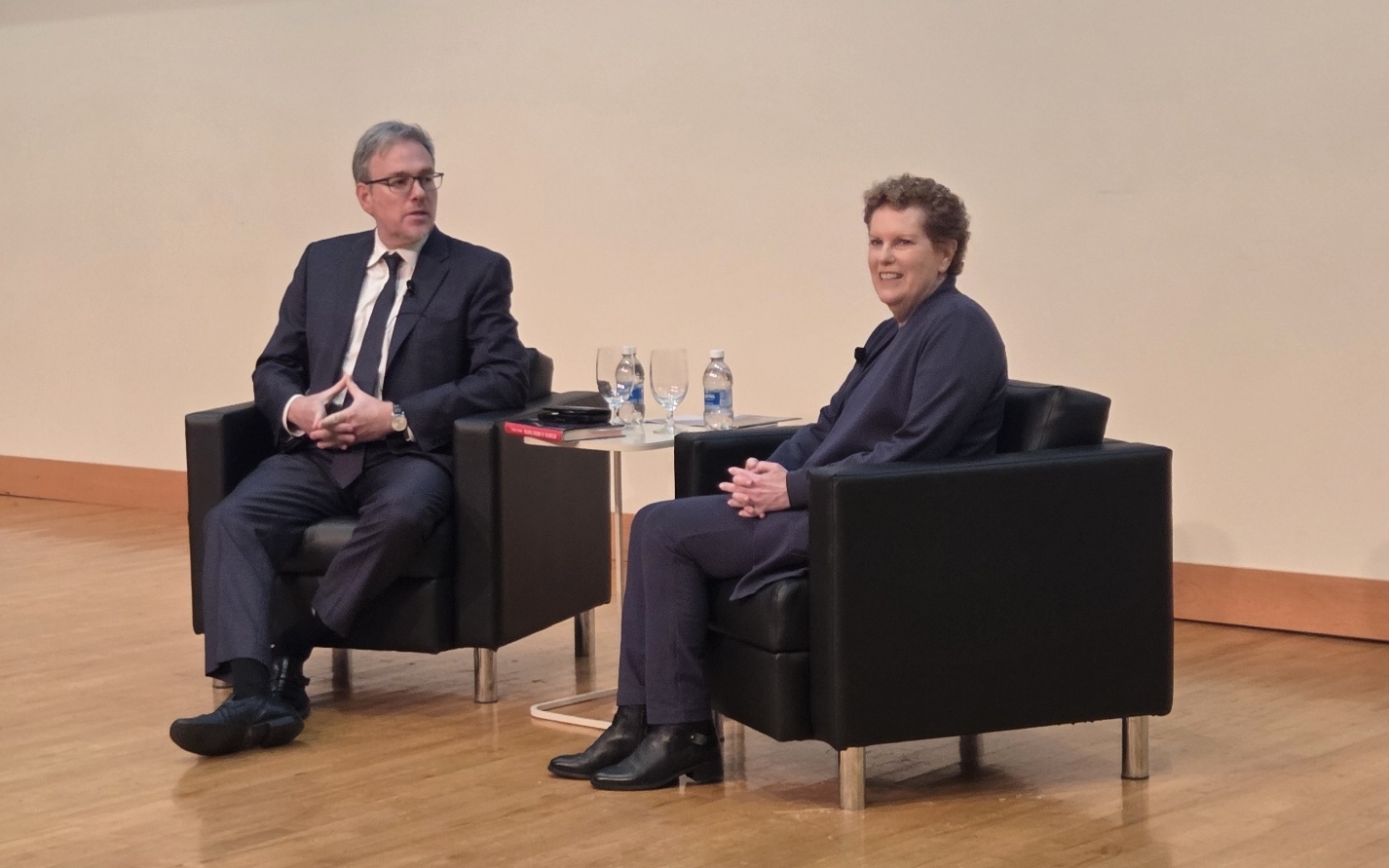
Pulitzer Prize winner Bret Stephens told a Pittsburgh audience that he agreed to interview Pamela Nadell because he found the opportunity “intellectually enticing” and “morally important.”
Nadell is the author of the new book “Antisemitism, An American Tradition.”
The Oct. 19 conversation, held at Carnegie Mellon University, was attended by more than 100 people in person and nearly 300 online. It was hosted by The Tree of Life. Nadell is a member of the organization’s Academic Advisory Board and a professor of history at American University in Washington, D.C.
The far-reaching discussion touched on the golden age of American Jewry, historical antisemitism, Zionism, free speech and the New York City mayoral race, among other topics.
Nadell told Stephens that the Oct. 27, 2018, Pittsburgh synagogue shooting was the impetus for the book.
“The trauma that hit this community swirled beyond, and it swirled out to American Jews,” she said. “In my tiny little corner of the world, a group of historians began meeting to talk about, ‘How did we miss this story?’”
Reams of books, she said, have been written about Jewish accomplishments, Jewish communities, Jews in America, “and we missed this story. That led me down this path.”
Nadell’s book begins in colonial America, travels through the new country and the Civil war, into the 20th century and World War II, and concludes with a chapter on the antisemitism experienced by communities in Charlottesville, Virginia; Pittsburgh; Poway, California; Jersey City, New Jersey; Monsey, New York; and Hamas’ Oct. 7 attack on Israel.
The book’s final chapter discusses the author’s view of the Oct. 7 massacre in the hours immediately following it. It does not include the two-year war and its aftermath, which has led to a marked increase in antisemitism and anti-Zionism across the country and globe.
Until events like the Unite the Right march in Charlottesville, where attendees chanted “Jews will not replace us,” Nadell said that many Jews in America believed antisemitism was relegated to the fringes of society and not significant.
Stephens postulated that it was the rise of conspiracy theories — he spoke of the speculation that Barack Obama wasn’t born in America — and the belief that Jews are privileged, which helped give rise to the current strain of antisemitism.
“I think in much of the United States, particularly in academia, is this idea that successful people are privileged, and privilege is unfair and unearned. … Jews are therefore bad because they are disproportionately privileged,” he said.
Nadell concurred with Stephens’ assertion. She said that many academic societies in the early 2000s passed “essentially BDS resolutions” calling for the condemnation of Israel and boycotting Israeli scholars, and ultimately Jews. The pattern, she said, has continued in Hollywood and in the publishing industry.
Speaking to the title and content of the book, Stephens and Nadell discussed the historical record of antisemitism in America, which began in at least 1654 when Jews arrived in New Amsterdam under the governorship of Peter Stuyvesant, whom Stephens called “antisemitic.”
Nadell said antisemitism in America presented a counter-tradition to the American experience.
Conspiracy theories, she said, pushed the idea that, like in Europe with the Rothschilds, Jews would come to America and gain power and influence.
“You read in your book the effects of the revolutions of 1848 and the perception that the Rothschilds had financed the regimes that suppress these kinds of early manifestations of workers, popular revolutions,” Stephens said. “This is obviously when Marx comes of age and turns into a rabid antisemite.”
He asked Nadell about antisemitism on the left, something the author said she was careful to trace and document.
“It really flares up after the Six Day War,” she said. “Jews are white, Jews are privileged, and the people need to be championing those that are Black and brown and are oppressed.”
Propaganda from the Soviet Union also fostered and promoted antisemitism, Nadell said.
Antisemitism, Stephens offered, shape-shifts throughout history. Nadell agreed and pointed to the U.N.’s 1975 Women’s International Conference in Mexico City. The idea that Zionism is racism was promoted at the conference, she said.
At the same time, Nadell said Holocaust denial was taking place, which included ads placed in college newspapers by anti-Jewish groups, saying they should be able to present their truth about what happened in the Holocaust.
Near the end of the interview, Stephens asked about the New York mayoral race and Democratic nominee Zohran Mamdani’s refusal on several occasions to denounce the phrase “Globalize the intifada.”
Tree of Life CEO Carole Zawatsky interrupted to signal that it was almost time to begin taking questions from the audience due to the length of the program. She joked that she was “cutting you off because of my anxiety at this particular line of questioning.”
The program concluded with Stephens asking Nadell if she was optimistic about America.
“I am optimistic because all of you are here and those of you online,” she answered. PJC
David Rullo can be reached at drullo@pittsburghjewishchronicle.org.
comments