
At CMU’s newly reopened Posner Center, history is hidden in the margins
Since reopening in November 2025, the Posner Center has welcomed more than 8,000 visitors.
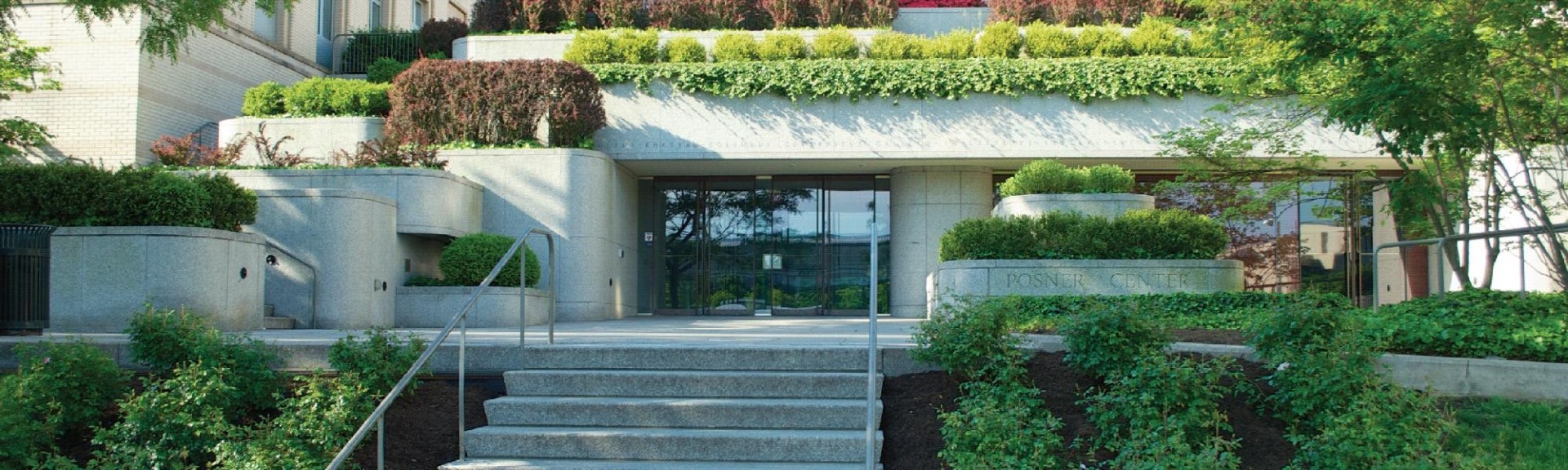
Amid rows of 19th-century books, Sam Lemley, the curator of special collections and director of the Posner Center for Special Collections at Carnegie Mellon University, noticed one that looked older — out of place.
Scrawled on the title page in faded ink, an inscription: “To His Excellency Thomas Jefferson, Esquire, respectfully presented by the author.”
“I just happened to pull it out and look at it,” Lemley said. “Thomas Jefferson had a really peculiar way of marking his books — he marked it, and so [we] come to find out that this book belonged to [him] and was in his collection at Monticello.”
Even after years of cataloging, the Posner Center’s collections continue to yield new findings. A stray note in the margin, a small letter astride a signature mark, or even a long-forgotten inscription can transform a seemingly ordinary book into a novel discovery.
Last year, the Posner Foundation funded a $6 million renovation, transforming the center into what the university describes as both “a museum and laboratory for the humanities.” The project added facilities including secure storage, a digitization lab and a reading room, while an additional $2 million gift endowed the care and expansion of the collection.
The renovated space, open to the public for the first time in its 22-year history, grants researchers, students and community members new opportunities to uncover the stories hidden within its shelves. Since reopening in November 2025, the center has welcomed more than 8,000 visitors.
“We’re open to everyone — not just the [Carnegie Mellon] community,” Catherine Blauvelt, special collections coordinator, said. “The greater Pittsburgh community is welcome for any of our events, talks, or to just make an appointment and come in.”
While the Posner Center houses over 8,000 books, its “amber core” is the Posner Memorial Collection.
Built by Polish-Jewish entrepreneur and philanthropist Henry Posner, the collection comprises roughly 1,000 books, containing some of the rarest books in the history of Western science.
“Henry Posner Sr. was very particular about what he bought,” Anne Molloy, trustee of the Posner Foundation, said. “It was built very intentionally and slowly — you couldn’t put together that collection today.”
The bulk of Posner’s collecting included acquiring early printings of Aristotle, Newton, Galileo, Copernicus — all major figures in Western science. Among its highlights is one of five known copies of the first official printing of the Bill of Rights, dating to 1792.
“He knew things, so he would challenge something that a librarian at the Library of Congress might tell him. For instance, when he acquired [the Bill of Rights], I don’t think anyone knew how rare it was,” Lemley said. “We have his letter that he sent to the librarian at the Library of Congress at the time, where he’s just asking, ‘Hey, what does your copy look like? How rare is this?’ He wasn’t happy with their response, so he kept doing the work, and he was able to show that it was quite a bit rarer than [that of] scholars.”
For Curatorial Intern Claire Thurston, every book contains a history of its own. She became transfixed by the marginalia of the first printed edition of Plato’s complete works, published in 1513 by Venetian humanist Aldus Manutius.
“I said, ‘OK, who wrote this? Why did they write it? What were they doing?’” Thurston said. “You have no idea what it could be.”
After studying the annotations, Thurston found that a reader had added in editorial notes from a later edition of Plato, published by German philologist Friedrich Ast. The jottings left in the margins, she says, reflects a broader movement across classical philology to standardize ancient Greek texts.
“Whoever was writing those [notes] in thought that those new ideas of Ast’s were definitive and important enough to write them into a centuries-old book,” she later wrote to the Chronicle. “Those discoveries are certainly waiting in every single book in the collection.”
Posner’s collection extends beyond literature, philosophy and history of science. According to Lemley, Judaica makes up anywhere from 2% to 5% of the collection.
“You see glimpses of Henry Posner’s involvement in the Jewish community and his interest in Jewish literature in what he’s collecting,” he said. “As an immigrant to the United States, I get the sense that he held immense reverence for the American story, and it’s … ideally welcoming of immigrants and different groups of faith traditions [and] ethnicities”
Among the collection’s oldest works is a pocket-sized 13th-century Hebrew manuscript. Shrouded in animal skin and inscribed on vellum, the book offers a view into Jewish devotional practice in medieval Europe.
Separated by nearly 700 years is a copy of Arthur Szyk’s illustrated Haggadah, drawn in the 1930s against the backdrop of impending war. Kaleidoscopic hues and sardonic caricatures animate its 48 illustrations, transforming the ancient text into a warning about the spread of Nazism.
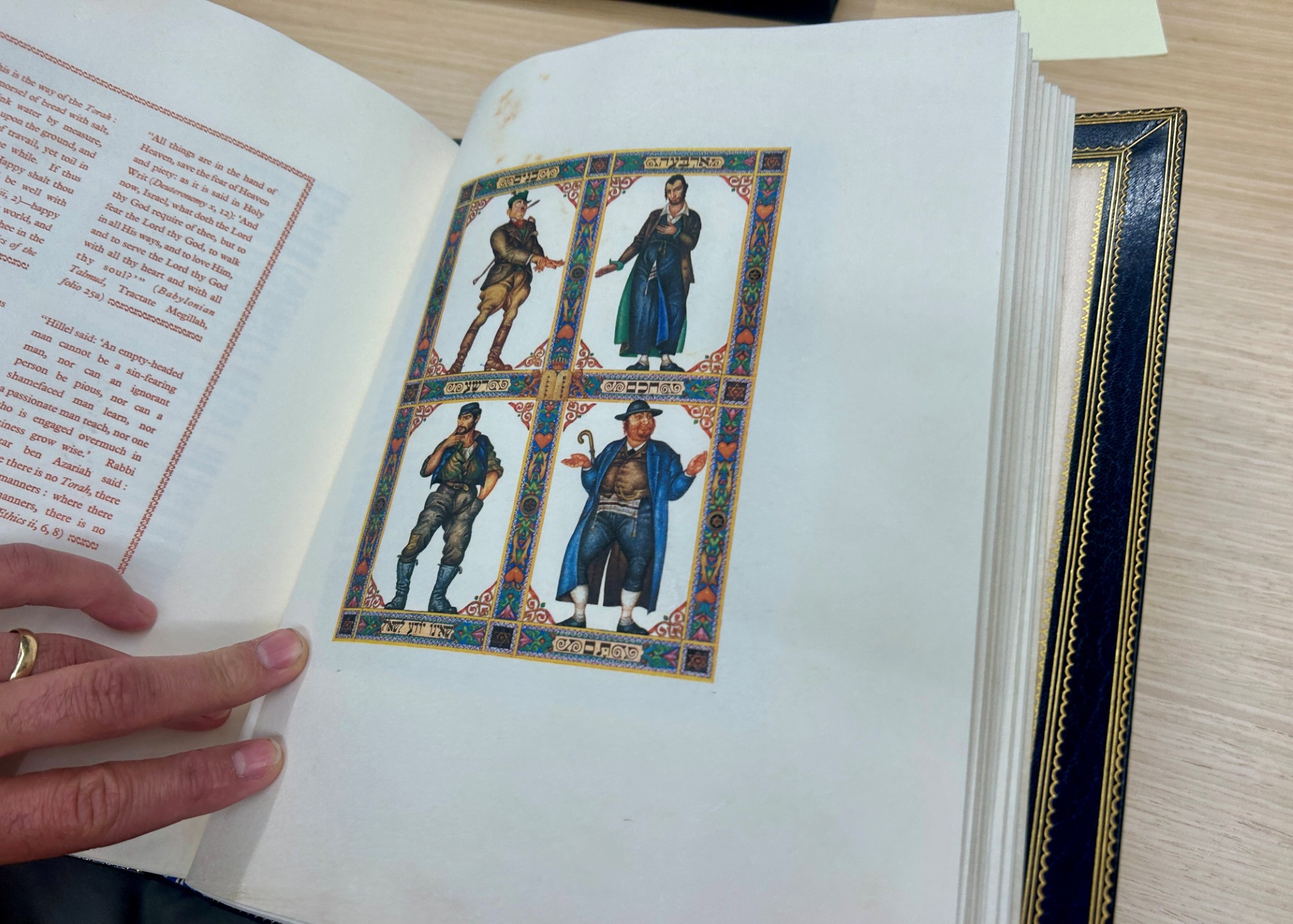
Lemley points specifically to Szyk’s depiction of ‘the wicked son’ as a testament to the artist’s political approach.
“He’s got the Hitler mustache. He’s got this cravat — that’s a Nazi red … Kitted out, much like a German would be in the 1930s,” he said. “Even though this is an ancient text, he’s connecting wickedness with what was then the rise of Nazism.”
Currently on view at the Posner Center is “Rare Books & Ancestral Machines.” The inaugural exhibit juxtaposes censored copies of Copernicus with the nation’s founding documents, Turing with Shelley, the old with the new. The exhibit, Lemley writes in the accompanying handbook, links “the tactile past to our digital present and our computational futures.”
The renovated space is set to host one major exhibit a year, alongside a series of “open stacks” events that invite students and community members to engage directly with the collection. PJC
Octavia Liku can be reached at oliku@pittsburghjewishchronicle.org.
comments