
‘Antisemitic speech is constitutionally protected,’ says Georgetown professor
David Cole appeared at Pitt’s Center for Civil Rights and Racial Justice event
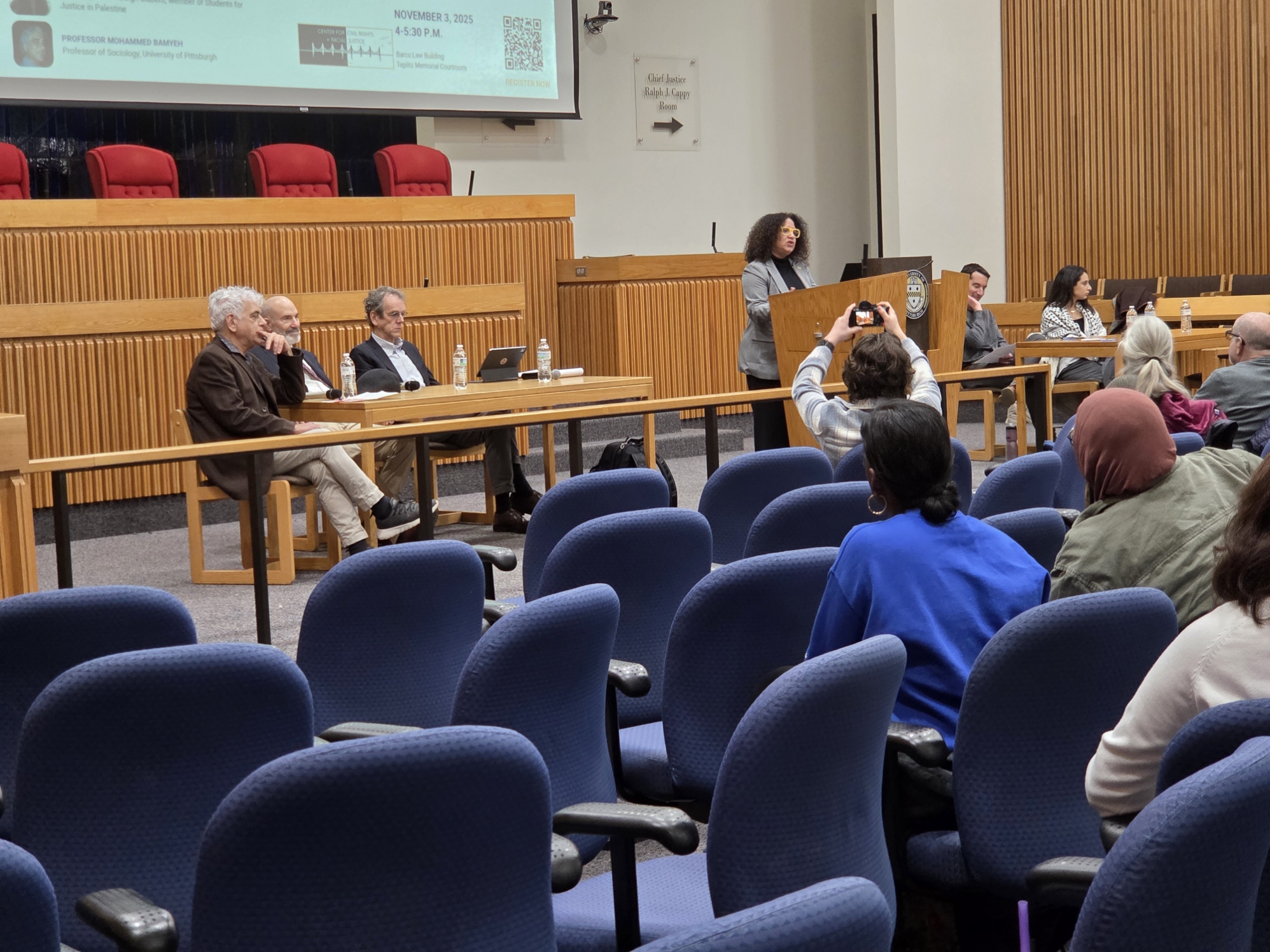
Antisemitic speech is constitutionally protected speech, David Cole told an audience of roughly 75 at the University of Pittsburgh’s Teplitz Memorial Courtroom.
The Nov. 3 “Free Speech and Universities” program was organized by Pitt’s School of Law Center for Civil Rights and Racial Justice and featured Cole, a law professor at Georgetown University and former national director of the American Civil Liberties Union; Jules Lobel, the school’s Bessie McKee Walthour endowed chair and professor of law; Mohammed Bamyeh, a professor of sociology at Pitt; and Mia Suwaid, a member of Students for Justice in Palestine at Pitt. It was moderated by the Center’s co-Director Sheila Vélez Martínez, and Jay Aronson, Carnegie Mellon University’s Center for Human Rights Science director.
“The First Amendment does not prohibit antisemitic speech. In fact, it protects free speech,” Cole said. “Why? Because the Supreme Court said it is a greater danger to give the government the power to suppress speech because it concludes it is antisemitic or racist or sexist than the harms that come from antisemitic, racist and sexist sorts of speech.”
As a result, he said, public universities are bound by the First Amendment and must tolerate offensive speech.
The remarks were similar to those Cole made when he testified at a hearing convened by the U.S. House Committee on Education and the Workforce earlier this year.
Cole’s assertion came during a lengthy presentation in which he took umbrage with President Donald Trump’s administration and its attempts to force universities like Columbia and Harvard to address the uptick in antisemitic activity following Hamas’ terrorist attack on Oct. 7, 2023, and Israel’s response.
“The Trump administration believes these institutions are too liberal so they’re using antisemitism as an excuse to punish them for being too liberal,” Cole said.
The bulk of Cole’s time at the Nov. 3 event was spent addressing the Trump administration’s actions as they relate to Title VI of the Civil Right Act of 1964, which prohibits discrimination on the basis of race, color and national origin in programs and activities receiving federal financial assistance.
Cole argued that even if actions committed by students violated Title VI, universities cannot be punished for those violations because the regulation applies to the schools, not students.
In his concluding remarks, Cole referenced Pitt’s suspension of SJP earlier this year and the federal court battle that eventually resulted in the group’s reinstatement three weeks earlier than what the university imposed.
“I find my hope in lawyers, like those here, the ACLU that sued this administration for the actions it took against the Palestinian student group here,” he said. “When the government targets your free speech, you have two choices. You can capitulate or you can fight. For me, that means you only have one choice.”
Lobel followed Cole. The pair co-authored the book, “Less Safe, Less Free: Why America is Losing the Battle on Terror.”
The Pitt law professor was listed as a pro bono lawyer representing SJP in its lawsuit against the university that employs him. He spent most of his time at the event recounting the case and making at least one assertion that might point to the next legal battle between progressive groups and the university.
“There are broad issues at this university in terms of free speech. The first involves where you can protest and what kind of protest can you engage in,” he said. “The university says many of these places are our property and it may be true that a classroom isn’t an appropriate forum for a raucous demonstration, but certainly the streets outside of the student union or the Cathedral of Learning, outside of the main university buildings are either public, or what we know in the law as quasi-public forums.”
Lobel also argued that pro-Palestinian groups have a right to protest in places like Hillman Library, the location of a demonstration that caught the attention of the university last year. It doesn’t matter, Lobel said, if people found this type of behavior off-putting.
“They say, ‘This is offensive for us, we are Jewish students,’ for example, ‘and we get offended by this.’ Doesn’t matter because if you allow a public university to prohibit things that are offensive, we won’t have free speech at all,” he said.
SJP’s Suwaid discussed her family’s history, accusing Israel of genocide and accusing Pitt of surveilling SJP’s activities.
She claimed the university has an anti-Palestinian viewpoint, citing an email sent by Chancellor Joan Gabel that condemned Hamas’ Oct. 7 attack on Israel as evidence.
“I’m going to start honing in on this sort of hypocrisy of the university’s administration and their clear pro-Israel, pro-Zionist stance,” she said.
The university, she asserted, used the email and subsequent actions as “doubling down on suppressing Palestinian political speech.”
The final speaker, Bamyeh, spoke against the university’s 2022 adoption of the International Holocaust Remembrance Alliance’s definition of antisemitism. He called the definition,adopted by 46 countries, 316 NGOs and 349 educational institutions, “kind of a questionable kind of definition.”
He accused the university and the administration of being “unresponsive” and “authoritarian” in its actions since Oct. 7.
While the speakers advocated for free speech, they failed to address SJP’s attempts to quell the speech of pro-Israel speakers on campus, including IDF veteran Yadin Gellman last year.
CMU’s Aronson, who identified as Jewish during the event, closed the formal presentation.
“We don’t have a right to be comfortable. I think that’s something that’s really important,” he said. “We don’t even have the right to go through life and never feel like there is some sort of threat or someone that is threatening toward us.” PJC
David Rullo can be reached at drullo@pittsburghjewishchronicle.org.
comments