
‘Wavelengths’ at University Art Gallery features work by Jewish women artists
“These artists have work ubiquitous to Pittsburgh’s history, but they don’t have name recognition."
Andy Warhol is often framed as the most prominent artist from Pittsburgh — and thought of as an anomaly. In many historians’ minds, Warhol was a singular talent in an uncultured industrial city. Pittsburgh was a place for artists to rise above, not a place to cultivate their careers. But the reality is that Pittsburgh has a rich place in contemporary art history, as proven with “Wavelengths,” an exhibition featuring four female artists from the modernist movement: Aaronel deRoy Gruber, Sue Fuller, Josefa Filkosky and Jane Haskell.
“Wavelengths” is on view in the University Art Gallery at the University of Pittsburgh through Jan. 30.
Though Haskell, deRoy Gruber, Fuller and Filkosky did not know each other, curators Brittany Reilly, founder of the Pittsburgh Modern Committee and executive director of the Irving and Aaronel deRoy Gruber Foundation, and Alex J. Taylor, associate professor in Pitt’s Department of History of Art and Architecture, had some expertise in each’s work.
Haskell and deRoy Gruber were both Jewish. Haskell grew up on Long Island and later moved to Pittsburgh. DeRoy Gruber was a member of one of Pittsburgh’s most prominent Jewish families, the daughter of Joseph Israel deRoy and Bessie Leyser deRoy.
While their work doesn’t explicitly reference Judaism, both Haskell and deRoy Gruber exemplify values of meticulous crafting and intellectual discovery integral to Jewish life. Haskell’s work was on view at the Jewish Community Center of Greater Pittsburgh and at the American Jewish Museum in New York. Both artists studied with Samuel Rosenberg, who taught at the Young Men and Women’s Hebrew Association.
“What’s been interesting is witnessing the four of these artists together,” said Shawn C. Simmons, a graduate research assistant who worked alongside Taylor and Reilly on the exhibition. “All of them used industrial materials and all had dreams of their art being accessible to the public in some way.” The University Art Gallery, which is free and open to the public, makes Haskell, deRoy Gruber, Fuller and Filkosky’s work available to anyone who wants to see it.
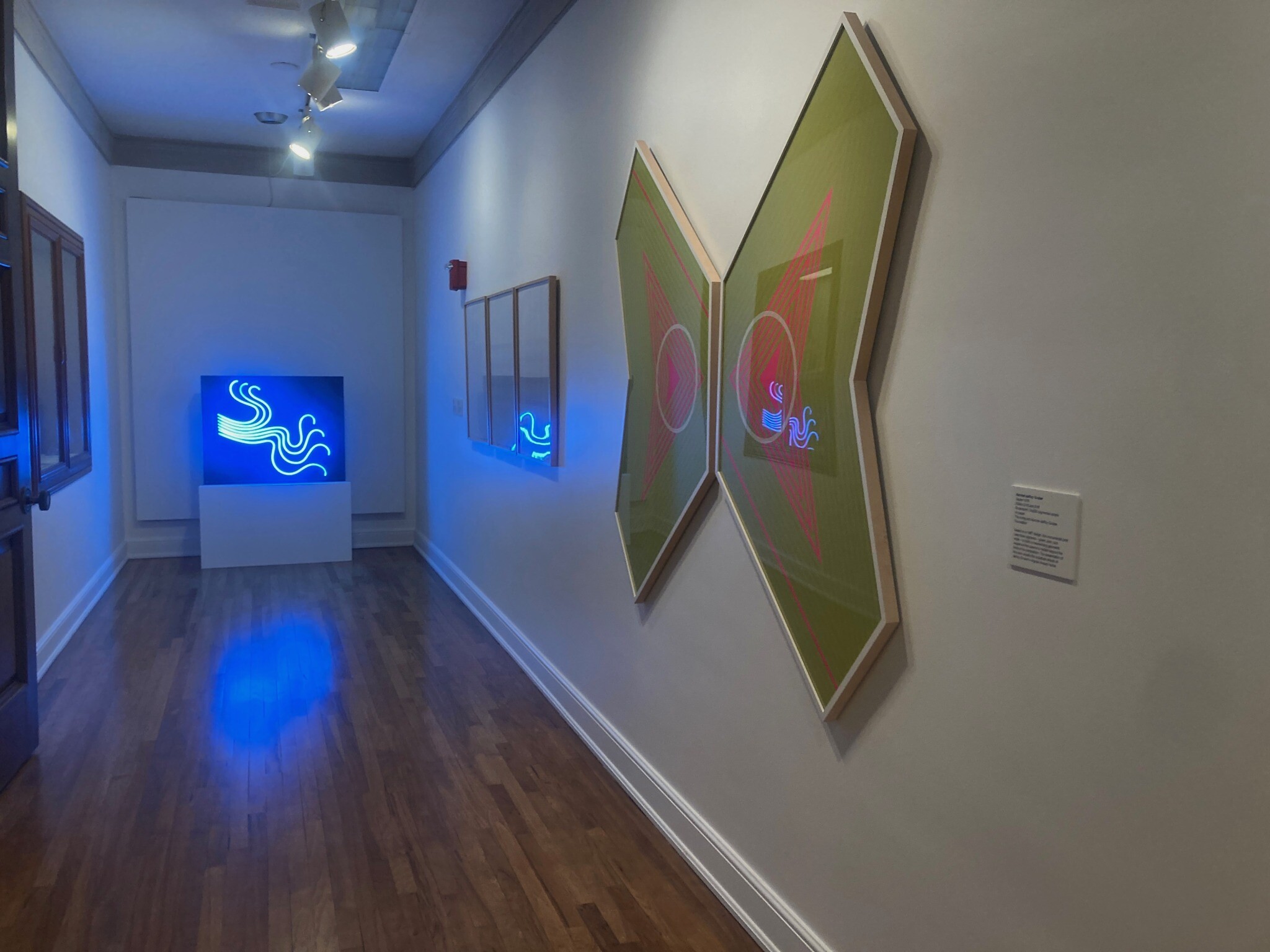
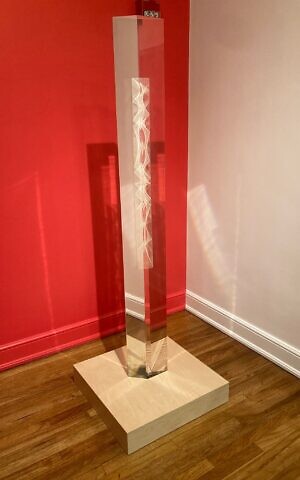
The piece of Haskell’s work most recognizable to Pittsburghers is her neon sculpture “River of Light,” which can be seen in the Steel Plaza transit station. But “Wavelengths” shows she made explorations on canvas, too, and had a deep interest in science and mathematics. Modernist artwork requires an attention to material and an understanding of geometry, and in Haskell’s two-dimensional works she took that to heart. “Flight of the Blackbirds” shows a sea of triangles that appear to undulate in front of the viewer’s eyes through small variations in the shapes. Staged on a bright red wall, it’s remarkable and a little unsettling. The piece also defies documentation. Capturing it in a still image makes it lose its optical illusion effect.
Haskell’s “Asymmetry II,” a pale blue neon shape on a black panel, is a study in how, in the artist’s words, “light and color spill onto the adjoining surfaces.” The resulting shape has an aquatic bent — it’s hard not to look at it and see a wave, or, if you look at it a little longer, the three rivers of Pittsburgh converging. Standing at the end of the gallery, there’s a fascinating effect where the neon from “Asymmetry II” reflects on the white graphite on paper drawings on the side wall.
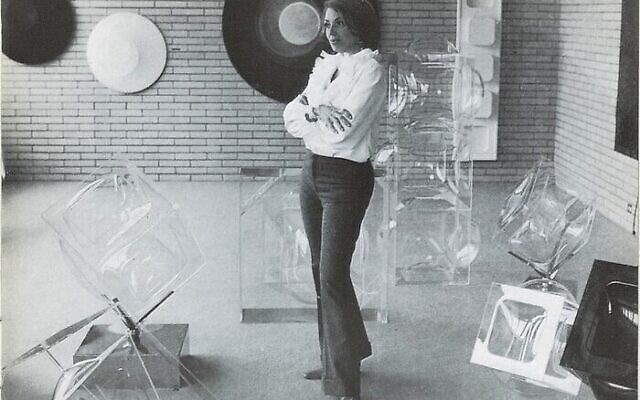
Anyone who’s seen photos of deRoy Gruber can sense her star power. One gets the impression that if more people knew about her work, she would have been as big as Warhol. Simmons described deRoy Gruber as “a true mid-century woman — she was chic.” An image of the artist in her studio gives the viewer a glimpse into her life. Even in photographs from 40 years ago, she exudes personality and vibrancy also present in her artwork.
The gallery space opens with deRoy Gruber’s rotating plexiglass sculptures, flashes of color moving on 1-rpm motors. They look like something between living beings and still objects, like tropical fish or flower petals swaying in a breeze, challenging what viewers feel when they look at still sculptural or decorative pieces.
In “Inside Womens Blues,” a hot pink color field with concentric squares, deRoy Gruber explores the subtlety of shape and what questions and emotions it can provoke, even without words. “Septet,” on an adjacent wall, shows the artist working with non-traditional frame shapes resembling butterfly wings, colored pink and neon orange with DayGlo acrylic.
Though Sue Fuller grew up in Squirrel Hill, she studied glassmaking in Great Britain and Italy, and calligraphy in Japan. From her humble upbringing in Pittsburgh, her career burgeoned into a solo exhibition at Storm King Art Center, home to one of the most prestigious public art installations in the country.
While deRoy Gruber has a striking studio portrait, Filkosky’s portrait shows her in a nun’s habit and a welder’s jacket. Accompanying the photo is a letter Filkosky wrote to Mother Superior of the Sisters of Charity, arguing why she should be allowed to wear clothing deemed immodest for a nun while in the welding studio.
Filkosky’s sculptures have a serpentine look, enormous swoops of steel that seem to build on the negative space around them. Simmons noted that one of her sculptures is in public view at PPG, but it has fallen into disrepair and frequently been vandalized. “Wavelengths” hopes to educate more people on Filkosky’s work and her unusual life story as a devout nun and also a gifted artist.
Though none of the artists represent faith in a literal way, their work serves as a kind of interfaith dialogue — that there is universal beauty in the fluidity of shapes, colors, lines and curves. Abstract modernist art can be a way of accessing spirituality beyond words. They show a vision of Pittsburgh as not a place for artists to leave, but a site of inspiration through its industrial history and unique character.
“These artists have work ubiquitous to Pittsburgh’s history, but they don’t have name recognition,” Simmons said. Through “Wavelengths,” hopefully they soon will. PJC
Emma Riva is a freelance writer living in Pittsburgh.
comments