
The voice of the Jewish people
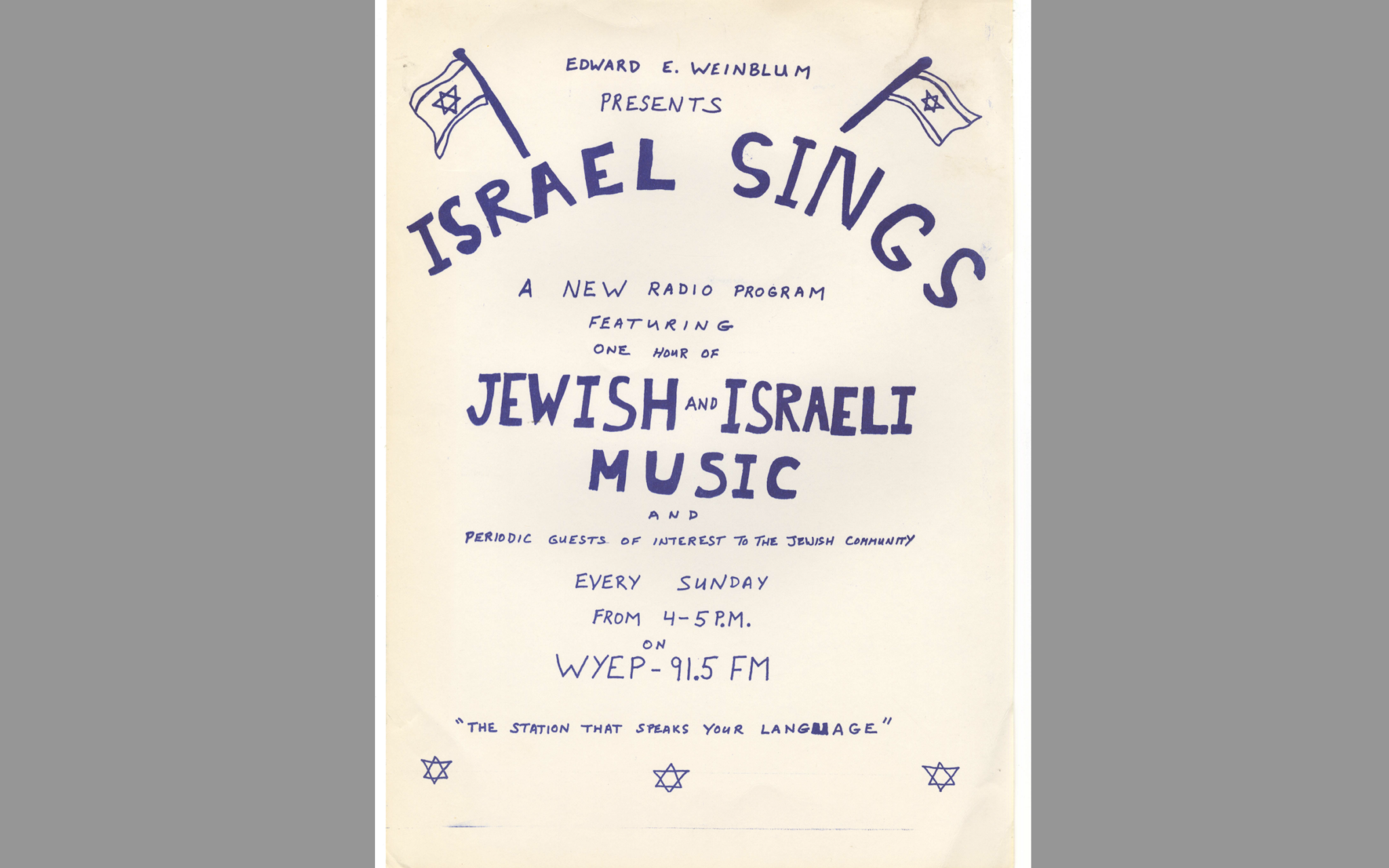
Each week, "Israel Sings” brought the wide array of Jewish music to the airwaves of Pittsburgh.
I had a song stuck in my head all summer. It was Chava Alberstein’s first recording of “Rabbeinu Tam,” the version from her 1967 album “Yiddish Folk Songs.”
The song condenses a millennium of Jewish culture into a hummable melody with fable-like lyrics by Yiddish poet Itzik Manger. In the song, the famed Talmudic commentator Rabbeinu Tam receives a mash note from the Queen of Turkey. He dismisses it as naarishkeit, nonsense. Then, his rebbetzin finds the note. Jealous and hurt, she beats her husband with a rolling pin. A coda reveals the affair to be a trifling fiction, conjured by a bored tailor unspooling the twilight hours before Shabbos ends.
Alberstein’s haunting interpretation turns this playful song into a wistful lament for the lost cultural world of the shtetl amid an emerging joyful Jewish future in Israel.
Get The Jewish Chronicle Weekly Edition by email and never miss our top stories Free Sign Up
I first heard this song on “Israel Sings,” a radio program that aired on the earliest days of WYEP-FM. Edward Weinblum launched the show in 1975 and hosted for several years with a series of Israeli co-hosts, including Sarit Gamliel, Malka Weitzman and Lynda Aussenberg. Aussenberg appears to have carried the show into the 1980s.
Weinblum recorded some of his programs. His widow recently donated these recordings to the Rauh Jewish Archives, and we have added the entire collection to our website. It comprises 24 hour-long programs between June 1976 and January 1977.
Weinblum took the show seriously. He prepared careful playlists for each episode, often with scripted comments between songs. He read announcements from local congregations and organizations, as well as news from Israel. The July 25, 1976, episode includes a recording of Yitzhak Rabin discussing Operation Entebbe. The Israeli co-hosts presented all their song commentary in Hebrew, followed by an English translation.
By the mid-1970s, America still had Jewish immigrants from Eastern Europe who held an ancestral musical culture of Yiddish folk songs and Chazzanus. And so “Israel Sings” played Theodore Bikel and Cantor Moshe Taube and “Romania, Romania.”
At the same time, a newly ascendant Orthodoxy was developing a contemporary musical cultural through boys’ choirs and groups like Ruach Revival and Shma Kolanu.
Israel was nearing the end of the heyday of its folk revival of the late 1960s, when acts like Chava Alberstein, Ilana Rovina, Nama Hendel and Ran Eliran were pairing traditional folk melodies with Jewish texts to create a new Israeli musical grammar.
And as Israel was completing its first quarter century, it was gaining confidence in its own culture. Musicians were developing secular Israeli takes on contemporary genres like musicals, disco and pop. Do you remember the groovy Israeli rock band Poogy?
“Israel Sings” played all of this music.
When you hear Aris San, the Barry Sisters, Cantor Seymour Rockoff, Shuli Natan and the Choir of the Chief Rabbinate of the Israel Defense Forces, all within the span of an hour, you get a visceral sense of the diversity of global Jewish culture.
On air, Weinblum described “Israel Sings” as a founding member of the Heritage Broadcast Institute. Curious, I dug around and found an archival collection at the University of Pittsburgh. The collection had belonged to Marcel Kopp, a Belgian immigrant who was producing a music program on WYEP called “The French Horn.”
In March 1975, Kopp was invited to a one-day Conference on Ethnic Radio and the Community, sponsored by the new Study Center and Archive of Musical Pluralism at the University of Pittsburgh. SCAMP was created to document ethnic music in Western Pennsylvania. At the conference, Kopp and others founded the Heritage Broadcast Institute to revitalize the fading world of ethnic broadcasting in the city.
The Heritage Broadcast Institute was a brokerage service. It secured airtime on local radio stations, which it turned over to producers from different ethnic communities.
A robust media landscape made this possible. WYEP, WDUQ, WEDO, WAMO, WPIT and WPSL all participated. Commercial stations were generally locally owned and could make programming decisions. The late 1960s and early 1970s also saw the flourishing of full-power FM stations operated as community nonprofits. The National Federation of Community Broadcasters began in 1975 to advocate for these stations.
Heritage Broadcast Institute’s keynote project was “Living Heritage,” airing twice weekly on WDUQ. Each episode highlighted a different community. Titles spanned the globe: the French Horn, the Slovak Radio Program, Grecian Melodies, Hungarian Varieties, The Green Groves of Erin, the Polish Radio Hour, Israel Sings, Slavic Moods, the Arabic Hour, the Russian Hour, Regina del Mio Cuore and Ukrainian Music.
This international roster obscures Pittsburgh’s actual demographic makeup. By the mid-1970s, less than 5% of the metropolitan area was foreign born, smaller than Philadelphia, Detroit, Cleveland, Chicago and Boston. And while all those cities would see their foreign-born populations increase over the next 40 years, ours stalled.
Pittsburgh was no longer an immigrant city. It was a second-and-third-generation city. It was a city where many had a parent or grandparent from another part of the world.
A similar decline in the Jewish community prompted cultural heritage initiatives in the late 1960s and early 1970s, such as the National Council of Jewish Women Oral History Project, Judaica libraries at major universities, and the Western Pennsylvania Jewish History Project. Anxiousness about a fading heritage appeared as an occasional criticism of “Israel Sings,” that it didn’t play enough of the old Yiddish classics.
Heritage Broadcast Institute aimed higher than all this. It often insisted it was not a documentation effort, nor was it serving local communities. Through its distinct format, it wanted to model a multicultural ideal. “‘Living Heritage’ is not an ethnic series directed to any of the many ethnic groups in the area. No, ‘Living Heritage’ is (ethnic) people living, rejoicing, acting, producing among (American) peoples,” Kopp wrote.
A generation earlier, the “melting pot” theory had proposed that each new immigrant group would contribute to a shared American culture. It did, but it also left those groups worrying whether they would disappear entirely through assimilation.
The U.S. Bicentennial year drew these complex feelings to the surface. In his first press release for the “Living Heritage” series, Kopp wrote, “The 200-year-long building of America by many peoples of foreign origins, their presence as part of America, their radiance in the American culture, is celebrated by a new joint radio broadcast.”
Already by early 1976, though, the radio stations were pulling back. WYEP dropped many Heritage Broadcast Institute programs in early 1976. “Israel Sings” survived the cut for a while, thanks to a write-in campaign from the Jewish community.
“Israel Sings” caught a moment. It existed through a combination of robust local media, changing ethnic demographics in the region, an emerging multiculturalism and a thriving Jewish musical cultural, all supercharged by the ferment of the Bicentennial.
At first I thought, “This could never happen today.” But with podcasting, it definitely could. What’s needed is dedicated people like Kopp, Weinblum and the others. PJC
Eric Lidji is the director of the Rauh Jewish Archives at the Heinz History Center. He can be reached at rjarchives@heinzhistorycenter.org or 412-454-6406.
comments