
The Goodwill Collection
In the last era of turmoil overseas and rising threats at home, one Jewish communal leader sent Jewish books to libraries across the region.
A letter appeared in the American Jewish Outlook on Feb. 24, 1939. It read, “A set of Jewish Encyclopedias is needed as a gift for a college library near Pittsburgh. Will you donate yours? It does not have to be new. For particulars, call S. A. T. …”
Beneath was a note: “The requester of the above has been doing yeoman’s work in placing Jewish books and encyclopedias in many local and surrounding libraries and institutions. Any reader in position to cooperate is urged to call Mr. S. A. T.”
Anyone who followed local Jewish affairs at the time might have quickly identified the author of this letter. The most famous S. A. T. in the Jewish community was undoubtedly Sidney A. Teller, who ran the Irene Kaufmann Settlement House.
A few issues later, the Outlook broke the story. For two years, Teller had been secretly donating Jewish books to libraries throughout the city and across the region. He began by sending nine copies of the 12-volume Jewish Encyclopedia to three branches of the Carnegie Library of Pittsburgh and the libraries of six area colleges: Carnegie Institute of Technology (now Carnegie Mellon), the University of Pittsburgh, the Mount Mercy College for Women (now Carlow), the Pennsylvania College for women (now Chatham), Duquesne University and Westminster College. That last one was the outlier, a United Presbyterian college in New Wilmington, Pennsylvania, up in Lawrence County.
In a thank you letter, Westminster College Librarian Mildred A. Ailman told Teller the reference set would “fill a need in our library collection and I hope it will lead students to a knowledge and appreciation of the Jewish race which is too often lacking.”
This was the purpose of Teller’s campaign, as he explained at the time: “The placing of these Jewish Encyclopedia in the various libraries has been a great help in giving factual information as regards our people. And the value of these gifts has been increased with the situation which has developed since we started two years ago.”
The developing situation was Nazism. Germany had annexed Austria in March 1938 and then coordinated Kristallnacht in November 1938. Jewish deportations were underway. War was inching closer. All this overseas turmoil was reverberating back to the United States, rattling the ground beneath the feet of American Jews through the antagonism of Father Coughlin, Charles Lindbergh and the German American Bund.
Teller planned to keep his work private. He only went public because Funk & Wagnall’s ran out of copies of the Jewish Encyclopedia. He needed to find used ones.
The coverage helped. Teller found a copy, which he sent to the State Teacher’s College in Slippery Rock, now Slippery Rock University. Requests soon came from St. Vincent’s College in Latrobe and Grove City College in Grove City. With help from local Jewish organizations, Teller was more easily able to find and buy encyclopedias.
Following each donation, the Outlook printed thank you letters. From St. Vincent College’s Rev. Valentine J. Koehler: “Much of the printed matter today on the Jewish people is tainted and colored so as to produce only intolerance and breed animosity. We are confident that the Jewish Encyclopedia will go far in dispelling false ideas and help many to realize the many contributions made in diverse fields by the Jewish people.” From Grove City College Librarian Isabel Forbes: “You may tell the donor that here Jews, Protestants and Catholics mingle and are accepted on equal standing. The students seem to judge each other by ability, character and personality, irrespective of creed. The attitude of the students reflect in a great measure the attitude taken by the faculty.”
In addition to encyclopedias, Teller raised money for the Carnegie Library of Pittsburgh to acquire introductory volumes about Judaism. He branded his effort “The Goodwill Collection.” By early 1940, he had placed 58 books into the library system.
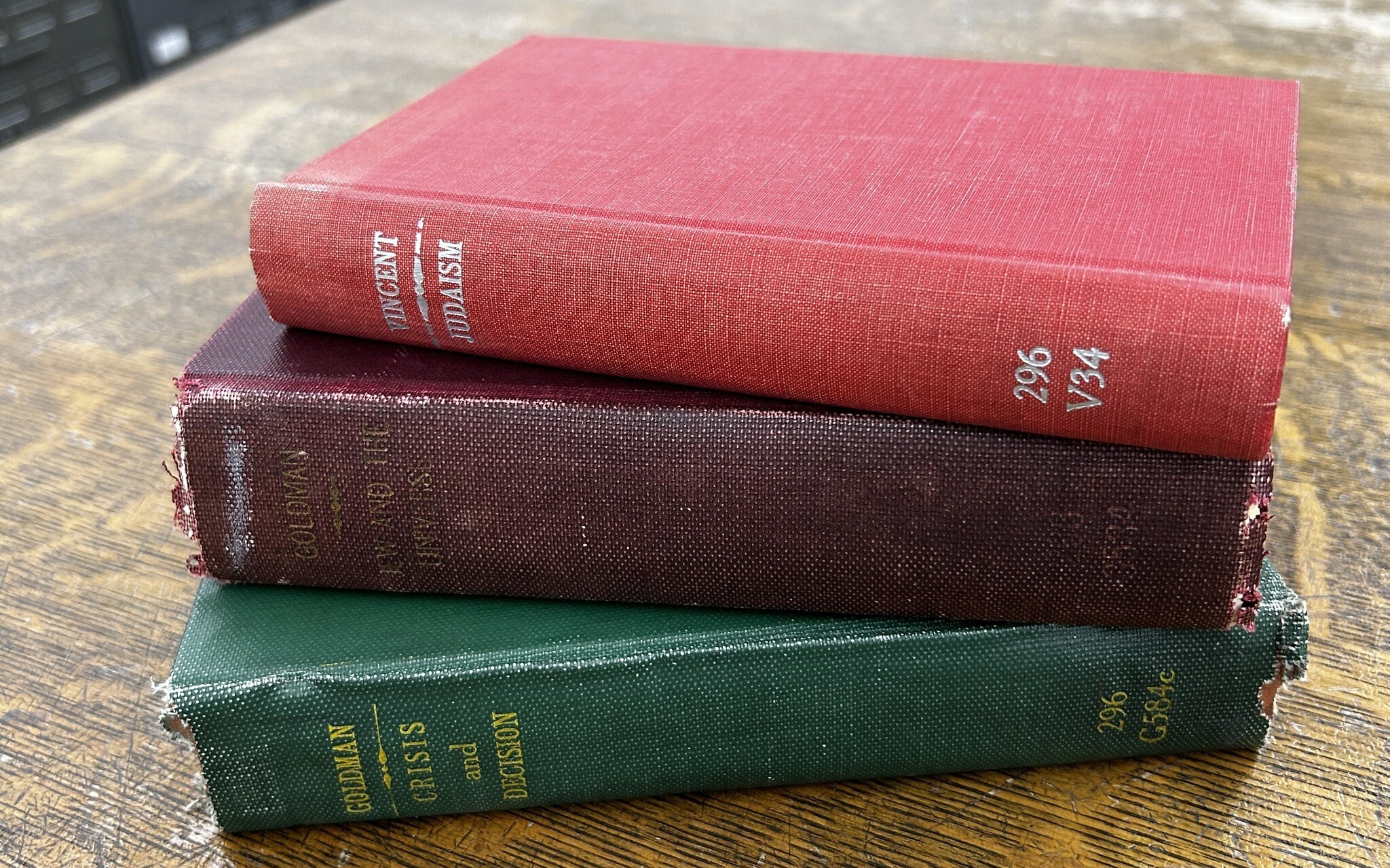
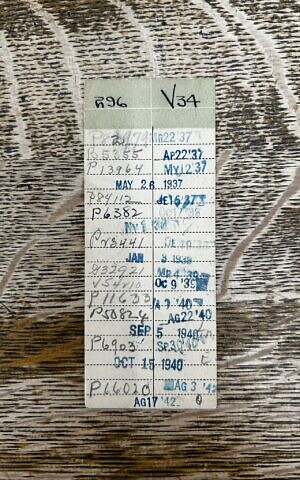
As I was researching this story, I realized that some of these books might still exist. After a long catalog search, I found that the main branch of the Carnegie Library in Oakland still held at least three of the original 58 volumes. All three were kept in the closed stacks, beyond the reach of the inquisitive browser, available only by request.
When the books were brought to the reading room, they gave the impression of a dozing shopkeeper awaking at the sound of the front door opening, groggy but ready to make a sale. These books were archaic, written in a gust of mechanically precise 50-word sentences ill-suited to our impatient age. I was saddened that none bore a special bookplate announcing the Goodwill Collection but delighted to find a donor name hidden in the gutter of two of the volumes: “Presented by Leon Falk Jr.” The third read, “Anon.”
Teller came to settlement work with a deep faith in the humanities. As an idealistic young man in Chicago at the turn of the century, he founded a group called The Butterfly Association. It took its name from a Hawthorne story. Its purpose was “the betterment of humanity and the encouragement of all that is good and beautiful.” It produced a journal of poetry and essays yearning to help humanity reach high ideals.
Our era leans toward data, and so everyone will want to know whether the Goodwill Collection worked. Well, if effectiveness is defined by the elimination of bigotry, then, no, it didn’t, unfortunately. Thankfully, other metrics exist. The project didn’t so much create goodwill as build upon existing goodwill. The important part of the story is the four small-town librarians who called Pittsburgh, seeking Jewish books. One wonders if these relationships were maintained after the Jewish Encyclopedias arrived. PJC
Eric Lidji is the director of the Rauh Jewish Archives at the Heinz History Center and can be reached at rjarchives@heinzhistorycenter.org or 412-454-6406.
comments