
Mock seder at Pitt brings students, elders together through food and tradition
"[W]hat happens once they’re there — the exchange of ideas, stories, and perspectives across generations and common ground — is where the real value lies.”
Multiple ages and cultures will join in celebrating Passover when GIFT (Giving It Forward Together) holds an experiential mock seder at Chabad at the University of Pittsburgh Sunday, March 22.
The event was inspired by GIFT’s annual Passover2Go program which delivers meal and gift kits prepared by university students to hundreds of elderly residents throughout Pittsburgh.
Those students as well as faculty, members of Osher Lifelong Learning Institute, and others will be seder guests, said GIFT founder and executive director Rochel Tombosky, who expects an “eclectic” mix.
“A lot of the student ambassadors who curate our kits every year are not Jewish. Some are from other countries and may not know about, or have ever experienced, Passover. We realized we needed to create a learning opportunity and fuel a kinship.”
The gathering will include traditional seder plate items, matzah ball soup, kugel and other fare, as well as a matzah making station, and a charoset bar that reflects how Jews in various parts of the world prepare the fruit-and-nut mixture symbolic of Passover.
“Food is one of the best ways to bring college students together,” said Susan Baida, vice-president of GIFT’s board and former executive director of the Center for Applied Research on Targeted Violence at Carnegie Mellon University and Pitt. “But what happens once they’re there — the exchange of ideas, stories, and perspectives across generations and common ground — is where the real value lies.”
Cards with talking points will be distributed among guests to spark conversation about the Passover story and associated elements of freedom, grief, kindness and humility, said Tombosky, who is working with half a dozen other women to create the cards.
“A big part of the Passover seder is having young people ask questions.”
Madison Jean, a graduate level physical therapy student at Chatham University and a GIFT volunteer, said she’s “excited to attend.”
“One of the great things about living in Pittsburgh is that it opened my eyes to other cultures, which I didn’t experience much in my small town,” said Jean, 24, who is from Williamsport, Pennsylvania. “The Jewish culture seems super interesting to me, and I want to learn more about it.”
To prepare for the seder, Jean watched “The Prince of Egypt,” an animated movie adaptation of the Book of Exodus, and read a tutorial about Passover provided by Tombosky.
Envisioning her career in health care, Jean believes that becoming familiar with other cultures, and not just Judaism, will enhance her professional development.
“In terms of future patients, respecting and appreciating their differences will help me in my practice,” she said.
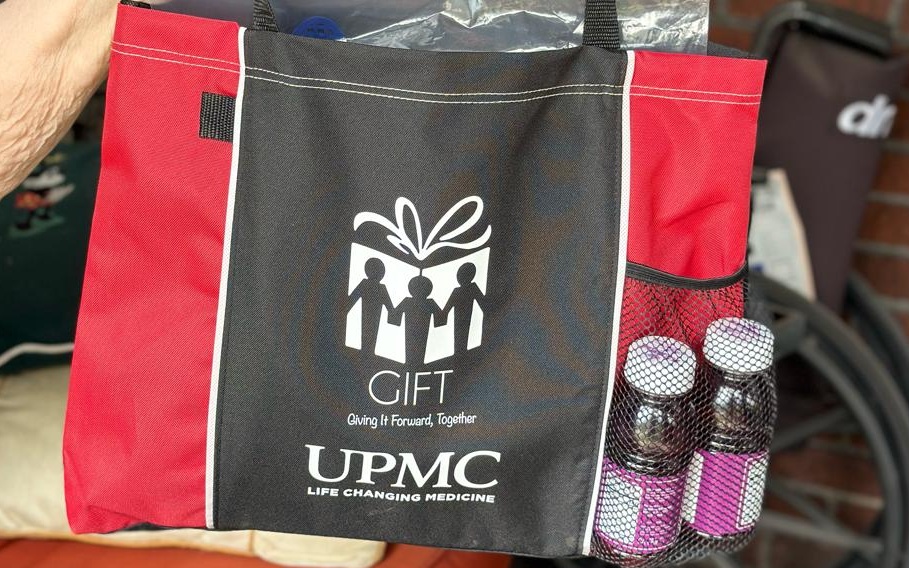
Jean and other volunteers from Chatham curated gift bags for distribution with the Passover2Go meal kits by the beginning of the holiday April 1. Working within a budget they selected comfort items such as pill organizers, lip balm, notebooks, heart-shaped hot-and-cold packs, and crocheted sunflowers with an inspirational message.
Meal kits, which will include Haggadahs, are being prepared in partnership with the nonprofit Our Giving Kitchen.
This is the ninth year for Passover2Go, which is supported by UPMC and other donors, said Tombosky, former owner of a home health care agency.
“We’re providing healthy food that taps into food insecurity but we’re also helping seniors to feel seen and heard. Our meal kits are the only way that some can celebrate the holiday. They’ll tell us it reminds them of when their house was full.”
Some kits have gone to Holocaust survivors, whose diminishing numbers have given the home-delivered seders a poignant meaning.
“It could have been their last seder,” said Tombosky. “I know that sounds dark, but it’s also beautiful that they got to celebrate Passover one last time.”
She recalled one survivor who died a week after receiving a kit. “He passed away knowing that a younger generation did not forget about him. For the students who put time and effort into making the kits, learning this left them speechless,” she said.
Noting the need for better education around the Holocaust and other historical events, Baida said interactions with elders and exposure to Jewish traditions, like a mock seder, foster understanding in ways that textbooks and coursework alone cannot.
“In the United States, studies indicate that more than one in 10 young adults may not have heard of the Holocaust and about one in five believe it is a myth or exaggerated,” she said.
“Even more striking, nearly two-thirds of young adults are unaware that 6 million Jews were killed.”
Experiential learning is also an antidote to misinformation promulgated on social media, Tombosky said.
“We want young people to be culturally aware, but we don’t want them getting their information from Instagram and TikTok. Sitting at a seder and breaking matzah together and tasting charoset for the first time is a very different and valuable learning opportunity.”
Positive interactions like these, she said, enable people to respond to messages of antisemitism with “That’s not my experience.”
GIFT was founded to help foster a culture of empathy and meaningful intergenerational connections, said Tombosky, noting the nonprofit is non-denominational and performs many different acts of kindness.
Besides Passover, meal kits are delivered at Thanksgiving and during the winter. Other GIFT initiatives include packaging food and diapers for community distribution centers, making toys for dogs and cats in animal shelters, and creating snack packs for guests of Pittsburgh Family House, whose loved ones are being treated at area hospitals.
One of GIFT’s latest projects is arranging bouquets for women who have lost their babies by partnering with Pittsburgh Doula Bereavement.
“We go where the need is,” Tombosky said. PJC
Deborah Weisberg is a freelance writer living in Pittsburgh.
comments