
Miriam Udel, prominent scholar of Yiddish literature, comes to Pittsburgh
Udel hopes her role as darshanit helps more audiences access Yiddish texts and be curious about the past.
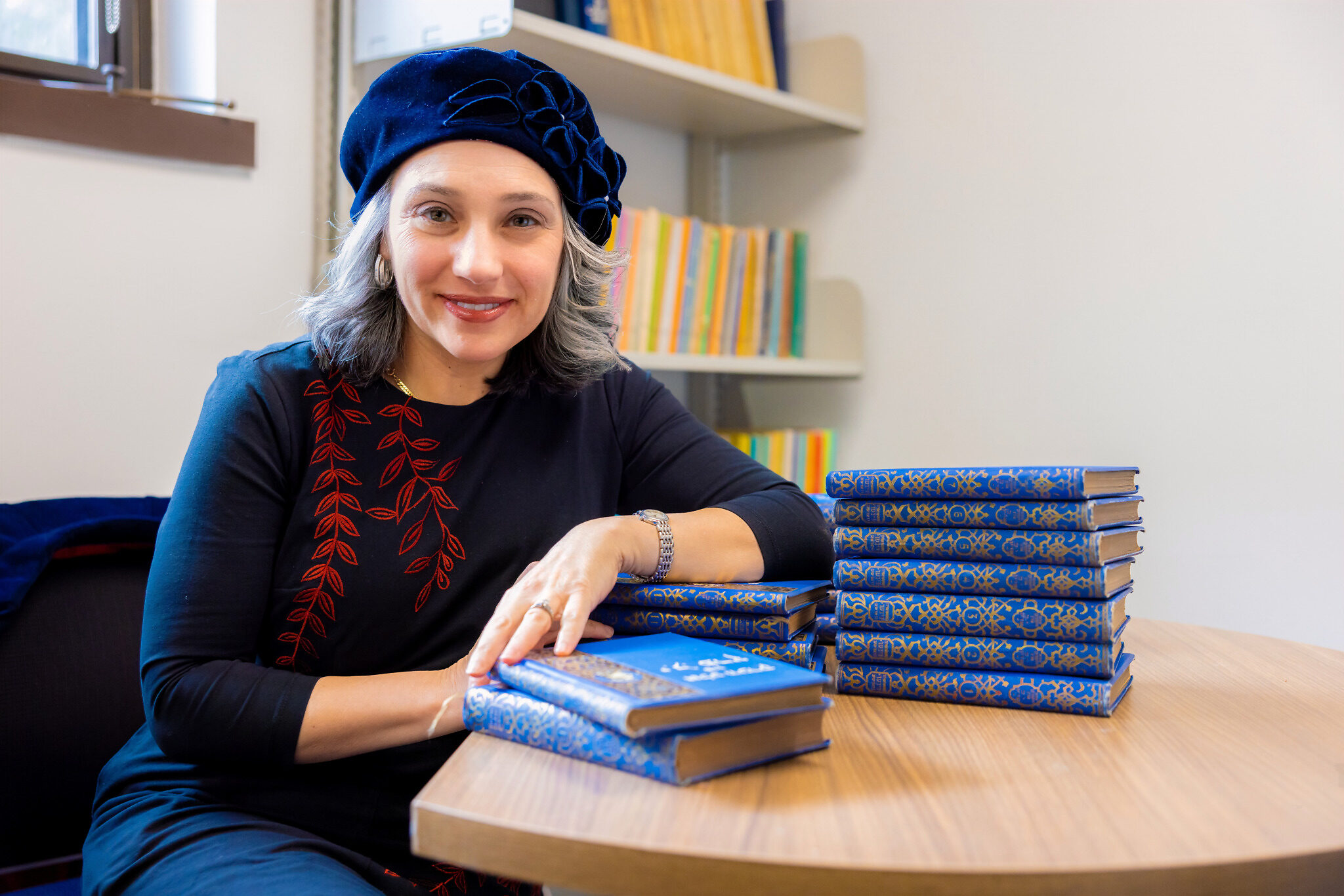
When professor Miriam Udel pursued rabbinic ordination, none of the existing titles felt right to her. While others in her cohort at Yeshivat Maharat — the first Orthodox yeshiva in North America to ordain women — chose rabba or rabbanit, Udel landed on something different. She chose darshanit, meaning “interpreter.”
Udel is one of the most prominent scholars of Yiddish children’s literature, and is also known for translating “Meynekes Rivke,” the first known book published by a Jewish woman. Rivke bas Me’ir Tiktiner, the author, identified herself as “harabanit vehadarshanit,” so Udel felt it fitting to pay tribute to her. The “Meynekes Rivke” was a code of conduct for young women, separated out by relationship: how to be a bride, how to be a mother, how to be a daughter-in-law, and so on.
“The body of the book is written in Yiddish, but it begins with a piyyut, a Hebrew poem,” Udel said. “She quotes from a series of biblical verses and establishes herself as a pioneer, writing as a woman writing for women, but also plugging herself into centuries of tradition.”
This resonated with Udel. “I would like to show up as an interpreter of text in a distinct feminine or feminist way,” she said.
Udel, who will be presenting her research both into Rivke bas Me’ir Tiktiner and Yiddish children’s literature in Pittsburgh on Oct. 21 at the Jewish Book Festival and Oct. 22 at the University of Pittsburgh through its Jewish studies program, ties her scholarly interests together through an interest in how Judaism changes in modernity.
“I had a life-changing conversation with my doctoral adviser, where said I was thinking of studying the relationship between literature and the historical process of secularization. They said ‘why don’t you give Yiddish a chance? You could study the questions you’re interested in very efficiently.’ So I did,” Udel remembered. Her Hebrew was strong enough that she could pick up Yiddish quickly, and it proved to be a lifelong relationship that was essential to her research.
“If we had to give one single bold headline to the story of Jewish modernity it would be secularization,” Udel said. “What used to be a profoundly religiously-rooted culture has to transform. It destabilizes some Jewish communities, who have to ask how to retain what is distinctive, what is meaningful, and what is ethically rooting.”
These are still questions that are pervasive elements of contemporary Jewish life. Fraught discussions around Diasporism and Zionism, religiosity and secularism, and what it means to be Jewish in the first place are as relevant now as they were 100 years ago.
Children’s literature enters that conversation through a way to instill values in the next generation at a young age.
“I got interested in this at the convergence point of two of my roles in life: teaching Yiddish language courses and a mother of two young children. I started wondering one day whether there was Yiddish children’s literature and I quickly found out there were about a thousand children’s books and several children’s periodicals,” she said.
These periodicals were often associated with a fraternal organization like the Bundists, the Sholem Aleichem Folk Institute, Workmen’s Circle socialists, Labor Zionists, or Communists.
“Children are going to assimilate the values they’re taught, rebel against some of them, enact some of the ideas they encounter in early childhood,” Udel said.
Udel wrote an op-ed for The New York Times in November 2023 titled “What I Read to My Son When the World is on Fire,” where she detailed a central idea of her scholarship, that children’s books can bridge political divides by providing a more hopeful vision for the future. Reflecting on that, she added “Hope is a political tool and a political necessity.”
Her translation of children’s literature includes “Labzik: Tales of a Clever Pup,” the story of a Yiddish-speaking family in the Bronx exploring right and wrong through the eyes of an adopted dog, and “Honey on the Page,” an anthology of the many stories she’s encountered in her work.
For the Pittsburgh Jewish Book Festival, Udel will be teaching workshops both for children and for adults. For adults, she will be presenting on the ideas she’s found in her research on children’s literature on Oct. 21 at Congregation Beth Shalom, and she will present the story of the “Meynekes Rivke” in a workshop on the Oct. 22 at Benedum Hall at University of Pittsburgh.
Udel hopes her role as darshanit helps more audiences access Yiddish texts and be curious about the past.
“If I’m going to think about one overarching theme, it is the liveliness of Jewish text culture and the ways that we can find ourselves and our experiences in and through these texts, not putting ourselves into the texts and reading into them but reading out of them,” she said.
Even if the ideas in an older Yiddish text are ones you might not see yourself in, you can learn and form your own opinion by engaging with it, she said.
“These books are a groundwork for empathy. Training for empathy is the bedrock for Yiddish children’s literature.” PJC
Emma Riva is a freelance writer living in Pittsburgh.
Miriam Udel will be lecturing at Community Day School 8 a.m. on Wednesday, Oct. 21, then on “Modern Jewish Worldmaking Through Children’s Literature” at Beth Shalom at 7:30 p.m.. She will be at the University of Pittsburgh, 227 Benedum Hall speaking on the topic of “The First Jewish Woman Author (That We Know Of)” at 11 a.m.
comments