
Meat out of the pot
Before the New Deal and the Great Society, the Lechem Aniyum Society met a simple need: delivering kosher food to those who could not afford it.
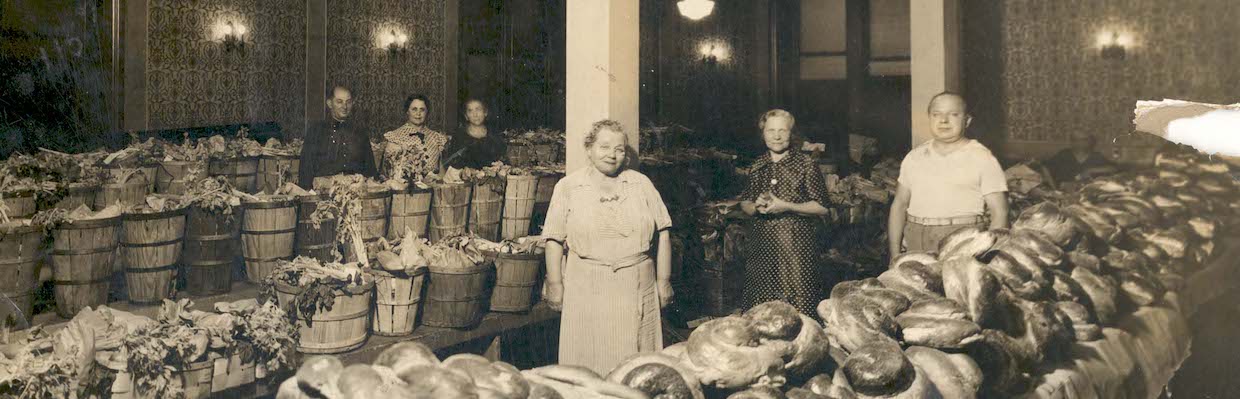
If you want to see abundance, there is an incredible photograph of the Lechem Aniyum Society. In a large room, likely the basement of the old Beth Jacob synagogue in the Hill District, six people stand between benches lined with newspaper. The benches are packed with overflowing bushels of leafy produce and piles of gorgeous challahs.
The photograph is dated Dec. 27, 1936. “Lechem Aniyum” means “Bread for the Poor.” It began in an informal capacity in the Hill District around 1917 and expanded its efforts in late 1920s and early 1930s, as the economy worsened. At its peak, it delivered some 200 boxes of kosher food every Thursday, for Shabbat. Each box contained “meat, bread, sugar, flour, rice or beans, tea or coffee, candles, potatoes, onions, carrots, cabbage, and sometimes fish,” as one member explained to a donor in late 1932. The motto of the organization was “He who saves one life, is as he saved the entire world.”
For nearly a century, Lechem Aniyum volunteers made pre-dawn visits to the produce yards in the Strip District, spent long hours packing and delivering boxes, and expended much energy pleading for funds. Lechem Aniyum was still operating in some capacity into the 21st century, but its scope gradually declined decade by decade.
Get The Jewish Chronicle Weekly Edition by email and never miss our top stories Free Sign Up
Bess Feingold took over in the mid-1960s, after the death of previous organizer Ben Edelstein. “We used to give it every week when Ben was living,” she said in 1985, in a National Council of Jewish Women oral history. “Then we started every two weeks. Then we went to every three weeks. Now it’s once a month because finances are low. See: for soliciting, we have a file. We have the names that we send the letters to twice a year, to the same people. And they send in money. Well, they’re not sending it in as good as they used to. Because things are rough. And that’s why we go once a month now.”
By “rough,” Feingold likely meant the regional economy, which was slogging through the depths of deindustrialization. She also blamed overseas giving, feeling that many who gave to Israel couldn’t afford two causes. And she cited cultural changes in giving, recalling how people with pushkes once walked Murray Avenue seeking support.
There was a related cause, one that comes into clearer focus today. Through its Great Society legislation in the late 1960s, the Johnson administration made new money available for social needs. These funds were channeled through local governments and existing charitable agencies. The United Jewish Federation created the Council on the Elderly to better coordinate local communal efforts around seeking funds. A string of elder care projects followed, including new housing projects and recreation programs.
The Older Americans Act of 1965 is sometimes overlooked among the many consequential pieces of legislation from that era. It created a national funding network for elder care. An expansion of the law in 1972 created the Senior Nutrition Program, including grants for meal deliveries to the elderly. Lutheran Service Society had launched its first Meals-On-Wheels program in the Pittsburgh area in 1968. With the Senior Nutrition Program, the Lutherans and other food delivery groups could seek federal aid.
On a visit to Israel in early 1971, Jewish Home for the Aged Executive Director Leon Kalson learned about the meal deliveries of Malben, a social service agency created by the American Jewish Joint Distribution Committee and the United Jewish Appeal and later absorbed into the Israeli government. He wanted to bring the idea to Pittsburgh.
Kosher Meals-On-Wheels began in spring 1972. Jewish Family & Children’s Service handled the intake of clients. The Jewish Home for the Aged prepared the meals in its kosher kitchen. B’nai B’rith Women oversaw volunteer delivery drivers. The program continues today as Mollie’s Meals, named for longtime volunteer Mollie Dugan.
At the same time, interfaith clergy from Squirrel Hill met with an adviser from Lutheran Service Society to create a neighborhood Meals-on-Wheels. The project stalled for three months until two Temple Sinai members made a surprise announcement: Minnie Litman had raised almost $1,000, and Jackie Unger said the Temple Sinai Sisterhood would lend its kitchen to the group. Squirrel Hill-Greenfield Meals-On-Wheels began deliveries on July 31, 1972, and later expanded to Shadyside, Point Breeze and Oakland.
Using funding from Allegheny County, the Council on the Elderly began offering hot, non-kosher lunches at Murray Towers in June 1977. A few months later in September, the Council on the Elderly helped organize daily kosher lunch service at the Jewish Community Center in Squirrel Hill, prepared by Prime Kosher. The cost of the kosher program surpassed the $1.10 per meal allowance offered by the county, and so the Federation provided supplemental funding through its Louis Engelberg Endowment Fund. The program allowed the Jewish Community Center to serve anyone over 60 in Allegheny County, which meant kosher residents of other wards could come for meals.
Throughout these changes, Lechem Aniyum remained independent. Feingold said the organization didn’t want to mess with the paperwork associated with public monies.
Publicly funded programs greatly expanded the number of Jewish elderly being fed in our community. The public funding structure also put more distance between giver and receiver. Your tax dollars meander through federal, state and local treasuries, and trickle into agency budgets, before landing on the plate of an elderly person.
In moments like the present, it can be easy to forget that the hope of public money is not to replace personal giving — it is, after all, still your tax dollars — but to make the most out of private money. When public funding is tightened, we remain responsible.
Feingold felt obligated to feed the hungry because her family had turned to Lechem Aniyum when she was a child. In those rough years, she recalled a moment when a man came to the door one night, asking for food. “[My mother] took the meat out of the pot and gave him. We didn’t have enough for ourselves, but she made sure he had some. She said, ‘As long as they ask for food, you’re not allowed to turn them down.’” PJC
Eric Lidji is the director of the Rauh Jewish Archives at the Heinz History Center and can be reached at rjarchives@heinzhistorycenter.org or 412-454-6406.
comments