
Jewish Genealogy Society of Pittsburgh marks 10 years with growing membership and expanded programming
Through hybrid and online-only gatherings, group enables like-minded individuals to explore their own histories while creating community
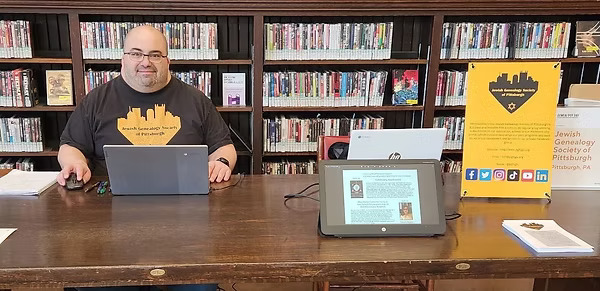
As the Jewish Genealogy Society of Pittsburgh approaches its 10th anniversary, the once-small local group is marking the milestone with ambitious programming, a growing global membership and a renewed commitment to helping people uncover — and make sense of — their family histories.
Steve Jaron, JGS’ president, touted several upcoming events and reflected on the group’s near-decade of growth.
On Jan. 25, JGS will welcome Janice Lovelace, a genealogical researcher, author and lecturer, with over 30 years of experience, for “The Emotional Roller Coaster of DNA Testing.” The Zoom program will allow participants to explore the messy side of DNA testing and address strategies for navigating genealogical surprises, such as what to do when discovering previously unknown relatives or non-responsive matches.
Weeks later, on Feb. 15, JGS will welcome Ava Cohn, a genealogist referred to as “Sherlock Cohn,” for a program aimed at helping participants make sense of old photographs and the confusions arising from dating pictures and identifying individuals.
Then, on May 17, JGS will host Janette Silverman, a professional genealogist with over four decades of experience, for an exploration of how a Lithuanian family arrived in Pennsylvania in the late 19th century and somehow ended up in Bisbee, Arizona.
JGS events, which include both hybrid and online-only gatherings, enable like-minded individuals to explore their own histories while creating community, Jaron said. “There is some sort of genealogical learning opportunity for everybody.”
Jaron said he is proud of JGS’ “supportive” environment and noted the organization’s continuous growth: As of last week, the group includes 228 members, with many living nowhere near western Pennsylvania.
The fact that members worldwide belong to an organization rooted here “shows how far reaching we are,” Jaron said. Whether in Pittsburgh or at genealogy-related gatherings across the country, “people are always coming up to me and saying they love our programming.”
Eric Lidji, director of the Rauh Jewish History Program at the Heinz History Center, called JGS a “real success story in the local Jewish community.”
“Starting out with little more than a name and a lot of passion, they have created a robust programming calendar drawing participants from all over the world,” Lidji said.
In recent years, the Rauh has partnered with JGS, while also providing “space, administrative support and seed funding,” Lidji said. “We celebrate their milestone.”
A growing interest in genealogy isn’t only occurring in Pittsburgh.
With people purchasing DNA tests, access to online records, digital family tree building tools and other services, the global market for genealogy products and services was valued at $6.6 billion in 2024 and expected to grow to $16.6 billion by 2032, according to Kings Research, a global consulting and research group.
The attraction to genealogy, according to Psychology Today, stems from its ability to “make abstract history real, and we want to know if the past has guidance for us.”
Regardless of what initially drew someone to JGS — membership costs $18 per year — there’s a shared sense of camaraderie among members, Jaron said. During warmer months, the group often congregates and “talks about their genealogical brick walls and their success stories.”
The get-togethers are something generations of Jews can appreciate, Jaron said. They’re a “kibbitz session.” PJC
Adam Reinherz can be reached at areinherz@pittsburghjewishchronicle.org.
comments