
Jewish activist and organizer visits Pittsburgh, promotes empathy and respect
'We have never needed all of us more than we have needed all of us right now'
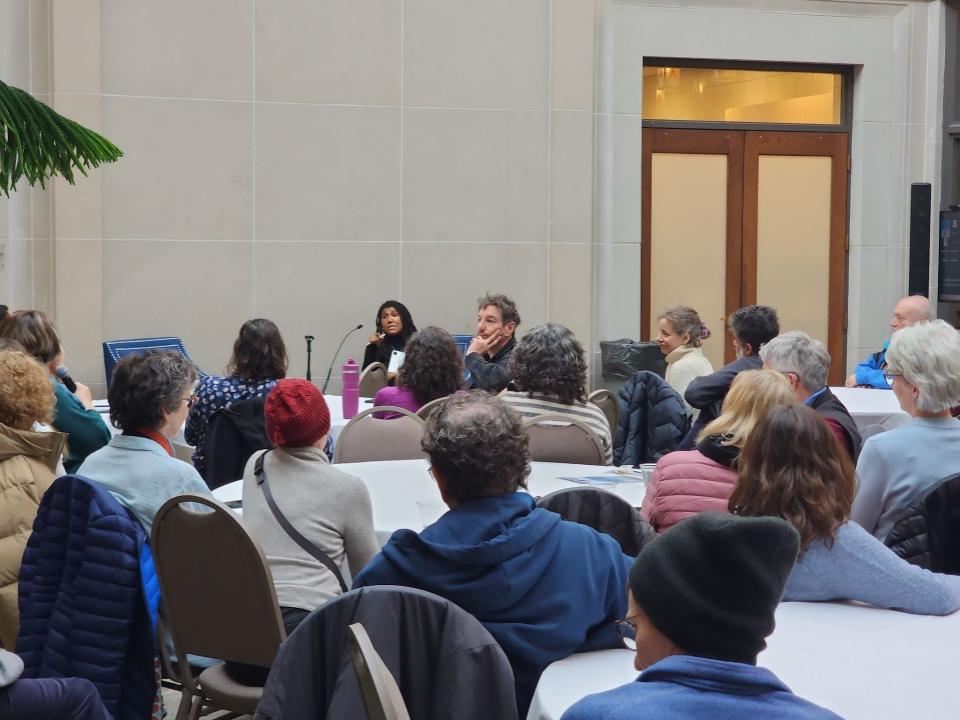
Threats to U.S. and Israeli democracy may be best countered by practicing empathy and respect, an activist known for working in progressive Jewish circles told Pittsburghers.
Speaking at Rodef Shalom Congregation on Feb. 22, Ginna Green, founder and principal of Horizon Philanthropy and a member of Bend the Arc’s board and former chief strategy officer, described a current period filled with divisive rhetoric and behavior within the U.S. and Israel as a moment ripe for communal betterment.
“We have never needed all of us more than we have needed all of us right now,” Green said during the Bend the Arc: Jewish Action Pittsburgh event, which was co-sponsored by Congregation Dor Hadash. “I don’t see a scenario where Israel is able to do and be the very best that everyone in this room wants it to be, if the United States also doesn’t be the very best it can be.”
Moving past this time of “authoritarianism” and creating solidarity and a beneficial future will require particular tactics, Green said. An inability to see people “for what they bring to our relations and communities forecloses on that possibility of changing the conversation.”
Too often, people wish to “be right” rather than “win,” Green continued. Success today is not necessarily within the confines of ensuring election outcomes; rather, “I mean winning the future where all of us are safe and where all of us are free.”
Certain “barriers” are plaguing that outcome, Green explained.
“I think it’s important for us to recognize that the division within the community along the axis of Israel-Palestine isn’t going anywhere anytime soon, and it behooves us to be willing to assess and interrogate and speak to that,” Green said.
The Sunday afternoon talk, which was titled “Building Bridges Against Fascism: Strengthening Relationships for the Battle Ahead,” decried presentism while promoting consideration of prior debate in an effort to effectuate communal healing.
Consensus around Zionism has never existed “anywhere in Israel, in the United States, around the world,” Green said. “There’s always been folks who have different opinions about what Zionism means, what Zionism constitutes, what the needs there and here constitute, and what it’s all about.” People should recognize “this is not the first time that we’re having conversations about what it should look like, what a Jewish state should look like, how it should operate … these are old conversations, actually.”
Moving forward as a community will require challenging conversations and restraint, Green explained.
Relationship building sometimes requires refraining from addressing contentious matters, Green said. Focusing on what’s agreed between parties is a “key strategy for keeping people at the table.”
Bend the Arc member Jonathan Mayo said welcoming Green back to Pittsburgh — the Jewish professional visited in solidarity after the Pittsburgh synagogue shooting — offered a chance to model “shared space and shared language.”
The program’s purpose, he explained, was neither to hear people’s takes on Israel nor to solve matters 6,000 miles from Pittsburgh; rather, it was “to build a momentary community where people felt like we could kind of approach the subject.”
“I do think that the threats that we are facing here at home are very, very real, and we are not prepared or equipped to really deal with them, because we’re not willing to sit at a table with someone just because they think X, Y or Z, and I think that’s true across the political spectrum,” Mayo said.
Dor Hadash’s Rabbi Amy Bardack, who, like Mayo, helped facilitate the conversation, said the program was a reminder “that we cannot avoid needing to talk to each other about the elephant in the room, which is very emotional disagreements about Israel.”
“We need to admit that that’s there, because it’s not going to go away, and we need to have unity and solidarity beyond that.” Only by “naming the divisions, and sitting and having those uncomfortable conversations,” Bardack said, “will we be able to join together and fight antisemitism, fight inequity and authoritarians. We can’t just avoid it and hope it will go away.”
University of Pittsburgh student Shobi Wise called Green’s remarks another reminder to “go outside into the real world, talk to more people, connect.”
Citing Green, Wise noted that “building trust and fellowship doesn’t happen if you stay in your home.”
“The first step of action — action that does anything, not just reactionary and senseless,” Wise continued, “starts with conversation and from a place of love.” PJC
Adam Reinherz can be reached at areinherz@pittsburghjewishchronicle.org.
comments