
Incoming mayor’s top cop pick is a familiar face to Jewish Pittsburghers
“I wouldn’t leave where I am now if I wasn’t serious about coming home and being in it for the long haul,” he said.
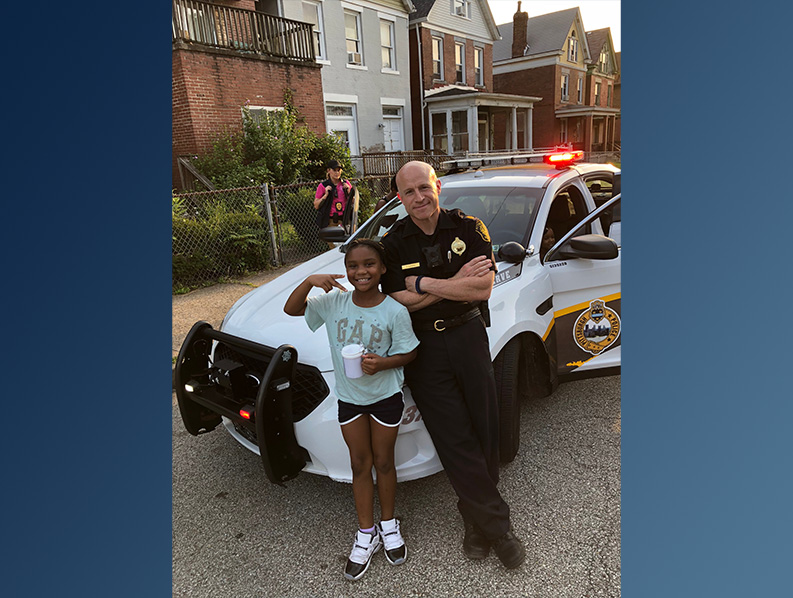
Jason Lando — Pittsburgh’s presumptive incoming chief of police — always knew he wanted to work in public safety. More specifically, Lando wanted to be a police officer. He had to wait a little while, though, until his age caught up with his ambition.
Although Lando grew up in a family of business professionals, he was fascinated by the police. As a child, he loved to play cops and robbers with several friends, who all made a pact to fight crime when they grew up.
“I’m the only one that made anything of myself,” he joked. “The others are surgeons.”
And while it was his dream to be a police officer, the Squirrel Hill native knew when he graduated from Shady Side Academy that he’d have to wait until he was a little older to join the boys in blue.
So, Lando became a volunteer EMT and paramedic while attending the University of Pittsburgh, working toward a degree in its new emergency medicine program.
Once he graduated, Lando’s dream came true when he became a Pittsburgh police officer in 2000, one of only three Jewish members of the more than 1,000-member force, serving as both a police officer and paramedic.
He spent the first five years of his career working out of the Zone Two police station in the Hill District.
His excitement at being assigned to what was then considered the “lead zone” quickly faded when he learned his initial beat was in “the park car,” meaning he would have to sit throughout his shift in a car in Point State Park.
“My first assignment was to drive this ridiculous baby car around the park,” he said. “People would point and laugh. It felt like a play car not a police car. I couldn’t wait to get on the street.”
Following that assignment, Lando spent time in the Narcotics and Vice unit beginning in 2005, including working a stint undercover.
“I would go out and do drug buys,” he recalled.
He was promoted to sergeant in 2007 before becoming a lieutenant in 2011. His final advancement occurred in 2014 when Lando became a commander. In the meantime, he earned a master’s degree in legal studies from the University of California.
While a lieutenant, Lando moved through most of the stations in the city.
“When you reach the rank of sergeant, you’re expected to be out on the street,” he said. “When you’re a lieutenant and commander, those positions have a lot of leeway, so if you want to be on the street and visible in the community, that’s your prerogative.”
Lando said he loved being in the community and with his officers, so he would go on calls from time to time.
It was that commitment to his team that led him to be one of the first officers to respond to the Pittsburgh synagogue shooting on Oct. 27, 2018.
Working as the citywide duty commander the morning of the attack, Lando had just left the hospital after visiting an officer involved in a car accident and was on his way home.
“I was passing through Squirrel Hill when the call came in,” he recalled. “They say everything happens for a reason. Under any other circumstance, I would have been at home in bed or drinking coffee and nowhere near the scene, not on duty, but I was coming back from an unrelated incident when the call came in.”
Lando was familiar with Tree of Life Congregation — it’s where he attended Hebrew school and celebrated his bar mitzvah, and his grandfather still attended Shabbat services there weekly. What he didn’t know at the time was that his grandfather stayed home sick that day.
“Joyce [Fienberg] would pick him up every Saturday at the Maxon Towers and drive him to the Tree of Life where they would go to services,” Lando said. “That morning was the first I recall in 20 years, since my grandmother died, that he missed minyan. He told her, ‘I just can’t go today.’ She went to the synagogue and was killed.”
For Lando, the days immediately following the shooting were meaningful because the city came together.
“Now there is a very strained relationship, not just between Jews and Muslims or Democrats and Republicans, but every time you turn on the news there is division,” he said. “In 2018, people were dropping off food baskets or stopping by to say thank you to the police officers for being there and doing their jobs — running into that synagogue. And now we’re talking about defunding the police. It’s a weird feeling.”
While he wouldn’t want to relive the tragedy, Lando said the unity was heartwarming.
The veteran commander retired in 2021 to become the police chief of Frederick, Maryland. Even while there, he still thought of Pittsburgh and the city still remembered him. He was a finalist for Pittsburgh’s chief of police job in 2022, but Mayor Ed Gainey eventually nominated Larry Scirotto, who resigned amidst controversy.
Earlier this month, Lando was nominated for the role of Pittsburgh’s police chief by incoming Mayor Corey O’Connor. Lando said it’s the only role for which he would leave Frederick, where he has a “supportive mayor and a city that truly loves and appreciates its police department.”
Lando is aware of tumult in his hometown’s police force and the possibility of City Council imposing a contract requirement for police chiefs. That doesn’t concern him because he isn’t viewing the job as a steppingstone or one he will give up anytime soon.
“I wouldn’t leave where I am now if I wasn’t serious about coming home and being in it for the long haul,” he said. “I want to try and get things turned around.”
His priorities include keeping the community safe, continuing the downward trend of violent crimes, dealing with the budget and equipment of the force, community relations and police wellness.
Lando believes in building relationships. Because of that, he said, community policing is imperative.
“We have to be creative how we do it. We can’t lose those relationships,” he said.
And police mental health — which he championed in Frederick — must be a priority, he said. It’s something he believes can help with community relationships.
“When you see it break down, the root is often because officers are stressed and struggling — going through divorce, drinking too much, doing double shifts. If you put them in a situation where they have to handle a potential critical incident and they aren’t in a good frame of mind, aren’t healthy, those things tend to go sideways,” he said.
He is also intent on growing the force, which he acknowledged will take time and effort.
“That is not an overnight fix,” he said. “I told people I come with a big heart, a love of the job and strong work ethic, but I don’t come with a magic wand. It’s going to take a lot of work to get the staff where it needs to be, but one of the priorities is to get our police stations back to where there are no part-time police stations.”
Lando said he and O’Connor are “very much in alignment in our priorities and our visions for the city.”
The presumptive incoming police chief, who will be moving to the South Side when he returns to Pittsburgh with his partner, Troy, said he plans on forging a strong relationship with the Jewish community, including the Jewish Federation of Greater Pittsburgh’s security team.
“We have a great relationship with our synagogues in Frederick, and I am confident that will happen in Pittsburgh,” he said. “As soon as I hit the ground running, we’ll start having meetings and getting everyone looped in. I look forward to that.” PJC
David Rullo can be reached at drullo@pittsburghjewishchronicle.org.
comments