
I am not yet done: Yom Kippur
Early America, Germany, Ukraine: Universal thoughts
Walls, towers and gates
One year during Yom Kippur, the Baal Shem Tov told the following parable: “There was once a very wise king who created the illusion of walls, towers and gates. He gave orders that people should approach him through these gates, ordering that his treasure should be scattered among the gates.” Most people stopped at the first or second gate, gathered a handful of the treasure, and left. “But eventually,” the Baal Shem Tov said, “[the king’s] beloved son went directly to his father, the king, and thus saw that there was no barrier between him and his father since the barriers were all illusions.”
The story is an essential one illustrating the Hasidic insight that “the Lord, may His name be praised, fills all worlds and there is no place devoid of Him. Every place in which a man is found, there His Glory will be found as well.”
Of course, a story like this prompts more questions than it answers. What part of our lives today, in late 2025, are illusory barriers to realizing God’s presence? Pop culture, social media, news updates that we cannot escape? Or are these things actually ways of seeing and understanding God? And why did the Baal Shem Tov choose Yom Kippur, of all days, for the telling of this tale?
Early America
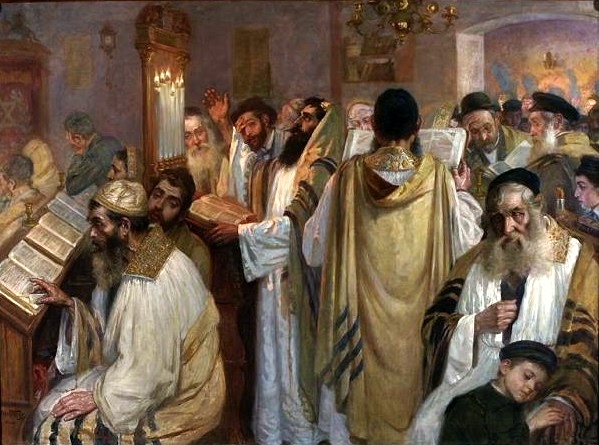
Rosh Hashanah and Yom Kippur were especially important in colonial America for Jews. Rather than belonging to the rhythm of the entire Jewish year, in many cases the High Holidays (along with Pesach) were the only days in which isolated merchants and their families could feel Jewish at all. They used this time of year to travel long distances to a community large enough to have its own synagogue — in 1755, a man named Isaac Solomon traveled from Nova Scotia to Shearith Israel in New York City.
Get The Jewish Chronicle Weekly Edition by email and never miss our top stories Free Sign Up
Jewish historian Jonathan Sarna writes of similar gatherings in the late 19th and early 20th centuries. In North Dakota, Jews traveled “for days by horse and buggy and by horseback” to a Jewish home hosting services, while in New York City, every available hall was rented out to cater to the Yom Kippur crowds. “One hall on New York’s Rivington Street,” Sarna writes, “housed five separate congregations, each on a different floor, with services lasting for twelve hours straight on Yom Kippur day.”
Germany, Ukraine and the Second Temple
Amid the scholar Victor Klemperer’s vast diaries of living in Germany from 1933-1945, he suddenly remembers Yom Kippur in 1901. In his early 20s by then, Klemperer recalled few antisemitic incidents until he and the few other Jewish students missed school because of the holiday. “The next day,” he writes, “our comrades told us, laughing and without the least malice … [that the teacher] had said to the reduced class: ‘Today it’s just us.’” As we think of all that has happened to Jews in America and elsewhere over the past few years, it’s worth remembering stories like this, along with every version of it that crowds our history.
A story from 19th-century Ukraine tells of man who got lost in the forest on his way to town to attend Kol Nidre services. Distraught to have no prayer book at hand, he prayed, “Master of the universe, what shall I do? But there is a verse, ‘The word of the Lord can be combined.’ I shall recite the alphabet and you, O Master of the universe, must combine the letters into syllables and words.” Who else but a Jew has ever thought of God, and language, and prayer, in this way?
When the High Priest left the sanctuary on Yom Kippur during the time of the Second Temple, he would pray, “May it be your will, O Lord our God and God of our fathers, that no exile shall come upon us, neither on this day nor in this year. And if exile is to come upon us on this day or in this year, may we be exiled to a place of Torah.” Is the world today more dangerous and precarious than the other time periods mentioned here? If so, can we at least say that we are holding a corner of ground dedicated to Torah?
Dudja and ibn Ezra
In 1909, a recent immigrant from Russia to the United States confessed some conflicting feelings in a letter to the Jewish Daily Forward. Having spent his boyhood up until the age of 16 in yeshivas, he abandoned all of it shortly after arriving in America. “But the nature of my feelings is remarkable,” he said. “Listen to me: Every year when the month of Elul rolls around, when the time of Rosh Hashanah and Yom Kippur approaches, my heart grows heavy and sad. A melancholy descends on me, a longing gnaws at my breast.”
Unable to believe in God, the man nevertheless says that while attending services, “I forgot my unhappy weekday life, the dirty shop, my boss, the bloodsucker, and my pale, sick wife and my children. All of my America with its hurry-up life was forgotten.” Feeling dishonest about attending synagogue simply out of nostalgia, he nevertheless asks, “Where can one hide on Yom Kippur?”
Isn’t that the question! Another letter writer perhaps provides an answer, though, on why and how a nonbeliever can attend synagogue services: “These people are my brethren, they are the people among whom I was raised, and I love them. Dudja Silverberg [a very pious Jew] goes to shul to speak with God, I go to shul to speak with Dudja.”
Sometimes, this has to be enough. So much of Judaism seems to achieve its power and permanence through accumulation. While Yom Kippur is a huge day, freighted with history and our own relationship to it, it is preceded and surrounded by our daily lives, our daily choices, “to be Jews” — whatever that means to each one of us.
Preparing for this article, I was happy to find a poem by ibn Ezra that said, “I am weary of roaming about the world, measuring its expanse; and I am not yet done … ” None of us ever are. PJC
Tim Miller is a poet and writer living in Pittsburgh. He is online at wordandsilence.com.
comments