
Honoring Esther’s legacy through a female-led Megillah reading
Considering Esther's role in the Purim story, "it just makes sense for women to narrate the story in a public way."
It is the centerpiece, the centrifuge around which the rest of the holiday of Purim revolves: the scroll of Esther. And the critical actions of the account — the coronation of a queen hiding her identity as a Jew, her willingness to speak to the king on behalf of her people even at the risk to her own life, the banquets with the king and his adviser, and finally writing letters taking charge of the affairs of Jews in the 127 provinces of the kingdom and instructing how they should recall this time period — are performed by a woman. So it just makes sense for women to narrate the story in a public way.
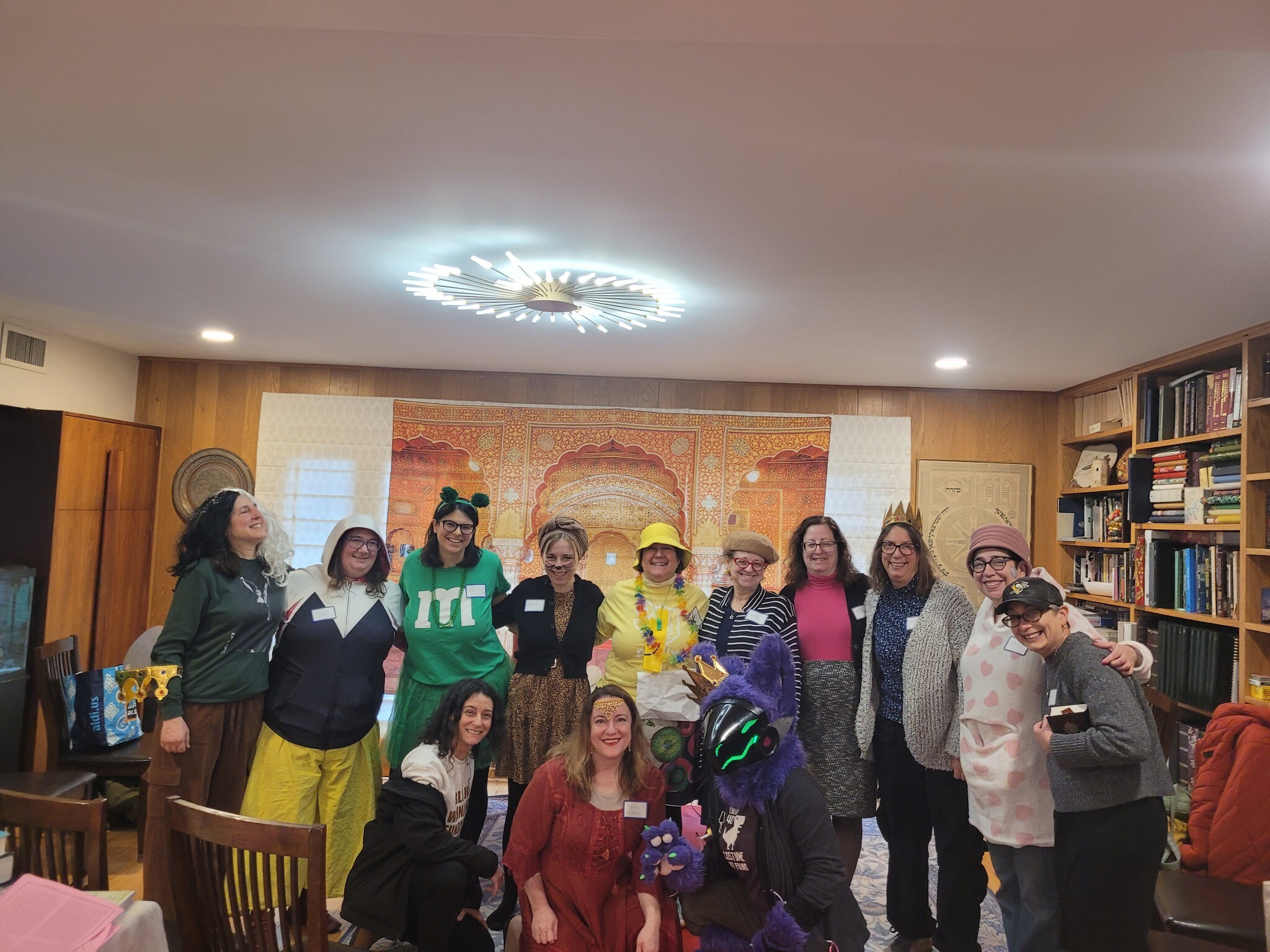
There have been many all-female Megillah readings in Pittsburgh, yet this year’s was different. Initiated by Beth Vander Stoep, who recently relocated to Pittsburgh from a community with an established women’s Megillah reading, it took place at the home of Marina Goodman, who rolled out a red carpet for attendees. Goodman had an actual red carpet for each guest to tread upon before arriving at the room where the reading of the Book of Esther would take place, which was adorned with a visual of a Persian palace.
Goodman said in an email that with her décor, along with a gold bar above her front door and purple curtains, that she “wanted to create an immersive environment where, starting with the grand purple and gold entrance, the red carpet, and the Persian palace backdrop, women felt like they really were in King Achashverosh’s palace and could imagine the intrigue around them. I wanted to make women feel like royalty.” Goodman’s email stressed the value of showing women “that their presence and active participation in Jewish ritual is crucial. When God created the human in His own image, the Torah says that ‘male and female created He them.’[Genesis 1;:27] When women are absent, passive, or in the background, we are only experiencing half of Judaism’s holiness.”
Get The Jewish Chronicle Weekly Edition by email and never miss our top stories Free Sign Up
Goodman’s words are in consonance with the law that says that women and men are equally commanded in the reading of the Megillah. The Babylonian Talmud in Megillah 4a quotes Rabbi Yehoshua ben Levi who says, “Women are obligated in the reading of the Megilla, as they too were significant partners in that miracle.” Though there are different interpretations of what this obligation means, and whether women can discharge the obligation for men, many modern rabbinic authorities believe that women can read for other women and fulfill the obligation that way.
There is a long tradition of women’s involvement with the Megillah scroll. A recent exhibit that will open after the war ends at the Israel Museum in Jerusalem displays two scrolls of Esther written by female scribes in Italy almost 300 years ago. The Jewish Orthodox Feminist Alliance which encourages active participation in ritual life by Jewish women in accord with Orthodox traditions lists over 100 communities where women’s Megillah readings are held and posts pictures as well as halachic (Jewish law) sources for the notion that women should be doing the reading. Because of the efforts of Vander Stoep and Goodman, Pittsburgh this year was one of the places included.
The feeling at the reading was one of joy and excitement. Frances Lasday wrote to me in an email that “The beautiful thing about the women’s megillah reading was that it felt like a group of people who cared deeply and were committed to making the celebration of the holiday happen for each other. I walked into a person’s house who I had never met before and felt greeted by our excellent hostess and by the shared ritual of hearing the megillah.” Lasday added that she felt the gathering broadened her “sense of Jewish community” because it was lay-led and that “it was a pleasure to be amongst an intergenerational group of women across the age and religious observance spectrum.”
The Talmud says that Purim is one holiday on which we do not recite Hallel, the psalms of praise recited at the beginning of each month and on special holidays, because the reading of the Megillah takes its place. This year a group of Pittsburgh women were able to enact this ritual in a surrounding befitting a royal palace as active participants, which seems appropriate for the retelling of a story that a queen activated. PJC
Beth Kissileff is a writer living in Pittsburgh.
comments