
From ‘false flag’ to ‘Bibiwood’: flydubai attack spawns conspiracy theories
Comments across social media are fueling more hatred and mistrust.
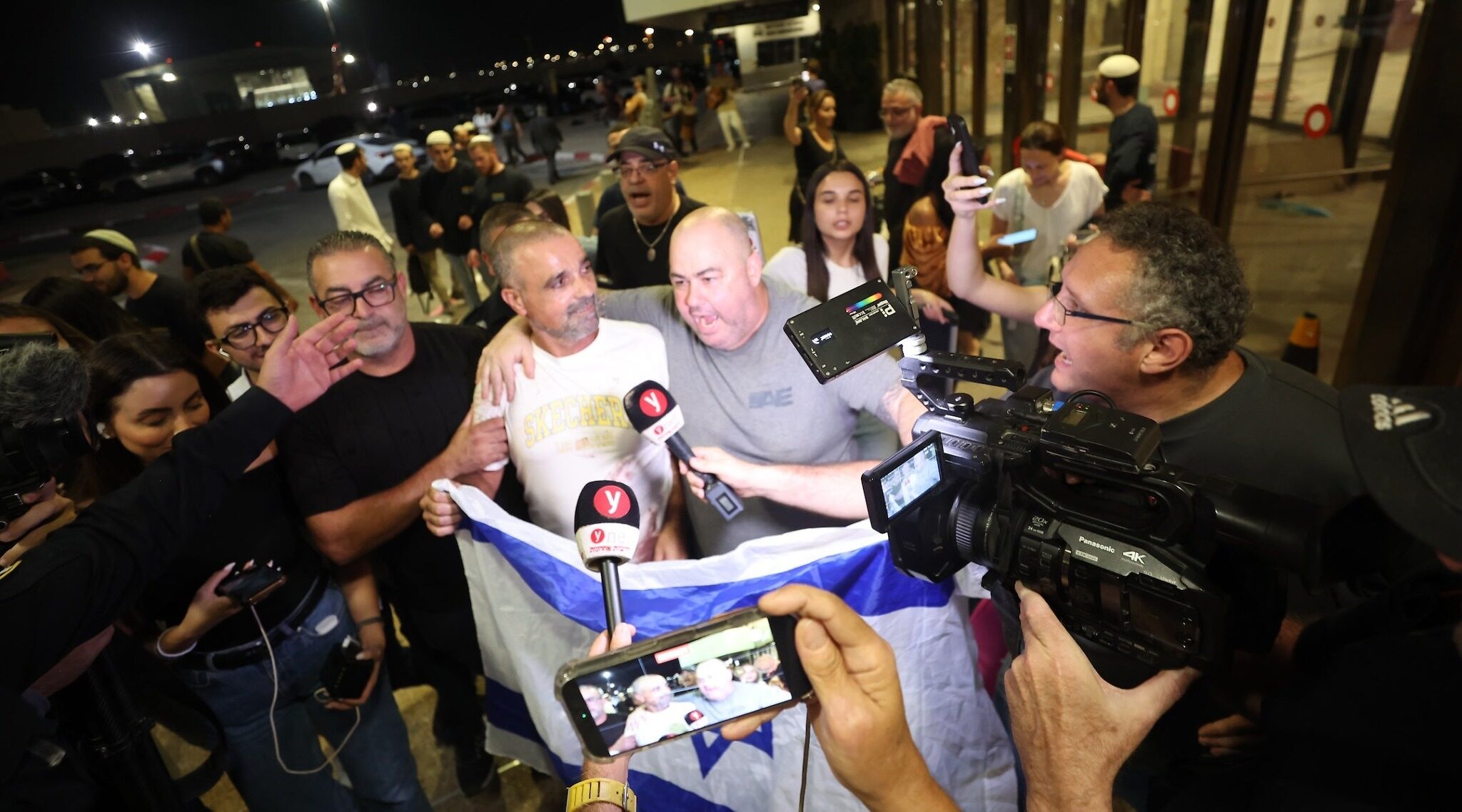
(JTA) —JERUSALEM – A young girl steps out of the bathroom on a flight and glimpses a bloody scene unfolding in the cockpit: the co-pilot is attacking the pilot with an axe. She screams for help.
A handful of unarmed passengers, still tanned from their vacations in Thailand, rushes by her, successfully grabbing the control wheel as the plane plunges 17,000 feet. They also manage to save the life of the bloodied pilot.
It sounds like the climactic scene from a high-stakes action movie, yet by now most people know that this is what happened last week on a Tel Aviv-bound flydubai jet.
Or did it happen? It is so fantastical that maybe it is just a fabricated story or an event staged by Israel’s Mossad? That is what millions of people on social media seem to be suggesting in online posts.
Even after nonstop media interviews with the hero pilot or with the ordinary passengers who took control of the plane, conspiracy theories about the attempted hijacking are swirling. Some mockingly insist the event never happened. Others say it was a false flag operation. And many of the comments invoke deep-rooted antisemitic tropes.
Some accuse Israeli Prime Minister Benjamin Netanyahu of staging the incident for political survival or to divert attention from the war in Gaza. Others say it was an attempt by Israel to play the victim or garner global sympathy.
“Brought to you by Bibiwood Productions,” wrote one person commenting on a CNN report posted on Facebook.
“Just stop already,” wrote another person beneath CBS’s clip of interviews with the men who fought the rogue co-pilot posted to Instagram. “It’s seriously embarrassing at this point. We didn’t believe it when the news broke; we didn’t believe it the first time you aired this interview. Reposting clips will not convince anyone with half a brain.”
“Bulls–t,” wrote another person.
Monitoring online responses as the attempted hijacking was unfolding last Wednesday, the Combat Antisemitism Movement’s Antisemitism Research Center found that the first conspiracy theories were posted just 67 minutes after the plane sent its first distress signal.
Within five hours, the ARC documented 1,000 hostile posts, and after 12 hours, 2,963 posts. The posts generated at least 30,000 likes and more than 3 million views.
“The fact is that internet companies have promoted a much more open free-speech policy these days, especially on Instagram and X,” said Sacha Roytman, CAM’s Chief Executive Officer, adding that it’s not just the posts that are problematic but also the comments they generate.
“They [the social media platforms] don’t control information anymore; they don’t want to control it,” he said.
Roytman added that another factor is that agitators – likely from Russia or Qatar – have learned how to build an effective bot network to spread misinformation. When the first post appeared after only 67 minutes, he said, “we knew it was not a human posting because no one cares to go online and start posting [that fast].”
“They were activated extremely fast and set up the stage to create an environment that’s toxic enough for other users to be inspired to find the stories they need to build their own claims,” Roytman said.
Amit Cohen, a research fellow at the Institute for National Security Studies and an expert in cyberattacks and digital fraud, said that during such events, “there is often a gap between what the public wants to know and the amount of verified information available at that moment.
“That is exactly the kind of environment in which rumors and conspiracy theories can develop very quickly,” she said. “In this case, claims appeared online within a short period of time suggesting that the event did not happen as reported, that the videos were fake, or that the incident was staged or a false flag.
“Posts like these are not necessarily the original source of the conspiracy theory,” she said, “but they can function as ignition points.”
Cohen said it was important to distinguish between those who “deliberately create disinformation and those who spread it.”
“Someone may share misleading content simply because it fits what they already believe, because it provokes a strong emotional reaction, or even because it seems interesting or ‘worth looking into,’” she said. “They do not need to know where the message originated, and they certainly do not need to be part of any coordinated campaign.”
Gal Yavetz, a senior lecturer of Artificial Intelligence at Bar-Ilan University, said the flydubai story was so incredible, it left many people “looking for answers.”
“Inevitably, some people will accept more natural explanations, and others, who are more extreme, will go and blame the Jews for it,” Yavetz said, pointing out that similar conspiracy theories arose over the summer when thousands of Moroccan nationals flooded Spain’s North African enclave of Ceuta in July.
“Every time there is something that we can’t really understand, that we can’t really explain, we blame the usual suspects — the Jews, the Jews who control the world, the Jews who are the natural scapegoat,” he said, adding that since the Oct. 7, 2023, deadly Hamas raids in Israel, conspiracy theories have become commonplace and all it takes is for a handful of people to start questioning the veracity of the events.
Posts by Egyptian-born, LA-based political satirist Bassem Youssef, known for his controversial comments about Israel and Jews, are a good example. In a series of videos, he mocks the flydubai event and raises suspicions about what really happened.
In one clip posted on X and viewed 64,000 times, Youssef, whose career was supercharged in 2012 when he was boosted by Jewish comedian Jon Stewart, even terms it a “Hollywood movie,” drawing on what critics say are familiar antisemitic conspiracy tropes about Jewish control of Hollywood and, by extension, the world.
“I wish it was chatbots, but the truth of the matter is that social media is a breeding ground for this kind of discourse,” said Yavetz, who specializes in social media, political communication and the spread of misinformation and disinformation online.
“They are definitely helping to spread and to reshare most of this misinformation and disinformation, but we know from previous studies that it is really just a negligible number compared to just regular people who are going to the more extreme sides and just taking their own outrageous opinions to social media just because it is now so easy to do so,” he said.
“You don’t really need to do much; you just need to make sure that you can stand behind your claims, and all of a sudden an outrageous post will have 1,000 likes, then 10,000 likes, and these comments are just circulating again and again, going from Facebook to WhatsApp to Messenger and back to Twitter with screenshots and back to Instagram… It’s a flood that you can’t really stop by taking out an umbrella,” Yavetz said.
INSS’s Cohen, who is also a national security expert with the Dvorah Forum, a group that promotes women’s voices in foreign policy, said that “conspiracy theories are not new, but the digital environment has changed their speed, scale, and the ability to obscure where a message originally came from.”
She explained that “in the past, there were more intermediaries between the person producing information and a large audience. Today, a single account can post a claim and reach very large audiences within a very short time.”
And, Cohen added, AI has made the problem worse.
“Mainly because it has dramatically reduced the time, cost, and skill required to create convincing content,” she said.
It has also made it harder for people to believe what appears on their screens.
“The problem is no longer only that AI can create fake content that looks real. It also makes it easier to dismiss real content by claiming that it is fake,” said Cohen. “Once the public knows that convincing images, audio, and video can be artificially generated, the existence of visual evidence no longer necessarily ends the debate.” PJC
comments