
Daniel Stern shares legacy of survival in new short film
A new short film traces Stern’s family legacy of loss, resilience and hope in the wake of the Holocaust.
As firsthand accounts of the Holocaust grow rare, Daniel Stern is ensuring his parents’ story of survival endures more than 80 years later through a new short film. Created in collaboration with Seton Hill University’s National Catholic Center for Holocaust Education, the 17-minute documentary follows his parents’ journey through seven different countries as they fled Nazi persecution.
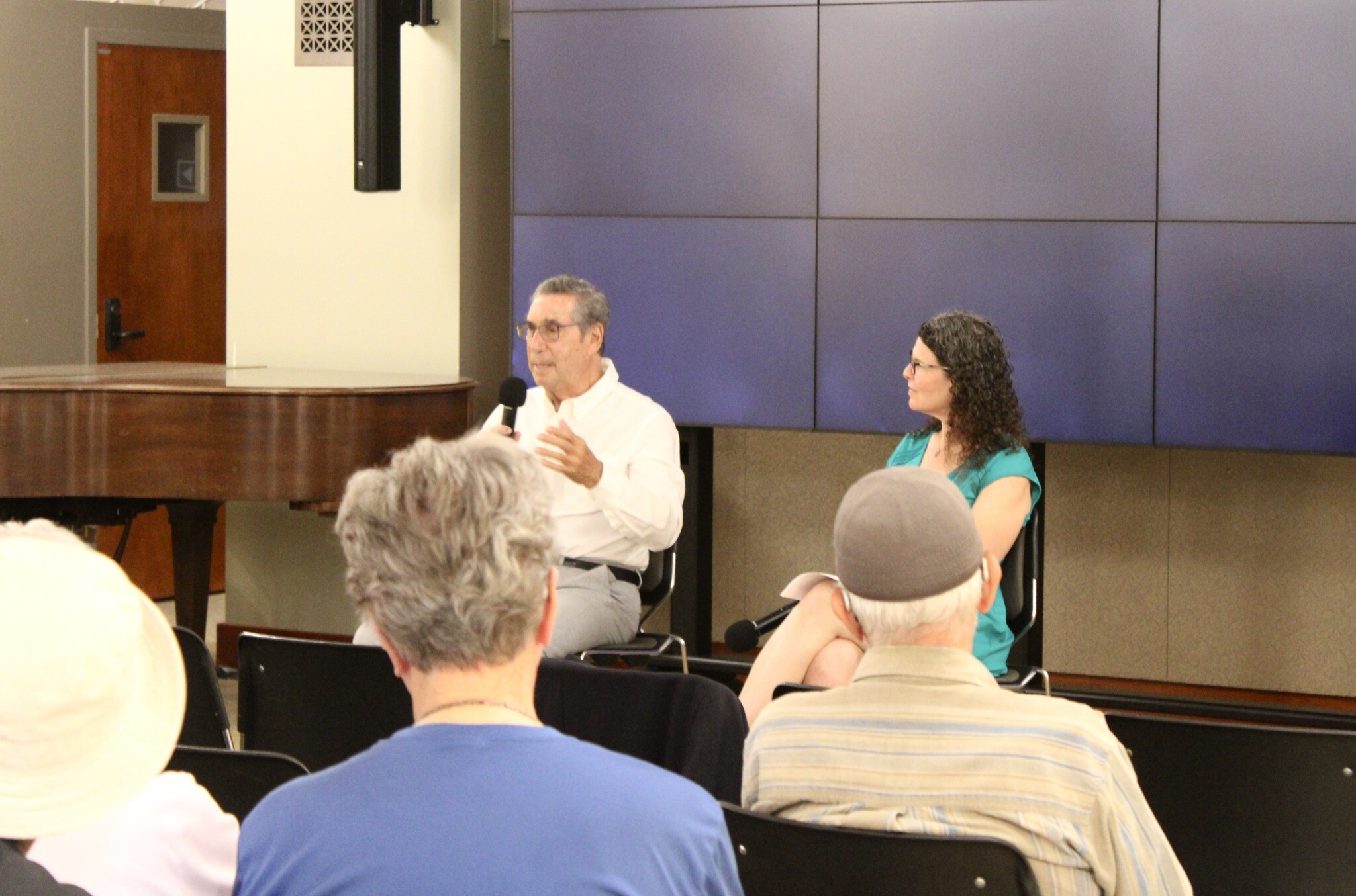
Hosted by the Holocaust Center of Pittsburgh and the NCCHE, nearly 40 people attended the film’s screening on July 9 at Chatham University. Following the showing, Stern took part in a brief Q&A session, fielding questions from the audience and continuing the conversation about his family’s story.
“This is part of their harrowing trip from place to place, from Portugal to Mozambique, Mozambique to South Africa, South Africa to Palestine, Palestine to Hungary, Hungary to France, each time with one suitcase to their name, and finally, their final stop in the United States of America,” he said. “The fact that my parents survived was a bit of a miracle, and of course I would not be here had they not survived that particular trip.”
The story began with Stern’s mother, Frieda Meyer, in Essen, Germany. One of seven children, the majority of Meyer’s family died in the Holocaust. Her parents were sent to Auschwitz, and her four sisters were sent to Treblinka. The first, and ultimately, last of her family to pursue higher education, Meyer enrolled in a pre-med program at Heidelberg University.
“In her second year of her pre-med program, the notorious Brownshirts that Hitler had got around him broke into the university, broke into her classroom, took her by the hair, threw her out of the classroom, and then kept throwing her onto the gate outside,” Stern said. “No German student came to her aid.”
Knowing she had to leave, Meyer’s family arranged for her to flee the country with a German widower who needed help caring for his three children. By bribing several German functionaries, the widower secured travel papers to Portugal, which ultimately remained neutral during the war. There, she was able to get a job in the British Embassy.
“She became a very popular figure with the Nazis with their parties, and her job was to get as much information as she could for them,” he said. “They would drink a lot and speak openly, and she would relay all that information back to the British, and she was helpful in the war effort.”
Daniel Stern’s father, Edward Stern, was a “much different story.” Born in Budapest, Hungary, his father owned a major tannery. Edward Stern was highly educated, and obtained a doctorate in economics from the University of Budapest, which scarcely admitted Jews.
“The tragedy of my father is that had he been able to stay in Hungary, his future would have been unlimited. Instead, in 1939, he was reading about what the Germans were doing in Germany to Jews, and he felt that Hitler was prone to the war, and Hungary is right next to Germany, not far, and so he said, ‘I’m out of here,’” he recounted. “He also told his parents to leave, but his parents said, ‘Look, we have Christian friends; they’ll protect us.’ And sure enough, they did survive.”
Edward Stern first went to France because he had read about the Maginot Line — a series of concrete fortifications that the French built on the eastern frontier to defend France from German invasion.
“They felt that we’ll be safe — the Germans cannot penetrate that. Well, of course, we now know today that they penetrated it in six weeks, and in six weeks, not only did France fall, but most of Europe,” he recalled. “Luckily, my father did not stay in France. He felt very nervous about the Maginot line, and he also decided to go to Portugal, again, because it was neutral.”
In Portugal, Edward Stern got a job at the British Embassy as a translator, where he met Meyer. The two fell in love and were married.
Their journey continued through Mozambique, South Africa, and Palestine, where Daniel Stern was born in 1945. Afterward, they returned to his father’s homeland in Hungary, then France, before spending seven years waiting for immigration papers to the United States — “their final mecca.”
“My first recollection of America is my father and mother waking me up at about 5 in the morning and taking me up to the ship’s deck, and they said we’re going to cross the Statue of Liberty, and we want you to see that,” he recalled. “Eventually, the Statue of Liberty was right in front of us, and I saw my mother crying. She was very emotional about it. This was to be their last stop.”
Daniel Stern’s family lived in Brooklyn for some time, before moving to Eastern Pennsylvania. He later attended the University of Pittsburgh on a full scholarship.
The film was conceptualized half a century later, when he was downsizing his home.
“I found a box that I really had never paid attention to, and the box is filled with photographs that appear to be 80 years old or more. And those photographs were of my parents, their siblings, [and] other family members.”
He shared these findings with a colleague, Tom Benick, a self-proclaimed “amateur World War II historian.”
“He said, “Let’s take these pictures and make a story out of them and cover some ground,” he recalled.
Together, they made a two-part PowerPoint presentation — one traversing his parent’s story of survival, and another telling his wife, Danielle Stern’s, story. After viewing the presentation, the NCCHE invited him to turn the PowerPoint into a short film.
The program closed with a brief Q&A session. The audience’s questions traversed his family’s history, politics, and spirituality. Daniel Stern, however, left the audience with a simple message.
“Never forget.” PJC
Octavia Liku can be reached at oliku@pittsburghjewishchronicle.org.
comments