
Community reacts to announced closure of Pittsburgh Post-Gazette
A “seismic event” for the city
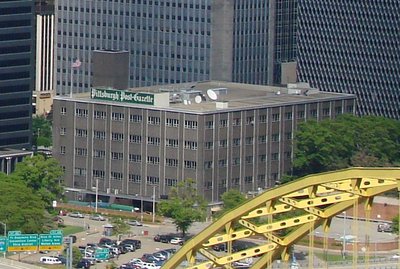
The Pittsburgh Post-Gazette announced plans to cease operations on May 3, 2026, after nearly 250 years in print.
The Jan. 7 announcement came hours after the U.S. Supreme Court ruled against the paper’s owner, Block Communications Inc., ending a more than three-year legal battle with the Newspaper Guild of Pittsburgh, which began when writers, mailers, production workers and advertising staff went on strike in October 2022.
Workers were notified of the impending closure by Jodi Miehls, president of Block Communications, on a pre-recorded Zoom call lasting slightly more two minutes.
The paper’s owners said they have lost more than $350 million in the last 20 years running the Post-Gazette.
The announcement came about a week after Block Communications shuttered the Pittsburgh City Paper. The alternative paper was acquired by a Block Communications subsidiary, Cars Holding Inc., in 2023 from the publishers of the Butler Eagle. Block Communications said it was shuttering the City Paper because its “business model has not reached a level of financial performance that allows Block Communications to continue operating it responsibly.”
In August 2025, Gray Media Inc. acquired WDRB, Block Communications’ broadcast division, for $80 million.
In 2021, the Post-Gazette cut its print edition to just two days a week, moving to a digital-first model. That followed a 2018 decision by the Blocks to stop publishing on Tuesdays and Saturday, and a 2019 decision by the owners to slash two more issues, leaving only three daily editions a week. Although print editions were reduced over the years, the Post-Gazette continued to publish a print facsimile online daily.
The company will continue to own the Toledo Blade.
The announced closure of the Post-Gazette comes at a time of shrinking local media nationwide. According to a 2025 report from Medill at Northwestern University, the number of newspapers published in the U.S. dropped from 7,325 in 2005 to 4,490 now. There are fewer than 1,000 dailies remaining in the U.S.
The Newspaper Guild blasted the announcement in a statement, saying that Block Communications “couldn’t bust the union, so they shut down the paper,” accusing the owners of “wasting millions of dollars losing court battles in attempts to deny their workers’ basic rights,” before announcing the paper’s closure.
Andrew Goldstein, president of the Guild, told the Chronicle that after losing at the Supreme Court, the Blocks “decided to pull the plug, to take their ball and go home.”
He called the decision “pure retaliation,” saying that it will “punish dozens of local journalists and news workers, as well as the city of Pittsburgh and all of western Pennsylvania.”
The paper’s closure, Goldstein said, was just the latest in a string of poor decisions by the Blocks, including “running a racist editorial on MLK Day in 2016, declaring an impasse and changing our health care in the middle of COVID, taking health care from the production unions that caused the strike to happen. Time and again, they’ve made the worst decisions possible.”
The closure will leave the city, ranked 27 in the United States for its media market size, without a daily newspaper.
Andrew Conte, director of Point Park University’s Center for Media Innovation and author of “Death of the Daily News: How Citizen Gatekeepers Can Save Local Journalism,” called the announcement a “seismic event” for the city.
“It’s the disruption of local news that we’ve seen over the last 10 years that has had an impact, not just in the way people interact with information but the ways they connect with one another,” he said.
Conte said the region was still grappling with the loss of the City Paper when the Post-Gazette announcement was made. The area’s other large newspaper, the Tribune-Review, based in Westmoreland Conty, recently announced it was cutting its print edition from seven to five days a week, he noted.
The Post-Gazette’s announcement and the current atmosphere for print publications, Conte said, shows that even in a competitive environment, there’s value in publications collaborating.
“News organizations realize that it’s better for themselves to work with other news organization,” he said. “More importantly, it’s better for the community.”
The Southwestern Pennsylvania chapter of Press Forward, a national initiative that works to strengthen communities by supporting local news, said the impending closure of the Post-Gazette is “disheartening,” and “underscores the fact that supporting local news matters.”
“Strong communities depend on strong local news,” Press Forward said in news release. “Local news connects neighbors, holds leaders accountable, and gives people the information they need to make informed decisions. At a time when trust in many institutions is eroding, local news remains a unifying source of reliable community information.”
Ann Belser is the publisher of Print, a community newspaper focused on the city’s East End. She worked at the Post-Gazette for 24 years, beginning in 1994.
She said that the paper’s demise will have a ripple effect on media in the region.
“TV has depended on newspapers for many years,” she said. “A reliable local newspaper gives us all a base of facts to
work from.”
Pittsburgh, Belser said, has always been a “media city,” but the way people get information has changed over the last few years, leading to disruptions in newspaper publishing.
As a former employee, the paper’s demise, Belser said, feels like receiving news that an ex-spouse has a terminal disease.
“I’m not really in touch with the P-G. I’m not reliant on it for anything. It’s not in my everyday life, but I remember the good times,” she said.
Another former Post-Gazette employee, Chuck Finder, said in an email that the paper’s announced closure should “sadden any Pittsburgher, any reader of Western Pennsylvania-related news, anyone with a history in this region that the Pittsburgh Post-Gazette may soon cease.”
“To the Jewish community,” Finder said, the Post-Gazette was “an independent voice that was respectful, if not a friend, for so long.”
Finder pointed to the paper’s headline following the Pittsburgh synagogue shooting as a moment when the Post-Gazette embraced the community in a meaningful way — it printed the first four words of the Mourner’s Kaddish in Hebrew on its front page following the funeral for the massacre’s last victim.
“That Kaddish banner headline for the Pittsburgh synagogue shooting made every Jew and Hebrew-reader weep who saw it,” Finder said. “Still does it to me.”
The paper earned its third Pulitzer Prize for its coverage of the shooting.
Pittsburgh attorney Jeff Pollock said his relationship with the paper began in elementary school, when he would read it cover to cover.
“It helped my vocabulary skills, kept me apprised of all the latest news about my favorite sports teams, gave me chuckles from the comics, and always allowed me to be up to date with current events in the local section,” he said.
Pollock continues to cut out cartoons or clip other items from the paper he wants to share with a friend, he said, viewing it as more personal than forwarding an attachment in an email.
“An educated person is a person who keeps abreast of the topics du jour from multiple viewpoints,” he said. “I have been disappointed with the bias and poor grammar of journalism over the recent past, but I could not have become a moderate, well-informed, balanced, involved citizen without it.”
Cheryl Moore said she was “shocked, but I think that I probably shouldn’t be.”
She noted that the paper’s demise has been a “logical progression.”
Moore questioned how a “major” city could have “innovation, discovery, creativity, vitality,” without a newspaper of record, noting the importance of the Post Gazette’s investigative journalism holding officials accountable, as well as its government, arts, real estate and sports reporting.
“Embarrassing. Sad. Foreboding,” she concluded.
Goldstein said he isn’t sure what will happen to the paper now that its closure has been announced.
“We’re not taking this lying down,” he said. “I’m not giving up hope just yet and I don’t think anyone should. We are working on our own to find potential solutions outside of the Block media company. We are exploring legal options, as well.”
And while the paper’s announced closure has left a hole in the media landscape that will be discussed by media pundits and those interested in what the loss of “the first newspaper west of the Allegheny Mountains” will mean for the region, for others the absence is more basic.
“How will I find out about obits that aren’t Jewish?” Post-Gazette reader Marcy Grupp asked. “How about daily TV listings?” PJC
David Rullo can be reached at drullo@pittsburghjewishchronicle.org.
comments