
Christmas, made possible by Jewish Pittsburgh
In the days of Jewish manufacturing, Santa always stopped in Pittsburgh.
Here’s how Christmas works, as I understand it.
At some point after Thanksgiving, although potentially as early as July, Santa Claus makes a tour of American shopping centers to hold negotiations with children.
The children want gifts. Santa wants proof of good behavior. From these private negotiations, Santa makes two lists, one of “naughty” children and one of “nice” children.
On the afternoon of Dec. 24, Santa sets forth upon a one-night global voyage. The nice children get gifts. The naughty children get coal. As an 11th-hour tactic, some children will prepare milk and cookies for Santa to enjoy, hoping to become “nice.”
This system was arduous but straightforward until the mid-20th century. Then, with skyrocketing global population, far-flung settlement, machine production of toys, mass media advertising and a new consumer culture, Santa’s job became overwhelming.
And so at some point in the mid-1960s, Santa Claus partnered with two Jewish-owned businesses in Pittsburgh to ensure the entire process would run more smoothly.
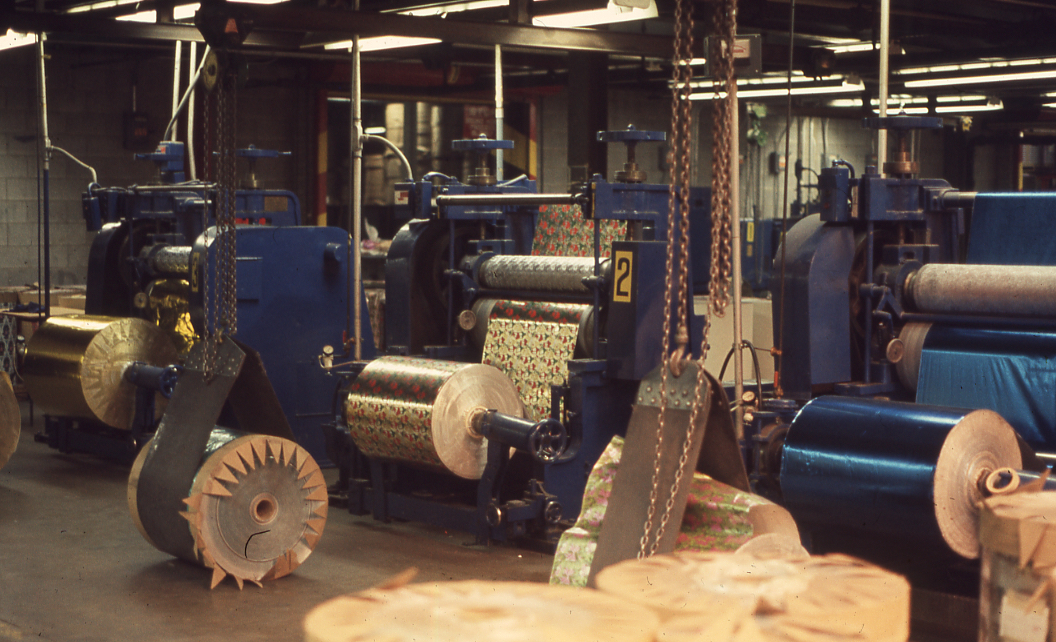
A big component of the Christmas operation is wrapping paper. Each of these millions of gifts being delivered all over the world must be properly sheathed. By the late 1960s, the largest giftwrapping manufacturer in the world was Papercraft Corporation.
Joseph Katz had immigrated to Pittsburgh from Odessa as a child. He learned to set type while volunteering in the printing department of the Hebrew Institute on Wylie Avenue in the Hill District. With this skill, he started a small printing business out of his garage, making graduation and High Holiday cards with the help of his brothers.
Annoyed by the high cost of supplies, Katz pivoted to wholesaling paper. He financed this move by selling a booklet of souvenir photographs of the 1936 flood. He bought images from Pittsburgh photographers, sent the materials out of town for publication, and then sold 100,000 copies in four days, while the floodwaters still raged.
Locked out of the wholesale paper market by existing players, Katz purchased the unwanted “job lots” of paper manufacturers. He sold these odds and ends at a discount around the region. He shifted to stationery during World War II, creating a popular letter-writing kit for the thousands of people corresponding to their loved ones overseas. By the end of World War II, Katz and his brothers had earned enough to start Papercraft.
Papercraft boomed in the postwar economy. From $900,000 in annual sales in 1946, it recorded $7.2 million in 1957. A period of expansion followed — growing sales, expanded inventory, an initial public offering, global branches and strategic acquisitions.
Papercraft soon outgrew its Pittsburgh facilities. It built a 900,000-square-foot factory at the new RIDC Park in O’Hara Township in 1965. The factory was a quarter mile long and had road, rail and river access. During peak summer production season, the facility employed around 1,000 people in three around-the-clock shifts and produced some 600 miles of giftwrap daily, according to a 1967 profile in Time magazine.
In the merger and acquisitions frenzy of the 1980s, Papercraft Corporation attempted a leveraged buyout. A newly formed subsidiary of Citicorp Capital Investors Ltd. acquired the company for around $240 million. The new company was never able to clear its debt, leading to a declaration of Chapter 11 bankruptcy petition in early 1991.
Another important aspect of Christmas is Santa’s wardrobe. Like Steve Jobs or Tom Wolfe, Santa has one outfit: a red fur suit and hat combo with white trim. By the 1980s, one of the leading manufacturers of Santa suits in the country was HALCO Inc.
Julius Halpern started a toy and costume company in 1946 called Halco. Through its costume business, Halco became one of the “big four” Halloween companies, alongside Collegeville, Ben Cooper and Rubies. Its toy business was aimed at Christmas.
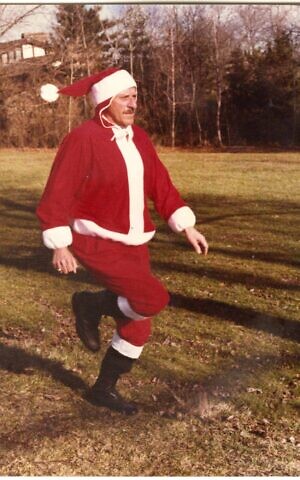
In the late 20th century, HALCO Inc. was one of the largest manufacturers of Santa Claus suits in the country. The company had a sense of humor and occasionally made gag products, such as a lightweight and breathable “Santa’s Jogging Suit,” seen here modeled by HALCO Inc. President Allen Hoffman in 1980. (Image courtesy of the Rauh Jewish Archives)
In addition to clothing thousands of Santa surrogates, HALCO suits appeared on Arnold Schwarzenegger in “Jingle All The Way” and Will Ferrell in “Elf,” as well as episodes of TV shows “Law and Order” and “The Late Show with David Letterman.”
HALCO was part of a community of Christmas companies associated with the National Costumers Association. But HALCO had a sense of humor. In addition to its traditional red Santa suits, it made a blue Santa suit for Chanukah, a lightweight Santa “jogging suit,” and a bedazzled Santa suit designed to throw off its competitors.
With the rise of globalization in the early 21st century, HALCO outsourced production overseas while retaining its local warehouse. In the early 2020s, owner Terri Hoffman Greenberg retired and sold the business to Morris Costumes in Charlotte, North Carolina.
Christmas is a bellwether of American retail and by extension the broader economy. And so the trajectory of these two Jewish manufacturing firms means more than mere trivia. It is an indicator of the evolving way our community has made its living.
In the late 1930s, about 65% of the local Jewish population worked in sales or manufacturing, with 10% in “the professions.” By the early 1960s, about half worked in sales or manufacturing and a quarter were professionals. The community stopped asking the question in later surveys, but I suspect the trend continued. Think about your circle. How many have specialized training? How many make or sell things?
The era of Jewish business left its imprint on communal life. The world of manufacturing and retail cultivates certain skills: comfort with money, acceptance of short-term loses and gains, willingness to pivot as a market changes, knowledge of real estate and supply chains, ease with people of various background, flexible work hours.
Jewish communal organizations in the late 20th century made the most of those skills. Just one example, the Jewish Federation of Greater Pittsburgh once structured its annual campaign around these local industries. The most respected Jewish car salesman, for example, would be asked to solicit donations from everyone else in the field.
In those years, every operation and capital budget throughout the Jewish community had a bit of Christmas in it. That is the gift that Santa left under our tree.
Eric Lidji is the director of the Rauh Jewish Archives at the Heinz History Center and can be reached at rjarchives@heinzhistorycenter.org or 412-454-6406.
comments