
Shai Miller’s Old Country
Dispatches from a 20-minute drive through Oakcliffe with its historian emeritus.

A year or so before he died, I asked Sheldon “Shai” Miller to take me through his old neighborhood. He grew up in a triangle of South Oakland bounded by Bates Street, the Boulevard of the Allies, and a hillside overlooking the Parkway East. Today it’s known as Oakcliffe, a name that dates to the early 1990s. In Shai’s day, it had no name.
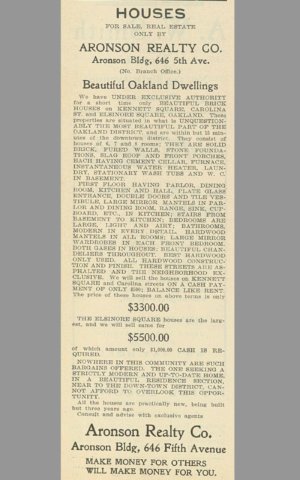
Oakcliffe was a network of country estates until the early 20th century, when developers created a working-class neighborhood. Soon, six large apartment buildings anchored Craft Avenue, lead by the gigantic Saybrook Apartments. Aronson Realty Co. was advertising houses in this little enclave in the Jewish Criterion by 1905. Tree of Life relocated nearby on Craft Avenue in 1906. By the 1920 census, as many as half the families in this little enclave were Jewish, and their numbers were growing.
Today, though, only a few well-hidden clues attest to this Jewish past. I wanted Shai’s help summoning the history that couldn’t be easily found in available records.
We pulled off the Boulevard onto Craft Avenue. The bustle of the busy roadway faded behind us, replaced by neighborhood calm. “That has to be a sandwich shop,” Shai said about a building on the corner. “We used to go over there for lunch, best corned beef around. I used to get corned beef on a heel. It was the end of the rye bread. Delicious.”
He was talking about S&B Deli at 294 Craft Ave. It was Goodman’s Drug Store in 1930 and Simpson’s Pharmacy by the mid-1930s. In the early 1940s, it became S&B.
S&B sold all the “regulars,” as former South Oaklander Richard Tenebaum once described it to me. He, too, had strong memories: “I can clearly remember their corned beef sandwich packed with many slices of warm meat, a great brown mustard, home grown ripe tomato slices and a delicious sliced pickle all piled high on fresh thin-sliced warmed bread. It was so huge that we found it hard to wrap our mouths around it.”
Shai and I turned right onto Joe Hammer Square. It was originally called Elsinore Square, part of a Shakespearian naming convention throughout South Oakland. The west side of Bates has Hamlet and Ophelia streets. The east side has Romeo and Juliet streets.
Joe Hammer was a child of Elsinore Square who was killed in action while serving with the U.S. military in France in September 1944. Over the next month, 60 residents of his street signed a petition, asking the city to change the name of the street.
We took a left onto Opheila Street. After half a block, Shai said, “Okay, this is Kennett Square, I believe. Make a right. Stop. OK, right there?” He was pointing to a stone-covered storefront at 3200 Kennett Sq. Letters above the window spelled Oakcliffe Laundry. He continued, “That was Nathanson’s. Nathanson’s Grocery Store. Max Nathanson.” It was Leif’s Grocery in the late 1930s, then briefly Harry’s Market in the early 1940s, then Plotkin’s Market. It became Nathanson’s sometime around 1950.
Shai pointed to a corner duplex across Opheila. “Right here. This house here? Was Bernie Peris Pharmacy. Yeah. Peris Pharmacy. Had a soda fountain, man. Still had a soda fountain with stools. You could go in and order a chocolate soda.”
The Kennett Square Pharmacy was already operating in the neighborhood by the mid-1920s, when it joined the Busis Drug Co. chain of stores. It became the Saybrook Pharmacy in the late 1930s under H. C. Winesburg and the Darling’s Drug Store under Meyer Levin in the early 1940s. Bernard Peris acquired the business around 1945.
At the end of Kennett Square we turned left. “And this must be Lawn Street, it certainly is,” Shai said. “OK, 347 was Frank Thomas. Where’s 347? Gotta be right here. There it is. Frank Thomas grew up there. Can you believe that?” Thomas was the child of Catholic immigrants from Lithuania. He was the best baseball player in the neighborhood and signed with the Pirates in 1947. They was traded him to the Reds in 1959. He became a journeyman and retired with good stats but not quite good enough for Cooperstown.
We rolled slowly down Lawn Street, past the narrow brick houses with aluminum awnings and cinder block porches and patched foundations. Shai continued, “Bubba Schachter’s father’s store was 53 Lawn St. We’ll be coming to it now, down the block. It burned to the ground, Bubba said. They never did rebuild it. He said they never rebuilt it. Yeah, so it was right there, where that tree is. That was Schachter’s Grocery.”
At the end of the street, Shai said, “OK. I’m gonna show you where Lubavitch headquarters was. Opheila, make a right.” We made a hairpin turn onto Ophelia and continued back toward Kennett Square. “Go slow, go slow. Might be this building right here, man, was the original Lubavitch. Right there. I think that was it.” He was looking at 3223 Kennett Sq. It looked like a small event hall, hastily painted entirely in dark pink.
Anshe Lubovitz had started in the Hill District between 1903 and 1907. It relocated to Oakcliffe in 1944. The latest known documentation of the congregation is a notice of a Shabbat Chanukah celebration at the Kennett Square synagogue in late 1953.
We turned right onto Craft Avenue and continued to its intersection with Niagara Street. On the corner was a playground. The lot used to be the main neighborhood shul.
Congregation Ohave Zedeck began meeting as early as 1917 and bought a house at this corner in 1921. With growth, the congregation renovated the building in 1936, creating a new sanctuary wing and adding a social hall in the basement. The congregation established a cemetery, started a religious school and formed a ladies auxiliary. It continued in the 1970s, when it gradually stopped meeting. The building is gone today.
“Did the Pittsburgher Rebbe have his place around [here]?” I asked.
“No, that was in Squirrel Hill,” Shai said.
I looked it up later. Rabbi Yosef Leifer had in fact lived at 3211 Niagara from 1932 until 1939, when he relocated to his better-known spot on Bartlett Street.
Just past the former Ohave Zedeck, Shai shifted into a different register. It sounded like he was accessing deeper, more essential memories. I readied myself.
We were facing a housing project. “Here was a blank open space where the greatest baseball games played anywhere were played by Frank Thomas and his friends. Right here where these townhouses are. And, when you turn around … you’ll see where the left fielder had to cross Craft Avenue in order to catch Frank Thomas’ hits.”
We turned right onto Opheila Street again until we hit Kennett Square from the other direction. Shai noticed an honorary street sign marking “Gene Rosner Corner.”
“Gene Rosner and his wife Irene were greenhorns. You know what greenhorn is? They were right off the boat. And they opened a little grocery store right there. You see where that air conditioner is sticking out? Right there. Max Nathanson passed away years ago. Gene used to go to Squirrel Hill at 5 in the morning, get lox, bagels, smoked fish, and bring them down here, so we’d be able to eat lox, bagels, and smoked fish and herring on Sunday morning, like the Jews in Squirrel Hill. Make a right, make a right.”
“That’s where we just came from,” I said.
“I know, I know … I just wanted to show you one more thing. OK. You see where that wall is right there?” We were facing a small parking lot behind the townhouses where the makeshift baseball field had been. The parking lot was bounded by a low concrete retaining wall with ghostly patches of gray paint covering old graffiti. “So that’s the back of Isaly’s … Now there’s an alley there with garages … Is it still there? Yeah, right, there it is, man. See that alley? That’s where the garages were. You can get down there to the Boulevard. Well, if you can get by. You probably can.”
What he was calling an alley looked more like a trailhead, a narrow patch of asphalt disappearing into a cave of trees. I thought, “No way am I going down there.”
Shai pointed to a dumpster at the far end of the lot. “Craft Avenue turned into a dirt road beyond that garbage container there. And at the end of that dirt road was a house. We never knew who lived there, though, but they were nice people. And Isaly’s was right there. That’s where they made the ice cream. And this is where the left fielder stood. Back in here, the grass was up to his knees. Yeah, see, all the garages are here.”
Shai wanted me to head down the alley, and despite my reservations, I obliged. I wanted him to have the experience of returning to the legendary outfield of his youth.
If you’ve been driving around Pittsburgh long enough, you’ve likely made an innocuous turn off a city street and suddenly found yourself in some impossibly tight, undeveloped country road. Inching forward through the overgrown trees, along patchy asphalt, I could not believe we were still in an urban neighborhood. I couldn’t believe we were still in reality. It felt as though we had entered the wild recesses of Shai’s memory.
And then, suddenly, we were back in the city, pulling onto the Boulevard of the Allies. Shai pointed to a UPMC building to our right, “There’s the Isaly’s, whoa. Inside Isaly’s, not only down on the first floor, was a restaurant, like it was a cafeteria. You’d get a tray, and you’d get the best sandwich, fresh salad, egg salad and everything. And then at this end, was the ice cream bar, when they came with the skyscraper cone. They had the long thin scoop. The ice cream above the cone was like this tall. Ten cents. Lime sherbet was my favorite. If I was a good kid all week, my mother would give the lady, the girl that walked me and Goldie to school, 30 cents and we’d all get ice cream cones on Friday. Isaly’s butter and Isaly’s dairy products were the choice of the world, man.”
Eric Lidji is the director of the Rauh Jewish Archives at the Heinz History Center and can be reached at rjarchives@heinzhistorycenter.org or 412-454-6406.
comments