
Ignoring Lior Raz
There is no scene unfolding. Only an actor waiting for his morning shakshuka and a man with an overactive imagination.
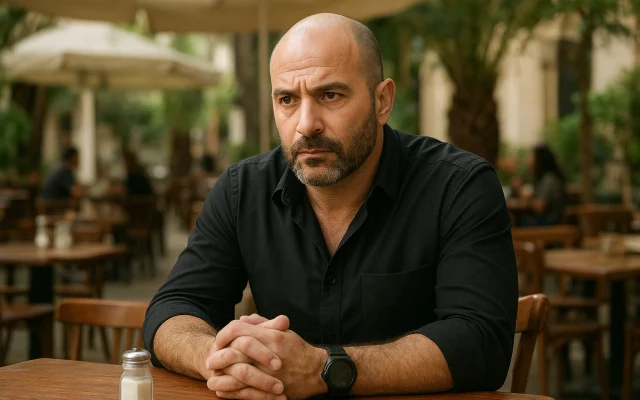
You know Doron from “Fauda.” Four full seasons where he fumes and furrows that rubbery brow, scowls through underground tunnels, reaches over a bullet-riddled car to unload a magazine of lead into the bad guys attacking his father’s farm, pretends to sip coffee in a village square before pulling a silenced machine gun and ventilating a terrorist.
And now I notice him at a café in North Tel Aviv. Slimmer than last season. In real life, as Lior Raz. He does not exactly look at me, but there is the faintest tilt of the chin, a micro nod that might have been aimed in my general direction. Almost certainly a Duvdevan reflex from his undercover days, that discipline of staring at someone by deliberately not looking at them. Yes, he has almost certainly clocked me.
I am sitting on a wooden bench with my bag, a curiously oversized bag. He is at an outdoor table. Maybe 15 meters away. Maybe 10. In “Fauda,” such pronounced non-eye contact means we are scouting each other. Did he just scratch his ear, whisper into a concealed earpiece — target confirmed?
Get The Jewish Chronicle Weekly Edition by email and never miss our top stories Free Sign Up
Watching Lior Raz not look at me only confirms he has seen me. His invisible surveillance team has seen me. Any stranger who sits this close to an indifferent Doron should be counting the seconds. It is his lack of recognition that unnerves me most. My shoulders tighten. The “Fauda” theme begins in my head, rising into a rapid heartbeat. This is high alert.
I get up. Stumble inside. Study the menu with the seriousness of a man decoding nuclear launch codes. I refuse to turn around. Out of the corner of my eye I catch several figures at his table who look suspiciously like characters from the series. Is that the actress who played Moreno’s sister, before the colonel was blown up in Season 2? That’s her: Anat. She got with Steve, one of the unit’s most seasoned killers, two episodes later. She glances at me. Or at my reflection in the espresso machine. Hard to tell.
We are running out of time. Any minute now Steve will appear, ash-laden cigarette dangling from one hand, the other brushing his grizzly, white-flecked beard. I will not even feel the knife.
Then again, maybe the safest strategy is to sit beside them. The very next table, with my back to them. Sip my coffee with idle British boredom. Who would suspect a man performing the theater of normality? If questioned, I have the perfect alibi. I’m a British tourist who has never seen the show. Show? What show? Jolly nice to meet you.
I hover too long. That alone feels incriminating. There is nothing gluten-free on this menu, I inform the waiter with a sigh, then exit, careful not to let my bag bump into anything, walking past the celebrity table with what I hope is a casual gait. Hundreds of digital eyes follow me. That discarded cigarette lighter is definitely a transmitter. They used that trick in Season 4. Not gonna fool me.
Around the corner, I cool down. Put my bag on the pavement. I have made it. Imagine. I’m carrying the contraband everyone was warned about and cleared the perimeter unchallenged.
If I smoked, I would light a long slow Camel and inhale victory. Me, an unlikely hero of Palestine, right under the Zionists’ noses in the fanciest neighborhood of occupied Tel Aviv. Wait, was Tel Aviv ever Palestinian? Maybe not this Kikar Milano neighborhood, built in the 1970s. Anyway, I have smuggled dangerous materials (dirty laundry and a bag of oranges) and a head full of literature past the most deadly Israeli agent in history. Mubarak! Mission accomplished.
But no true operative would stop here. I want one last encounter. One final brush with greatness. Swinging my bag across my shoulder, I turn back toward the café.
Doron is on my right. Same exact spot. Yes, he sees me. Our eyes meet for a fraction. His pupils are clear, his expression unreadable. He’s not aged at all. Did makeup deepen those wrinkles, grey his temples, for that last operation in Lebanon? At a glance — and I’m no professional — he seems unarmed.
I consider leaning in with something conspiratorial. Ani Amok Bifnim, I rehearse, I am deep inside the enemy network. The exact words he told Gabby when the Shin Bet’s chief interrogator lifted the cloth bag from his head in a jail cell. The sentence hovers on my tongue like a bad idea hoping to be chosen.
But those steady eyes tell me everything. There is no scene unfolding. Only an actor waiting for his morning shakshuka and a man with an overactive imagination. I’ll only blow my cover.
So I do the sensible thing, let my gaze lightly graze Lior Raz as though he is any other Tel Aviv resident who’s slipped into my line of sight. I walk inside, heart thudding with the embarrassment of invented espionage, and order an oat milk latte, to go. The barista nods politely, unaware that I have just completed the most delicate mission of my morning. PJC
Nathan Lyons is a Tel Aviv-based writer fascinated by the chaos and glory of life in Israel. This article was first published on The Times of Israel.
comments