
Former hostage Eli Sharabi visits Pittsburgh
"I’m here and life is here and I love life.”
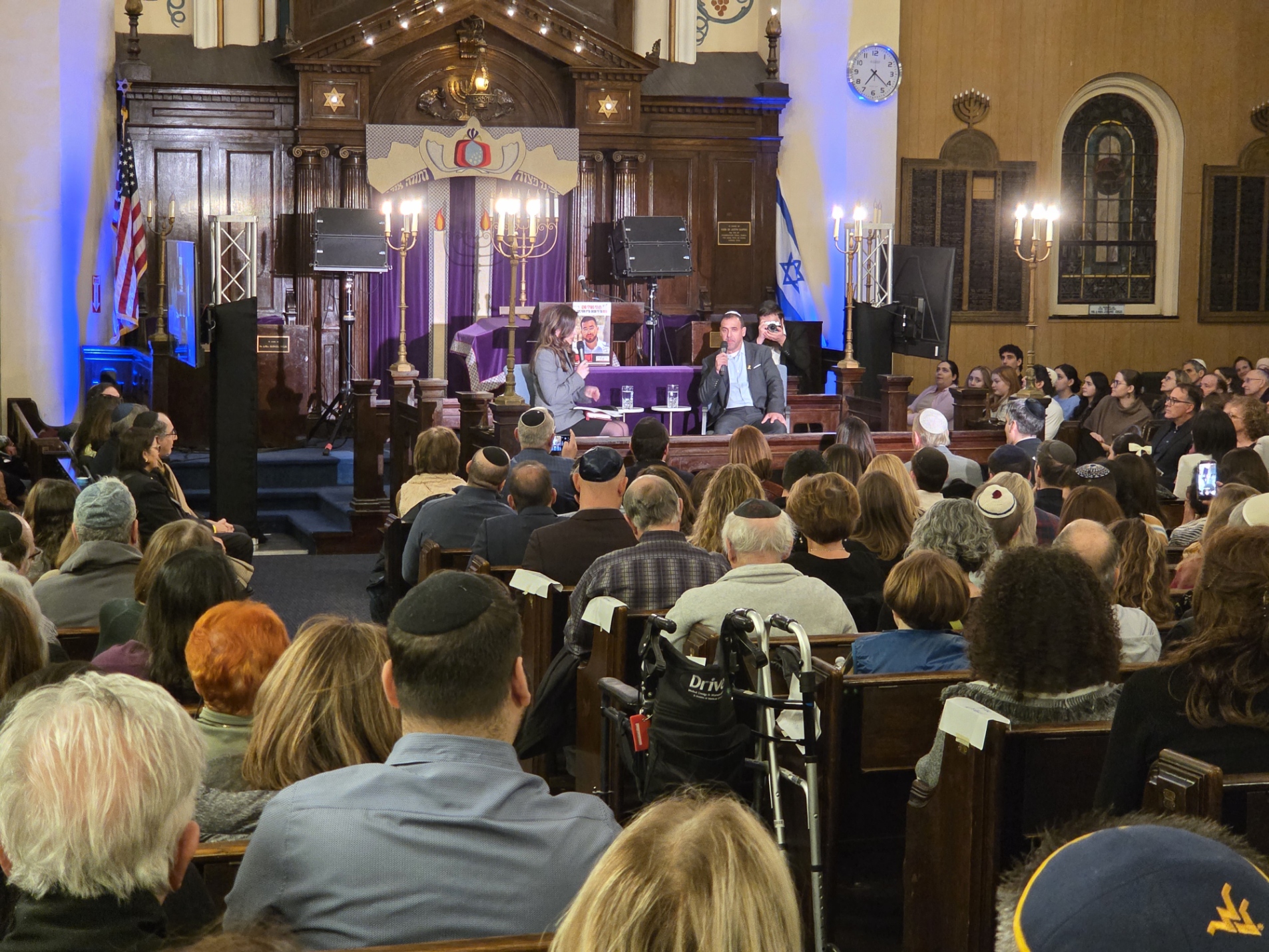
“I chose life,” Eli Sharabi told the more than 700 in attendance at Congregation Poale Zedeck on Dec. 7.
It was a theme repeated during Sharabi’s discussion with Laura Cherner, director of the Jewish Federation of Greater Pittsburgh’s Community Relations Council. Sharabi recounted the physical and psychological terror he experienced — including broken ribs and starvation — during the 491 days he was held in Gaza after his Oct. 7, 2023, abduction from Kibbutz Be’eri by Hamas.
The conversation touched on many of the same experiences Sharabi described in his book “Hostage,” the first account published by an Oct. 7 hostage, which the Chronicle Book Club discussed the same day as the event.
At its core, Sharabi’s talk spoke of his fundamental will to survive and find meaning during his time in captivity. The husband and father of two told of his motivation to return safely to his family, a goal he realized was empty only after being released and learning of their murder during the initial terrorist attack in Israel.
Sharabi’s retelling included details of being held in a Palestinian family’s home in Gaza before being moved to Hamas’ tunnels.
He also spoke about the relationships he formed with fellow hostages, including Alon Ohel. Ohel is a pianist from Misgav, Pittsburgh’s sister region in Israel, who was kidnapped while attending the Nova music festival.
At 51, Sharabi was older than those he was detained with and developed a paternal position within the group. That relationship was especially significant with Ohel, who suffered from untreated injuries, including near-blindness, and had difficulties adapting to his time in captivity.
Sharabi was released before Ohel, who endured an additional eight months in Hamas captivity before his eventual release on Oct. 13, 2025. The elder former hostage told of his conversations with Ohel’s parents after he was set free and his fight to ensure Ohel’s release, including appearing before the United Nations.
“He was like a son, and I needed to fight for him like his parents were fighting for him,” Sharabi said.

Sharabi’s Pittsburgh appearance was the idea of Israeli-American and Squirrel Hill resident Etti Martel, who enlisted the assistance of Michael Milch.
Martel recounted her emotional meeting with Sharabi in Israel after his release.
“All the worry, all the pain, it all came out,” she said. “I looked at him and asked for forgiveness — forgiveness for what we couldn’t prevent.”
Milch said he and Martel worked with Rabbi Yisroel Altein and Chani Altein of Chabad of Squirrel Hill, as well as the Federation and the Jewish Community Center of Greater Pittsburgh.
Sharabi, he said, is emblematic of a “human being’s great God-given ability to overcome any trial and tribulation, challenge or loss.”
One of the lessons of Sharabi’s talk, Milch said, is the need to look after others.
“Eli’s ability to be a father-like figure for so many amidst the hell on earth teaches us all that we have it in us to do the same with our loved ones and friends, even when times are tough,” he said.
In opening remarks, Yisroel Altein compared Sharabi’s captivity to the Torah’s story of Joseph.
“We have witnessed the story of Joseph unfold once again,” he said. “The 250 hostages held in unimaginable cruel conditions have shown extraordinary courage, resilience and care for one another. The stories emerging of their captivity reveals the strength of spirit that is nothing short of a modern-day Joseph.”
Several local, regional and state political figures were in attendance, including Pittsburgh Mayor-elect Corey O’Connor, City Controller Rachael Heisler, O’Connor’s incoming Chief of Staff Dan Gilman, Pittsburgh Councilperson Erika Strassburger, Sustainable Pittsburgh Executive Director Bhavini Patel and Gisele Fetterman, wife of Pennsylvania Sen. John Fetterman.
Heisler, who visited Kibbutz Be’eri a year ago, said that it was a joy to meet Sharabi in person.
“His bravery is unlike anything I have ever seen, and I think his final words are the ones that are the most important to take with us: ‘Freedom is priceless,’” she said.
South Hills resident and Dor Hadash Education Director Karen Morris said she felt fortunate to attend the event.
“It felt like a once in a lifetime opportunity to be in the space and hear a person who went through the unimaginable, survived and is now thriving. His description of what he was able to advise the younger hostages, in terms of acknowledging daily blessings, is a life lesson for all of us,” she said.
That reaction was echoed by Squirrel Hill resident Rebecca Dina, who called the experience “miraculous,” saying that “for more than a year, the Jewish community in Pittsburgh stood shoulder to shoulder on a Squirrel Hill corner praying for the release of the hostages.”
Sharabi’s recounting of what he endured was “difficult, humbling and profoundly moving,” she said.
Julie Paris, Mid-Atlantic Regional Director of StandWithUs, said her organization worked tirelessly to tell the stories of the hostages and remind the world “what Israel is fighting for.”
“At a time when our world feels deeply divided, his presence served as a powerful reminder of the importance of unity, empathy and standing together,” she said.
Sharabi’s talk originally was planned to be held at the JCC in Squirrel Hill; however, Milch said, it quickly became apparent that the number of people interested in attending would prevent everyone from being in one room, so it was moved to Poale Zedeck.
Fara Marcus, JCC chief development and marketing officer, spoke before the event began. She called Sharabi’s appearance “a gift to our community” and noted “you could hear a pin drop; that’s how deeply Eli’s words resonated.”
She said the JCC was proud to support the event, noting that the partnership extended beyond the location of the talk.
“I hope everyone left inspired to continue to honor the way Eli has ‘chosen life,’ time and time again over the past two years. I know my husband and I did. We must find the meaningful lessons that can be learned from even the most devastating events,” she said.
Rick Wice, head of Poale Zedeck security, said the coordination of law enforcement for the event was “cooperation of the highest level,” involving the Pittsburgh Police, the Federation’s security team lead by Shawn Brokos, and local security companies.
Near the end of his conversation with Cherner, Sharabi said he was a “practical person,” who spent a few minutes crying after his release, but stressed that people can choose how to react to horrible circumstances.
“I didn’t choose to be kidnapped. I didn’t choose what happened on Oct. 7. But for 491 days I chose how to react to my situation; what to hold onto and how to stay human in extreme situations,” he said.
Despite the death of his family, Sharabi said he has never found meaning in sadness or anger.
“I have a choice — to let my grief and loss bury me or find a way to move on,” he said. “I know I can’t do anything to bring them back. but I also know that I’m here and life is here and I love life.” PJC
David Rullo can be reached at drullo@pittsburghjewishchronicle.org.
comments