
491 days in Hamas’ hands
Among the 251 people kidnapped by Hamas, Sharabi was uniquely suited to write this book.
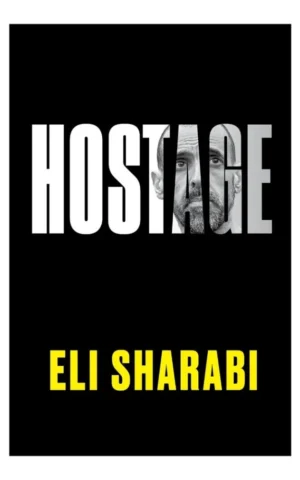
Has any book made a bigger splash in a shorter time in the Jewish world that Eli Sharabi’s “Hostage”?
Rushed into production and bookstores just four months after Sharabi’s release from captivity in Gaza, “Hostage” sold 100,000 copies faster than any Hebrew-language book in history.
The English translation arrived in the U.S. just six weeks ago and almost immediately appeared on a New York Times best-seller list. Within weeks, several Jewish friends had recommended the book to me, describing it as “compelling” and “impossible to put down.” Now I’m recommending it to others.
I sense that Sharabi has tapped into a deep wellspring of Klal Yisrael. Not perfectly and probably not even intentionally, Sharabi has given voice to the trauma and pain we all feel to varying degrees in our post-Oct. 7 world, and that our Pittsburgh community has felt ever since Oct. 27, 2018.
In writing “Hostage,” I doubt that Sharabi sought to make himself an agent of healing for the community at large, even if he finds himself cast in that role. Rather, it seems his objective was simply to highlight the importance of Pidyon Shvuyim, the Torah mandate to free captives.
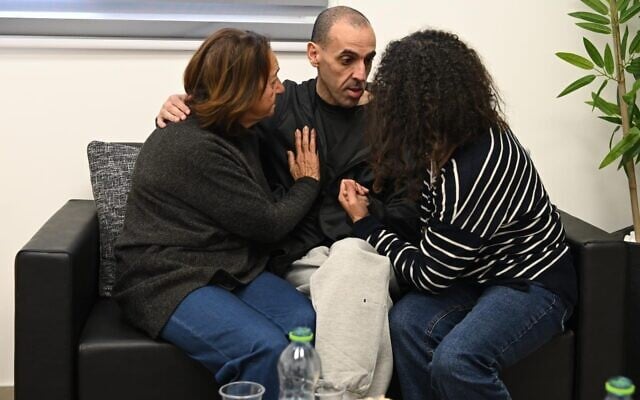
Among the 251 people kidnapped by Hamas, Sharabi was uniquely suited to write this book. His story pulled our heartstrings like no other. As you might recall, only after his long-overdue release did he discover that his wife and two daughters were among those murdered on Oct. 7.
Sharabi is not only the perfect person to write a book because of his tragic circumstances. As it turns out, he is also a fine writer.
“Hostage” is written with an extreme economy of language. Whether it’s attributable to Sharabi’s voice or an editor’s ruthlessness, the spare style is a perfect fit for the content. What happened to him was bad enough. There was no need to embellish or adorn his experiences.
He describes his 491 days of harrowing captivity in stark detail. He spent most of that time shackled, hidden inside Hamas tunnels. As you read about the deprivation, darkness, squalor, humiliation, hunger, pain and fear he and his fellow captives suffered, you can’t help but wish that Israel had secured their freedom much sooner.
That said, if you’re expecting a critique of Prime Minister Netanyahu’s handling of the Gaza operation, you’ll be sorely disappointed. He doesn’t weigh in on the controversy, one way or the other.
But he does freely express his disdain for Hamas, which is obviously justifiable. Sharabi was never in danger of contracting Stockholm Syndrome. He viewed his captors as brainwashed barbarians. Yes, there were moments, here and there, of humanity, but only when a Hamas operative was alone with the captives. When among their fellow terrorists, the captors were cold and cruel.
In our current political climate, I found his contempt for Hamas and his unapologetic Zionism to be refreshing. For his first public appearance after his release, Sharabi draped himself in an Israeli flag.
Make no mistake: Sharabi is a liberal Zionist, like me and like so many of us. In this country, when speaking or writing about the conflict, we have to carefully measure every word, for fear of provoking an anti-Zionist backlash among our erstwhile allies on the left. As a survivor of a terrorist attack and of prolonged captivity, Sharabi has many burdens to bear, but having to sideline his Zionism isn’t one of them, thankfully.
You can’t help but feel heaping amounts of sympathy and admiration for Sharabi. His mental strength and will to survive were inspiring.
He is not trying to emulate Victor Frankl, the Holocaust survivor whose experience in a concentration camp became the basis of “Man’s Search for Meaning,” a mega-selling self-help book.
But readers are free to derive their own life lessons from Sharabi’s experience.
In “Hostage,” he recalls the moment when his captors moved him from a house to the tunnels. For good reason, he desperately wanted to stay above ground. Standing at the lip of a tunnel entrance, he thought about resisting, but he knew that he would be shot and killed if he didn’t comply. So down into the tunnels he went.
Even in that dire situation, though, Sharabi recognized that he was making a choice. In this case, a choice to survive another day.
In our own lives, in our own far less dire situations, we always have a choice, too. Thank you, Eli, for the reminder.
No one can begrudge the success Sharabi has experienced with his first book. He has paid a horrible price, but he has squeezed from his suffering at least a few drops of redemption.
Buying this book, reading this book and talking about this book can be our own modest contribution to Sharabi’s mission to elevate Pidyon Shvuyim in our collective Jewish consciousness.
The Chronicle Book Club will discuss “Hostage” on Dec. 7 on Zoom. To register, email drullo@pittsburghjewishchronicle.org. PJC
Jeffrey Spitz Cohan lives in Forest Hills and writes on Substack at inalignment.substack.com.
comments