
Reading the obituaries, rewriting my life
I can reflect on a life well or poorly lived, reminisce over past loves, opportunities and travels, and gain some insight where I have been.

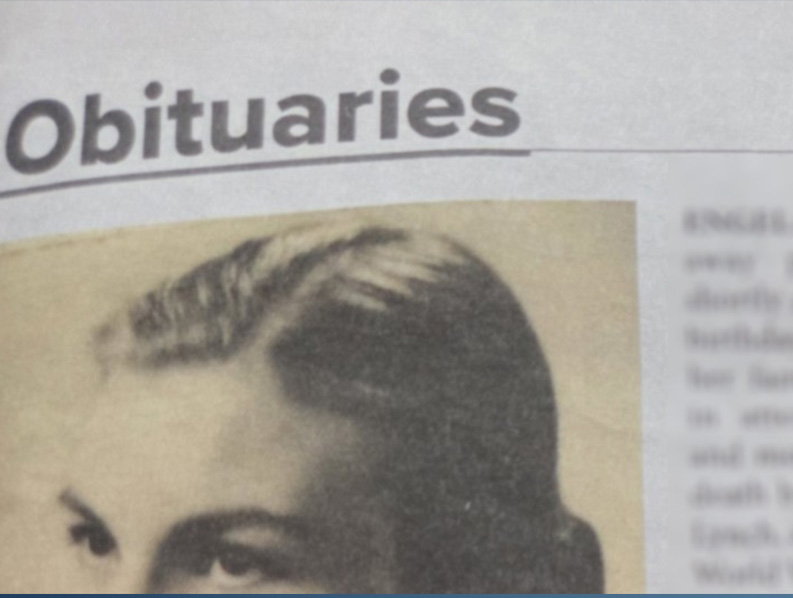
For the past few years, I have become a regular reader of obituaries. It is not out of a morbid curiosity or to confirm that I am still kicking, but it is a daily source of reflection and celebration of lives simply and well lived. I’m not interested in celebrities whose exploits or scandals are fodder for every social media outlet, but those thousands who tell stories of their education, military service and daily lives, and commemorate family and friends. In Pittsburgh, these most common citations are enhanced with one’s work experience, loyalty to our sports teams, religious affiliation and service — all reflective of the unique ethos of the ‘Burgh.
Each death is a reminder of the finite nature of our existence and something that cannot be avoided. So it comes down to a personal choice of how to confront or accept it. For many, an established philosophy or religion provides understanding and solace. The Latin root for obituary is obire, meaning “toward” or “to go.” In a physical sense, we all know where we are headed, but in many listings, a more spiritual destination is mentioned. That is a concept completely foreign to me, but I’m glad that it is a source of comfort to others.
Earlier this year I was shocked to read of the death of a very close friend and classmate from Taylor Allderdice High School. He was one of three friends with whom I shared countless hours at the movies, riding trolleys into town, and with whom I attended summer camp as campers and counselors. Danny was special with an amazing sense of humor and talent as he starred as
Harold Hill in the school’s production of “The Music Man.” I lost touch with him, like so many others from high school, college and graduate school, but his death was a real kick in the gut, and a clarion call for some reckoning.
Get The Jewish Chronicle Weekly Edition by email and never miss our top stories Free Sign Up
More recently I learned of the death of someone who loomed large not only in my life, but in thousands of others. His job title was the director of a summer camp, but his impact was much greater. Camp Comet was established in 1962, and keeping with the ethos of the day, was unique in that it was labelled a Space Age Camp. Along with the expected sports and nature activities, it also featured ham radio, photography, a science lab and rocketry.
Cabins were named for planets, and were distanced (appropriately) from the main office, known as the Sun. The youngest campers were Cosmonauts, and older groups named Astronauts, Gemini and Luna. The dining hall was the Galaxy, and a recreation facility was the Moon. You get the idea. What made they campers’ experiences unique were not the activities but the man who was the heart and soul of the operation. His name was Harry, a figure tall in stature and in compassion and leadership. He recently died just three weeks shy of his 98th birthday, and left a legacy to his family, community and all of us who were under his tutelage.
At a celebration of his life, all in attendance learned how he imparted a love of nature, wrote yearly letters to each of
his children and grandchildren, celebrating their accomplishments, and offering advice and encouragement. What struck me was how his love for each family member never diminished or was diluted by the addition of another grandchild or great-grandchild, but rather grew exponentially, and only stronger. And when I listened to his children’s and grandchildren’s eulogies, I was overwhelmed by how Harry’s advice, encouragement, love and even criticism made each of them feel they were the most important one. This was a revelatory moment for me, suddenly understanding the true power of and expanse of one’s love.
During Harry’s memorial service, the Jewish expression of condolence, “May his name be a blessing,” was frequently recited. Recited not to comfort one’s survivors, but to carry forward the energy of a life in service and in love. His name certainly has been that for all of us lucky enough to have known him, and for me in particular: a challenge to live so that my memory, flaws and all, might serve all whom I hold dear, in good stead.
Each spring, Harry would write a note celebrating its onset, richly describing in detail the visible colorful changes in the natural world and even the “beauty hidden in twigs, weeds, and over-crowded growth.” He was always grateful for the regrowth and beauty of that season, especially because he knew it would not last. These notes were titled “Once again … One last time.” Very prophetic and a call for his readers to appreciate how regularly that beauty returns, but also to acknowledge that, for all of us, that will occur one last time.
Being almost 76, I have tried to organize all the financial and other information for my wife and sons to make it easier to manage my estate after my death, but decided to go one step further by writing my own obituary. This was not to minimize any shortcomings or failures (of which there were many), or to pad my resume, but to reflect on what matters to me now, and hopefully for what I might be remembered. It gave me a chance to reflect on relationships, my career, and especially how my education provided outlets to pursue interests after retirement by celebrating and sharing Pittsburgh’s art and history.
It can certainly be argued that my self-reflections are not shared by others. We all have gaps in our self-assessment. I can’t control how I am seen by others and they will make their own judgments, faulty or not. That’s not what really matters. Maybe writing my obituary is just an attempt to come to grips with what good I accomplished, and to confront my mistakes and lost opportunities. To put it more graphically, as I recently read in a novel, “I’m at an age now when in the early mornings I’m often revisited by all my own mistakes, stupidities, and unintended cruelties.
They sit around the edges of the bed and look at me and say nothing. But I see them well enough” (Niall Williams, “This
Is Happiness”).
And yes, there are regrets, and I have tried to make amends. And fortunately there is much to balance these considerations. All it takes is to hear my grandchildren’s laughter or to reflect on the men my sons have become.
Maybe that’s enough. An obituary, by common practice, is rarely, if ever, read by one for whom it is written. None of us are like Tom and Huck who can return home after their “fatal” adventures and hear how they were remembered.
Instead, with this project, I can reflect on a life well or poorly lived, reminisce over past loves, opportunities and travels, and gain some insight where I have been; something much more important than where I’m going. PJC
Ken Glick is a native Pittsburgher and retired physician. He is a docent at the Carnegie Museum of Art and leads a variety of city tours at Walk The Burgh.
comments