Myron Cope’s legacy earns him a spot on Pittsburgh Walk of Fame
RecognitionInduction to be held Oct. 13

Myron Cope’s legacy earns him a spot on Pittsburgh Walk of Fame

Cope, while revered for his colorful 35-year broadcast career, is being feted as the father of the Terrible Towel.

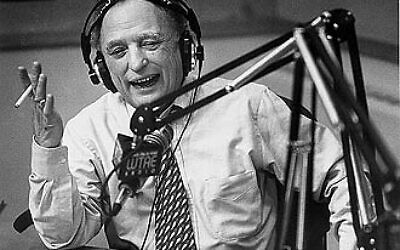
Myron Cope (Photo by Blargh29 (talk | contribs), via Wikimedia Commons)

Yoi!

The late Myron Cope — a legendary sportscaster and creator of the Terrible Towel — will be inducted into the Pittsburgh Walk of Fame in the Strip District Oct 13.

Bronze stars for Cope and nine other inductees — all western Pennsylvania natives who made it big in their chosen fields — will be unveiled in front of The Terminal on Smallman Street in the Strip District in a 10:30 a.m. ceremony.

They include modern dancer-choreographer Martha Graham, photographer Charles “Teenie” Harris, Pittsburgh Steelers’ Hall of Famer Franco Harris, H.J. Heinz Company founder H.J. Heinz, stage and screen star Shirley Jones, Pittsburgh Penguins player-owner Mario Lemieux, composer Henry Mancini, Academy Award-winning actor Jimmy Stewart, and industrialist-inventor George Westinghouse.

All were selected by committee from among hundreds of candidates suggested by the public earlier this year. To qualify for consideration, nominees must have been born in one of 10 western Pennsylvania counties and to have had national impact.

Cope, while revered for his colorful 35-year broadcast career, is being feted as the father of the Terrible Towel — an emblem of team spirit that has been waved from the depths of the Atlantic Ocean to the top of Mt. Everest.

It has even been carried into outer space.

“People all over the world know folks from Pittsburgh wave this gold towel,” said Walk of Fame founder Nancy Johnson. “There’ve been numerous copies of rally flags, but the Terrible Towel is the original.”

Myron Cope came up with the concept in 1975 when WTAE General Manager Ted Atkins was looking for a gimmick to boost station ratings, recalled Joe Gordon, then-Steelers public relations and marketing director.

“Myron said, ‘I’m not a gimmick guy, I’ve never been a gimmick guy,’ which is hilarious in itself,” Gordon said. “When Ted reminded him that his contract was coming up for renewal Myron said, ‘I guess I’m a gimmick guy,’ and he urged people to bring dishcloths, handkerchiefs — whatever they could wave — to Steelers games. It took off from there.”

“Myron was the most creative guy I have ever known. He was uniquely talented.”

He was also generous, Gordon said.

The documentary, “A Steelers Story: The Terrible Towel,” now in the running for an Emmy, describes how revenues from the towel and other Terrible Stuff have supported Merakey Allegheny Valley School, which serves individuals with autism and other developmental challenges.

Myron Cope’s son Danny, 58, has been a client of Merakey (formerly Allegheny Valley School) since childhood.

“My dad donated a portion of sales revenue to the school from the beginning and transferred full ownership of the trademark to Merakey in the 1990s,” said Myron Cope’s daughter Elizabeth Cope, 55, of Canonsburg. “He was a good person.”

Born Myron Sidney Kopelman to Lithuanian Jewish parents in Squirrel Hill in 1929, Myron Cope graduated from Taylor Allderdice High School and the University of Pittsburgh, and began his journalism career writing for various publications, including the Erie Daily Times, The Saturday Evening Post, Life, Sports Illustrated and the Pittsburgh Post-Gazette.

According to Cope biographer Dan Joseph, an editor at the Post-Gazette convinced Myron Kopelman to change his name to something less Jewish and he chose Cope.

Myron Cope married Mildred Lindberg and they had three children including a daughter Martha who died shortly after birth. He and his family lived in Mt. Lebanon and then Upper St Clair.

Although writing was Myron Cope’s first love, his daughter said, he got into broadcasting in 1968 doing sports commentaries for radio. His shrill, four-pack-a-day voice, Yinzer accent, quick wit, and excitable personality caught the attention of Steelers’ brass and they hired him for their radio team in 1970.

The Cope-isms that peppered his broadcasts like “yoi,” “double-yoi” and “okle dokle,” derived in part from his neighborhood upbringing, said Elizabeth Cope. “He grew up in a melting pot. Half the kids spoke Yiddish and Russian. He heard all kinds of stuff.”

As spontaneous as he was on air, Myron Cope spent hours preparing, she said. “He worked harder than anyone I’ve ever known, which is one of the reasons he was so good. He’d research tidbits about players — half of which he wouldn’t even use — but he wanted to have them in his head in case he’d need them.”

Between his TV and radio work he needed a lot of content and was “always on the prowl for information,” said Tom Rooney, a nephew of Steelers founder, Art Rooney, and founder-president of The Rooney Sports & Entertainment Group.

“Myron wasn’t a guy who didn’t return phone calls.”

“He was a PR guy’s dream,” said Rooney, “because he was so accessible.”

Gordon called him a Damon Runyan character, because of his larger than life persona. “And it was authentic,” said Gordon. “It’s genuinely who Myron was.”

He received numerous awards during his career and, in 2005, was the first professional football broadcaster to be inducted into the Radio Hall of Fame.

Myron Cope died of respiratory failure at age 79 in 2008.

While masses of fans gathered downtown in a final towel-waving tribute, Myron Cope was buried in a private funeral in the South Hills.

He was laid to rest with a Terrible Towel. PJC

Deborah Weisberg is a freelance writer living in Pittsburgh.

read more:
comments