
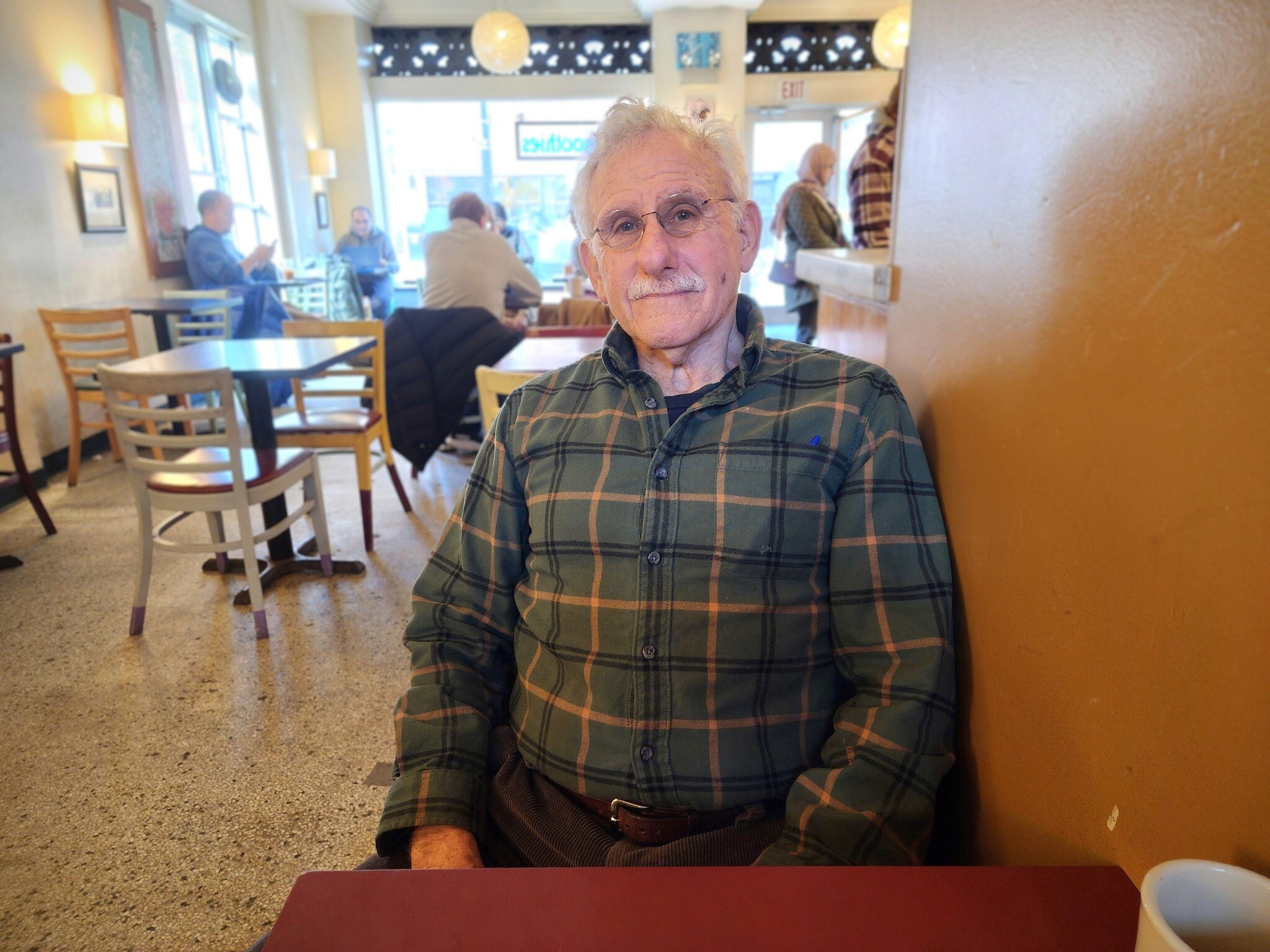
Apprenticed to a saddlemaker and a shoemaker in Paraguay 55 years ago, Eddie Shaw acquired a particular set of skills. That expertise, which includes sharpening knives, cutting leather and sewing with two needles still serves the Squirrel Hill resident well.
Shaw, 77, recently returned from New York City where he was one of 50 vendors invited to participate in Tablet Magazine’s Hanukkah Bazaar.
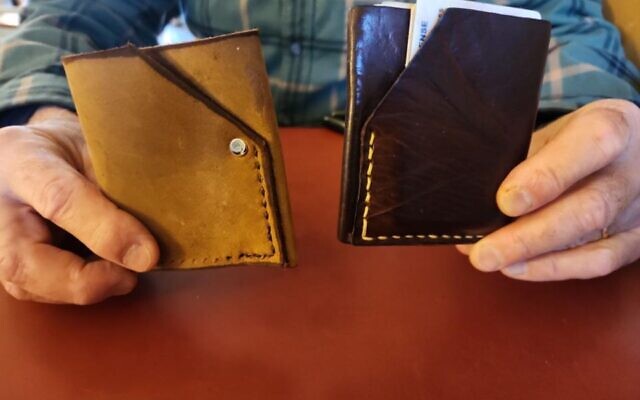
Billed as an “unapologetically fabulous mix of Judaica tastemakers,” the gathering afforded Shaw an opportunity to showcase various custom goods. Operating under the name Saba Eddie, Shaw sold leather aprons, small shoulder bags, wallets and laptop cases to holiday shoppers. Shaw’s works, which are intended to last decades, represent a commitment to handcrafted products and an ideology, he explained, running contrary to modern notions of disposability.
Speaking to the Chronicle inside a Squirrel Hill coffee shop, Shaw pointed to several bags — some designed to schlep groceries, some for transporting small handheld objects — and said the carrying cases are directly linked to cattle raised in the United States and Argentina. His belt, phone holder, an envelope for documents or a tablet, are also all made of leather and meant to outlast “plastic” alternatives.
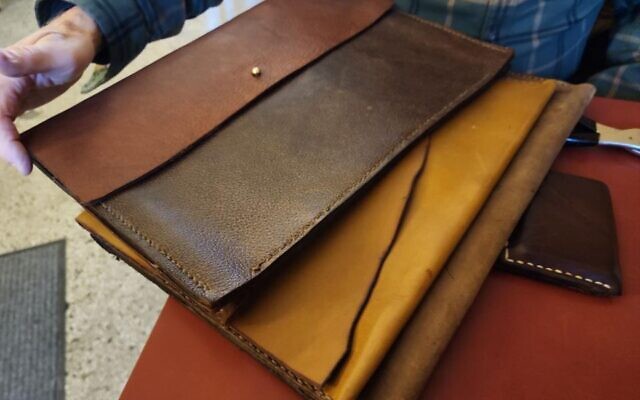
Like many artisans, Shaw is proud of his work. Using a 5-pound fork, Shaw initially punctures the leather before using a 2-inch steel needle to sew.
With the needle in hand, Shaw demonstrated the leather’s toughness and exhibited proper stitches. He spoke about the process of choosing and preparing materials, and how he used to travel to southeastern Ohio, but now frequents Greensburg for skins: “I’m much more selective about the hides I get.”
Holding a shoulder bag, Shaw said, “This hide over here is from a water buffalo from Pakistan.”
The pebbled quality makes it difficult to sew, but people appreciate flaws, he continued. Machine-made items are virtually impeccable. Handmade goods are desirable because they’re from human beings and have “imperfections.”
Shaw’s person-centered approach carries through to his other pursuits. For years, he’s sharpened knives for individuals and local kitchens. Relying on skills he acquired in Paraguay, Shaw employs special stones to “make an edge,” he said. “That’s what the term is, making an edge on knives.”
There’s a common misunderstanding, he said. Though some people are afraid of pointed blades, dullness is dangerous: “A sharp knife is a safe knife because the pressure will go where you intend it to. With a dull knife, you’re not particularly sure where the blade is going to end up.”
Imagine cutting a tomato or onion.
“You want to cut a slice of it, and you think you know where that blade is going to be. Your fingers might be a little bit too close to that area and all of a sudden the blade is going in a direction you didn’t intend it to,” he said. “People are surprised at how much easier it is, and how much more satisfying it is, to work in the kitchen with a sharp knife.”
When Shaw joined the Peace Corps more than 50 years ago and traveled to Paraguay, he didn’t anticipate learning how to work with leather or sharpen knives.
Instead, he was simply seeking adventure, he said. “I just had stars in my eyes about doing something exotic and different.”
The skills he acquired in Paraguay have origins dating back millennia. Shaw’s continuance of those practices renders him less a luddite or stodgy historian detached from present-day norms than someone fervently striving for endurance. For years, he’s studied languages at the University of Pittsburgh and has become “bilingual in Spanish and intermediate level in Italian.”
He volunteers with the Squirrel Hill Urban Coalition, has delivered tree request forms throughout the neighborhood and has planted about 100 street trees. He’s devoted to his family— two of his three children and multiple grandchildren live in Squirrel Hill — and regularly attends Congregation Shaare Torah.
The decision to adopt an Orthodox Jewish lifestyle came after he and his wife, Wendy Levin-Shaw, moved to Pittsburgh in 1979, he said.
The two had just returned from a seven-month stay at Kvutzat Yavne, a religious cooperative kibbutz located near Ashdod, Israel.
“I was in charge of the largest incubator in the Middle East,” he said. “They had a capacity of about 300,000 eggs every three weeks, and they were increasing it at that point.”
Shaw’s responsibility for “hundreds of birds” required administering shots, cleaning manure and entering cages.
“I was fine with it,” he said. “I’m really good with animals.”
Though the kibbutz asked Shaw to stay, he eventually left and moved to Pittsburgh. Before life on the kibbutz, he felt no “particular attachment” to observance, but after settling in Squirrel Hill, he and his wife made a deliberate choice about their religious path. The route has yielded a life of meaning and a continuance of time-honored exercises.
Before exiting the coffee shop to visit his grandchildren, Shaw asked this reporter to stop by Shaare Torah and inspect the first thing he made from leather after returning from Paraguay.
“My tallis bag is 45 years-old. You should see it,” he said. “It’s cool.” PJC
Adam Reinherz can be reached at areinherz@pittsburghjewishchronicle.org.
comments